





The spring of 2026, which should have been a critical juncture for international students transitioning from campus to the workplace, has been forced to a standstill due to a policy adjustment.
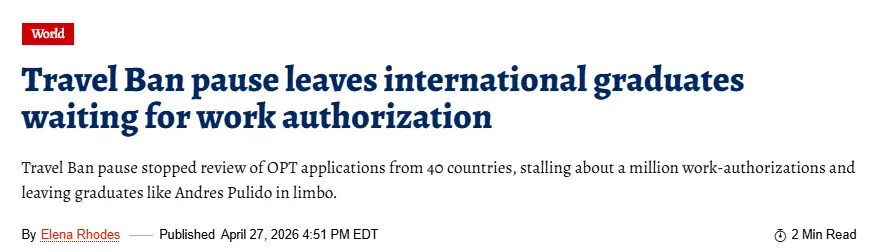
According to multiple media reports, the U.S. government has expanded the scope of the "Travel Ban" in a series of statements, one of which is: suspending the processing of certain immigration benefits for applicants from approximately 40 countries and regions, including the Optional Practical Training (OPT) that countless international students rely on to remain in the United States. This has caused a large number of OPT applications to stall, leaving students to wait in uncertainty for a result with no timeline, even if they submitted their materials on time.
This sends a clear signal: The U.S. immigration system is entering a phase that places greater emphasis on authenticity, transparency, and long-term compliance.
The "Darkest Hour" for OPT:
Increased Uncertainty for International Student Pathways
As the core transitional tool for international students to remain in the United States, OPT has always served as the starting point for the "graduation → employment → H-1B → green card" trajectory. However, with U.S. Citizenship and Immigration Services (USCIS) having suspended OPT processing for applicants from certain countries while new review rules remain unclear, this pathway has fractured at its very inception.
Administrative Black Hole:
Citing the implementation of "new review rules," USCIS has suspended approvals for applicants from approximately 40 countries and regions. Although forms can still be submitted, cases are effectively lost in a void—neither reviewed nor denied.
Indefinite Waiting:
This measure, initially declared "temporary," has now persisted for four months. It is estimated that the total number of various applications affected by this policy is as high as 2 million, with approximately 1 million work permit applications currently stalled.
The Invisible List:
The list of the 40 affected countries and regions has not been fully disclosed by the U.S. government. This lack of transparency has exacerbated panic. As advocates have noted, students are falling into a "processing black hole" with no clear direction.
Institutionally, applications can still be filed, but cases have entered a state of "pending but not being processed." This status means that while the path is not closed, it cannot be advanced. For graduates who have already received job offers and are preparing to start work, this uncertainty translates directly into real-world losses—inability to start work, voided contracts, and even being forced to leave the cities they had planned to reside in.
More importantly, OPT is not an isolated step; it is often linked to subsequent H-1B applications and green card planning. Once the starting point is delayed, subsequent status arrangements may also be disrupted.

The Path to a Breakthrough: EB-5
Taking Control of Your Own Destiny
The stagnation of OPT processing once again reveals a reality: the international student pathway is inherently dependent on multiple uncertain variables—whether policies change, whether employers provide support, whether one is selected in the H-1B lottery, whether processing proceeds on time, and so on. Any fluctuation in any of these links can affect subsequent status planning.
Rather than waiting passively for policy changes, it is better to establish a more certain status pathway in advance. Unlike the traditional international student pathway, EB-5 does not rely on employment opportunities, nor is it subject to H-1B lottery quotas. Its core logic is to apply for a U.S. green card through investment, providing applicants and their families with a relatively independent and plannable immigration channel, allowing them to take control of their future.
Currently, under the new EB-5 law, we are still in a relatively favorable policy window. Taking Rural EB-5 projects as an example, they currently enjoy the advantage of no visa backlog and priority processing; at the same time, the "concurrent filing" policy allows eligible applicants in the United States to file Form I-526E and Form I-485 simultaneously, enabling them to obtain a Combo card in about 3 months, thereby securing legal residency, work authorization, and travel convenience as early as possible.
However, this window will not remain open indefinitely. As the reserved visa quota continues to be consumed, backlog pressure is gradually emerging; meanwhile, the grandfather clause will expire on September 30; and the minimum investment amount may also be increased from $800,000 to $900,000 or more on January 1, 2027. In other words, for families intending to plan for U.S. status, the sooner they start, the more opportunity they have to lock in the current relatively clear and favorable policy conditions.


For inquiries in Mainland China: 400-138-2929, Hong Kong, China Customer Service Center: (852)2802 8798