





H-1B has more major news! Just as the discussions surrounding the rise in H-1B salary thresholds have yet to subside, another major update has emerged in the U.S. immigration community.
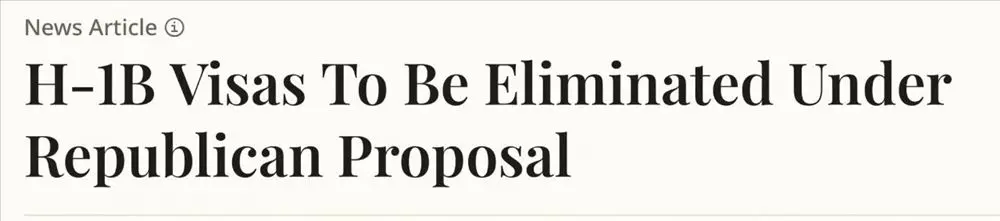
According to Newsweek, U.S. Representative Andy Ogles (R-TN) has introduced a new bill in Congress—the Assimilation Act—which plans to completely eliminate the Green Card Lottery and terminate the H-1B visa program in its entirety. This proposal has been described by some media outlets as "the most far-reaching immigration system reform of this century."

1. What exactly does this bill want to change?
Based on the details disclosed thus far, the bill primarily aims to do three things:
First, it would terminate the H-1B work visa program;
Second, it would eliminate the Diversity Visa Lottery (commonly referred to as the "Green Card Lottery");
Third, it would weaken the family-based immigration orientation, shifting toward a model that emphasizes "national interest," "cultural assimilation," and "security screening," while strengthening background investigations and social media vetting.
In other words, this legislative draft is not merely adjusting thresholds; it aims to tighten several standard channels for legal immigration. For international students, foreign professionals, and U.S. companies that rely on international talent, such proposals are naturally a significant blow.
The draft proposes: "All immigrants entering the United States must serve the economic, cultural, and national security interests of the United States." While the proposal is unlikely to be implemented in the short term, the signal it sends is clear: U.S. immigration policy is accelerating toward a "high-skill, high-wage, and rigorous-screening" approach.
2. The H-1B is becoming increasingly unstable
Why does this news make so many people anxious? Because the H-1B has long been a core channel for many international students to work in the United States.
Under current rules, the H-1B annual quota remains 65,000 standard places + 20,000 for individuals with a master's degree or higher from U.S. institutions. Furthermore, the new wage-weighted selection mechanism has been officially applied to the FY2027 H-1B registration season, with selection logic placing a higher premium on high-wage, high-skill positions than in the past. In other words, the H-1B program itself has become increasingly difficult over the last two years.
At the same time, the U.S. Department of Labor has released a proposed rule intending to comprehensively raise the "minimum wage standard" for H-1B visas, with the public comment period open until May 26, 2026. (For details, please refer to previous reporting by WorldWay: H-1B Emergency Alert! Changes Loom for Remaining in the U.S.)
This means that the cost for employers to sponsor visas for foreign employees will likely continue to rise. The introduction of the Assimilation Act pushes this trend to the extreme—the fate of the H-1B is no longer just a question of "thresholds," but a test of "existence versus non-existence."
3. Remaining in the U.S. cannot rely solely on the H-1B path
In the past, many felt that as long as they secured a job and went through the H-1B lottery, immigration status could eventually be resolved over time.
But the current reality is that job opportunities, employer willingness, lottery results, salary thresholds, and policy changes—if any of these components change, the entire path may change as well. Because of this, more families are beginning to realize: planning for residing in the U.S. cannot just focus on a single lottery result; it requires considering long-term residency arrangements as early as possible.
To put it bluntly, staying in the U.S. will increasingly rely less on "luck" and more on "strategy."
4. Breakthrough Strategy: The EB-5 New Act Window
Is the critical period for proactive positioning
In the current environment, more and more families are turning their attention to the EB-5 program. The core reason is simple: the H-1B solves a work visa issue, while the EB-5 focuses on the certainty of long-term immigration status.
Compared to the H-1B, the biggest difference of the EB-5 is that it does not depend on an employer and does not participate in a lottery, allowing applicants to be more proactive and less passive in their immigration planning. Currently, the EB-5 is in a window of opportunity worth seizing:
• EB-5 reserved visa categories under the new Act remain free of visa backlogs
• Concurrent filing: simultaneous submission of the I-526E immigrant petition and the I-485 adjustment of status application
• Legal long-term stay, with concurrent applications for employment authorization and advance parole
• Status is no longer tied to an employer
• Rural projects enjoy priority processing benefits
It is worth noting that this window will not remain open indefinitely. Market attention is focused on the key deadline for the "Grandfathering Clause," which expires on September 30; and on January 1, 2027, the minimum investment amount may be raised from $800,000 to $900,000 or higher. Furthermore, once a backlog appears in the new EB-5 reserved categories, the current "no-backlog + concurrent filing" golden window will end. In other words, the earlier you plan, the greater your opportunity to lock in the advantages of current conditions.

WorldWay currently holds two premium rural EB-5 projects with I-956F project approval: "North Carolina Sugar Mountain Hilton Hotel" and "Great Smoky Mountains Marriott Hotel," helping investors obtain U.S. Green Cards efficiently.


For inquiries, please contact Mainland China: 400-138-2929, Hong Kong Customer Service Center: (852)2802 8798