





On March 25, 2026, local time, the U.S. Department of State issued a new announcement, sending a very clear signal: the U.S. visa environment is continuing to tighten.
According to the announcement, starting from March 30, the U.S. Department of State will further expand the scope of online information review for non-immigrant visa applicants and require relevant applicants to adjust the privacy settings of all their social media accounts to "public" or "open."
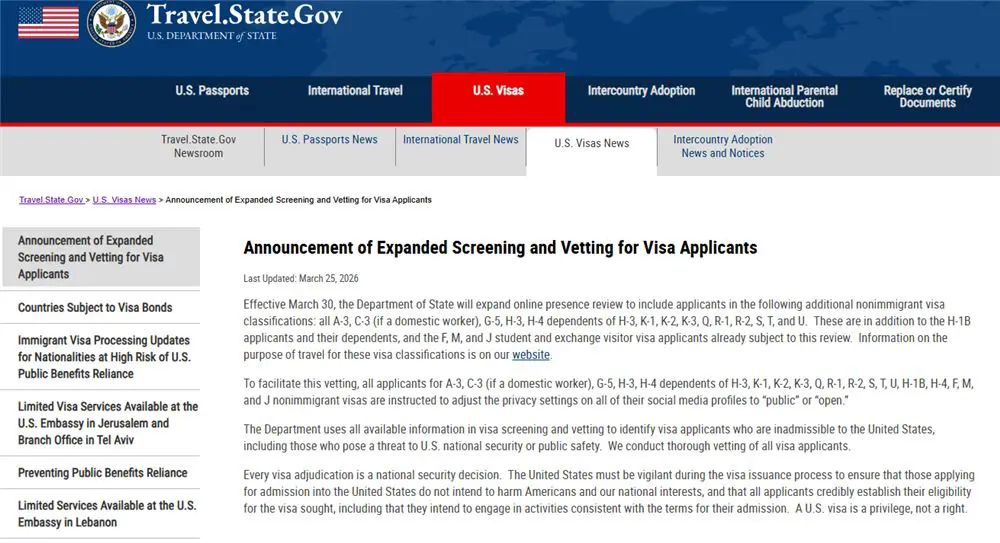

The review scope will further expand
14 new visa categories added
According to the announcement, the following non-immigrant visa categories will have new applicants subject to this review:
• A-3, C-3 (for family employees)
• G-5, H-3, H-4 (dependents of H-3)
• K-1, K-2, K-3 (marriage-based visas)
• Q (cultural exchange)
• R-1, R-2 (religious)
• S, T, U visa categories
These categories are an expansion on the existing scope. Previously, H-1B applicants and their dependents (H-4), as well as F, M, and J visa students and exchange visitor applicants, were already included in this review. (For details, please refer to the previous report by WorldWay: U.S. Visa Alert! A New Round of H-1B Status Crackdown is About to Begin)
In other words, the U.S. online review of non-immigrant visa applicants is expanding from specific categories to a broader population. In other words, social media, public expressions, and online footprints are becoming normalized content in U.S. visa reviews.
Applicants must open social media permissions
The announcement clearly requires that all applicants for the affected visa categories must adjust the privacy settings of all their social media accounts to "public" or "open."
The U.S. Department of State emphasizes that it will use all available information to review and screen visa applicants to identify those who do not meet the qualifications for entry into the United States, including those who may pose a threat to U.S. national or public safety. A comprehensive review will be conducted for all visa applicants.
More importantly, the U.S. Department of State reiterates: every visa decision is a matter of national security. The U.S. must remain vigilant during the visa issuance process to ensure that those applying to enter the United States do not intend to harm U.S. citizens or jeopardize U.S. national interests, and to ensure that all applicants can credibly demonstrate that they meet the eligibility requirements for the visa they are applying for, including that their intended activities will be consistent with the conditions of their authorized entry. A U.S. visa is a privilege, not a right.
Short-term visas becoming stricter
The value of long-term status planning is highlighted
The signal released behind this is very clear: in the future, short-term visas will increasingly emphasize "auditable, explainable, and verifiable." For those who already have long-term development needs in the United States, such as children's education, family residence, and life planning, relying solely on temporary visas will only lead to increasing uncertainty in the future. Those who truly have long-term needs for the United States will need to shift from a "visa mindset" to a "status mindset" as time goes on.
As the uncertainty of temporary visas continues to rise, the path that leads directly to long-term legal status will become even more valuable. For families looking to achieve simultaneous layouts for residence in the U.S., children's education, family planning, and stable status, EB-5 is no longer just an immigration project, but a more certain long-term status solution.
Under the new law, applicants can conduct "dual submissions" in the U.S., meaning that applicants without a waiting period can simultaneously submit the I-526E immigration application and the I-485 adjustment of status application, and can also apply for travel permission I-131 and work permission I-765, achieving legal work and free entry and exit, enjoying the conveniences of life and work similar to a green card in advance.
According to the U.S. Department of State's visa announcement, the EB-5 reserved visa category under the new law still maintains a no-waiting period status. Additionally, rural projects enjoy priority approval advantages. More importantly, the current EB-5 policy is still protected by the "grandfather clause"; applications submitted before September 30, 2026, can lock in the current policy framework and are not affected by future legal changes.

However, it is worth noting that this window will not last long. The grandfather clause will expire on September 30; the minimum investment amount may increase from $800,000 to $900,000 or even higher starting January 1, 2027. Furthermore, once the EB-5 new reserved category experiences a waiting period, the current "no waiting period + dual submission" golden window will end. For families that truly value long-term status planning in the U.S., the earlier they start their layout, the more opportunities they will have to take control of their own destiny.
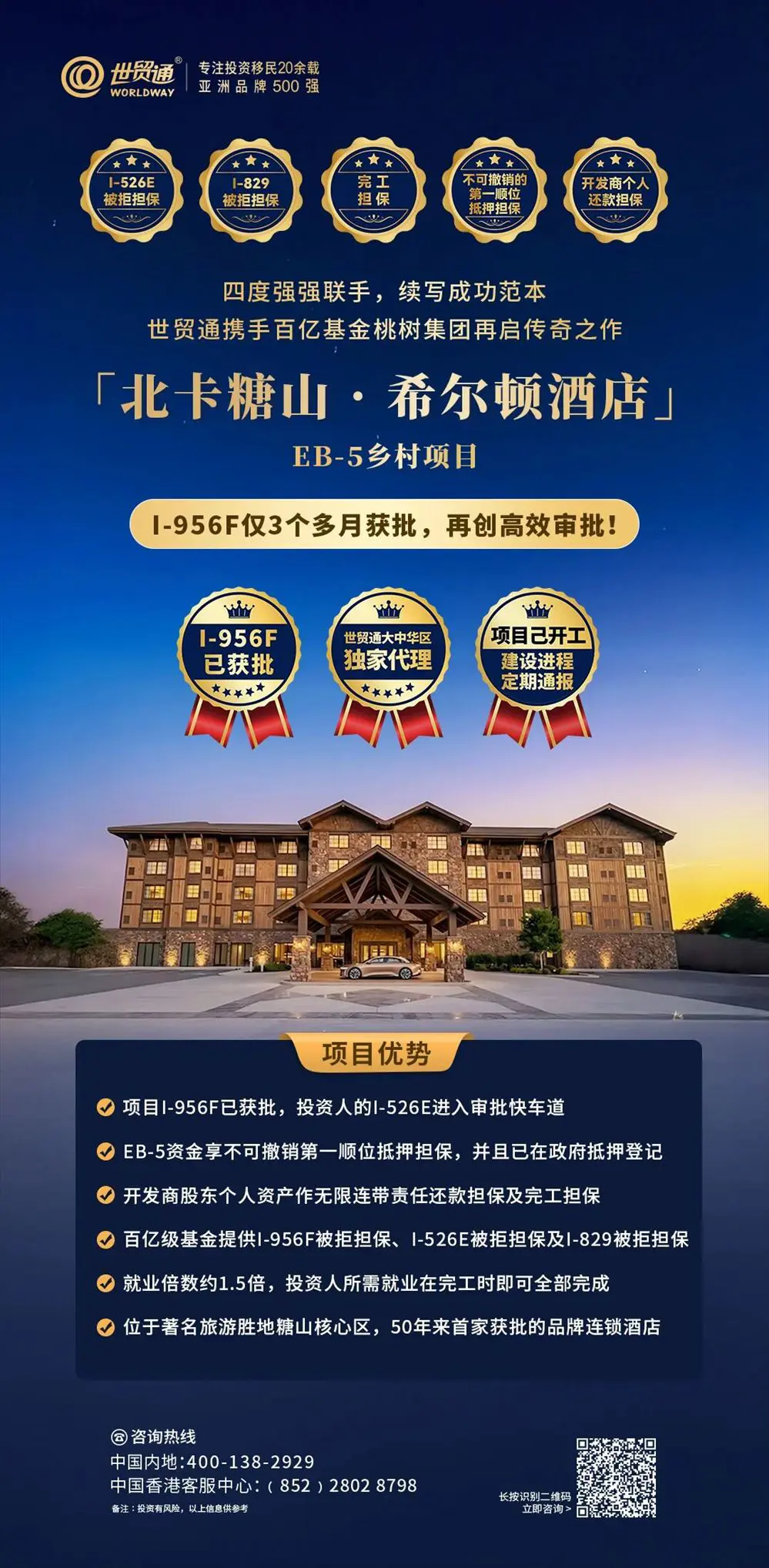
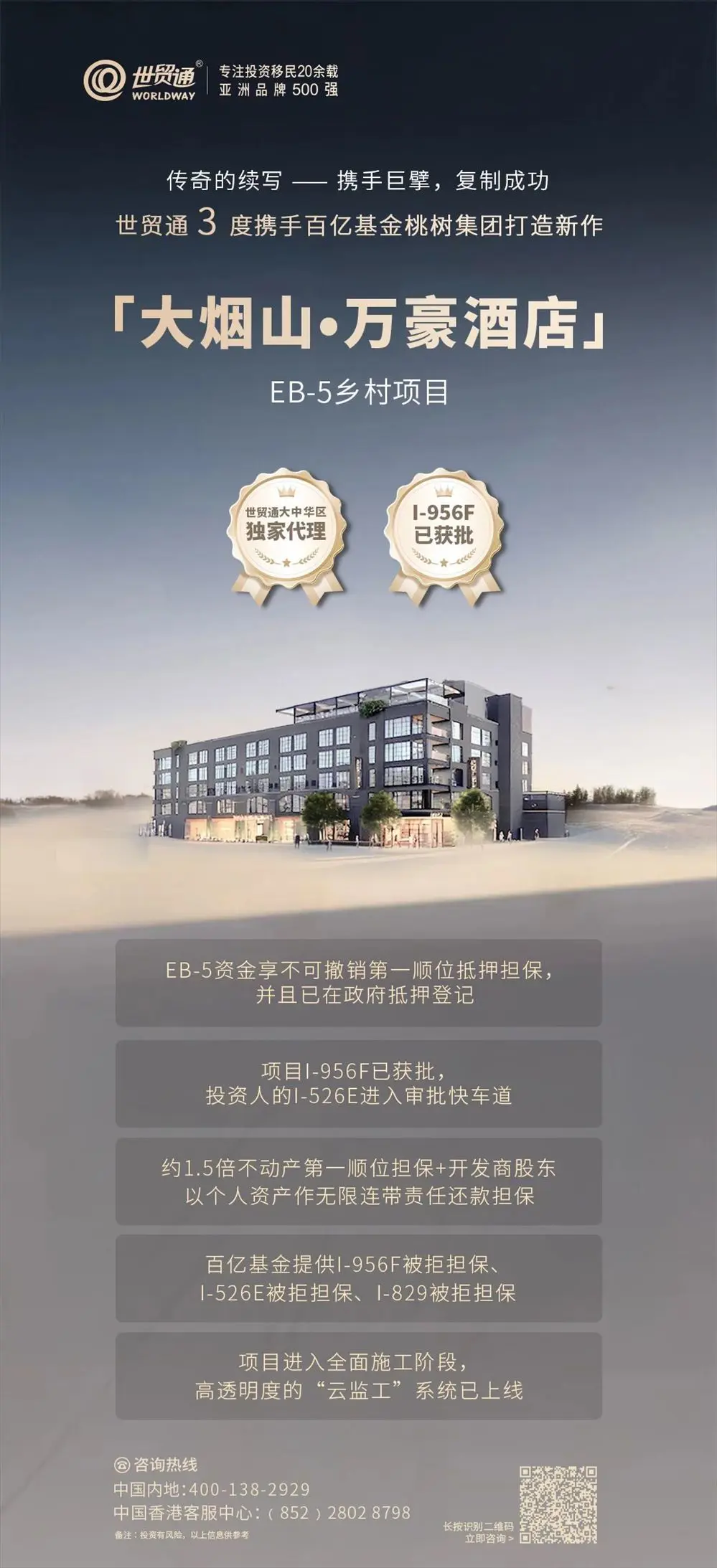
WorldWay currently has two officially approved high-quality rural EB-5 projects under I-956F—"North Carolina Sugar Mountain Hilton" and "Great Smoky Mountains Marriott"—to assist investors in quickly obtaining U.S. green cards.
For inquiries in mainland China: 400-138-2929, Hong Kong customer service center: (852)2802 8798