





In today's world, where global identity configuration has increasingly become a standard for high-net-worth families, the United States remains one of the most attractive immigration destinations. According to comprehensive data from the United Nations Population Division and the World Migration Report, there are approximately 52.4 million foreign-born individuals in the United States.
So, which families are more suitable for long-term planning through U.S. immigration? What mainstream methods deserve special attention?
1. Families More Suited for U.S. Immigration
Several Long-Term Planning Needs
1. Families with "Children's Education" as the Core Goal
This is currently the largest and most certain group choosing U.S. immigration. The direct changes brought by U.S. identity for children include:
• Free enrollment in U.S. public primary and secondary schools
• In-state tuition rates during college, typically 50%-70% lower than international students
• Competing for university spots with local students instead of competing with international students globally
For families planning to let their children enjoy an American education, a U.S. green card is essentially: a "long-term, certain" educational pass.
2. Families Who Have Already Sent or Plan to Send Their Children to Study in the U.S.
Many families realize the complexity of identity issues only after their children arrive in the U.S. on an F-1 student visa:
• Work restrictions during studies
• High dependence on H-1B lottery for staying in the U.S. after graduation
• High uncertainty regarding career paths, internship opportunities, and identity stability
However, if they plan U.S. immigration in advance:
• Children can study, intern, and work in the U.S. as permanent residents
• No employer sponsorship or lottery required
• Greater flexibility in career development and identity planning
For many families, this step is not about "immigration" but rather about risk hedging for studying abroad.
3. Families Needing Parental Accompaniment
For young children studying in the U.S., many Chinese parents' biggest concern is not the education itself, but whether their children can receive adequate care and companionship in a foreign environment. Therefore, parental accompaniment has become a rigid demand for many families.
However, the reality is that there is no specific "accompanying visa" for parents in the U.S. If parents enter the U.S. on a short-term visitor visa to accompany their children, they often face multiple restrictions: on one hand, long-term or repeated stays can easily be deemed inconsistent with the visa's purpose, posing risks for visa renewal and entry; on the other hand, short-term visas require timely departure, which can cause anxiety for young children when parents frequently leave. Additionally, during the accompaniment period, parents' identities are restricted, preventing them from working legally and making long-term living arrangements difficult.
In this case, considering study arrangements alongside identity planning often provides a more holistic approach. Once parents obtain U.S. identity, they can maintain long-term, stable companionship during their children's education, providing continuous support in learning, living care, and emotional companionship.
4. High-Net-Worth Individuals Needing "Identity Freedom"
Many high-net-worth families have their main assets and businesses still in China, need to frequently travel between China and the U.S., and do not wish to be bound by "immigration monitoring" or employer identity. The characteristics of U.S. immigration status include:
• Freedom of entry and exit
• Not reliant on employers, unrestricted by industry
• Ability to live, invest, and educate in the U.S., while also managing businesses overseas for extended periods
This identity is more like a "fundamental tool for global living and asset allocation" rather than a singular act of migration.

2. Why is EB-5 the Most Popular Immigration Method in the U.S.?
Among various U.S. immigration pathways, EB-5 investment immigration has long occupied an important position, and the reason is not complicated: the core logic of EB-5 can be summed up in one sentence: exchange a relatively controllable investment cost for a synchronized, long-term stable U.S. identity for the whole family.
Its advantages include:
• One application, the whole family obtains identity
• No language, education, or work background requirements
• No lottery required, not reliant on employers
• Stable policy framework, clear investment amount
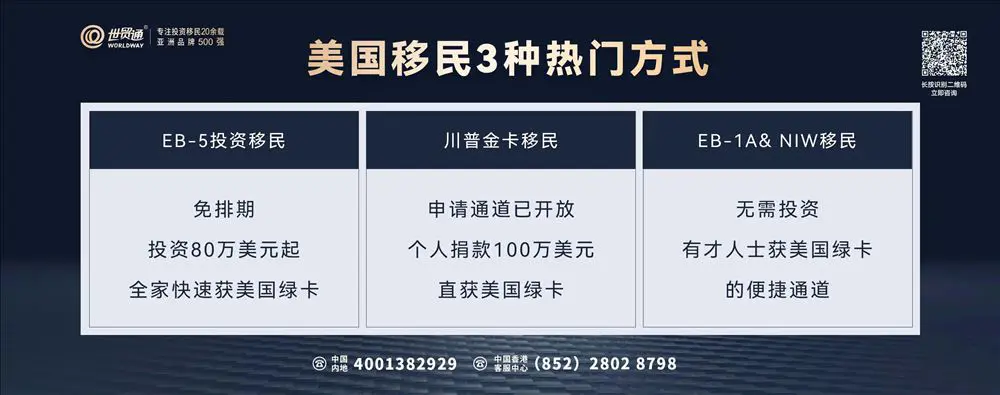
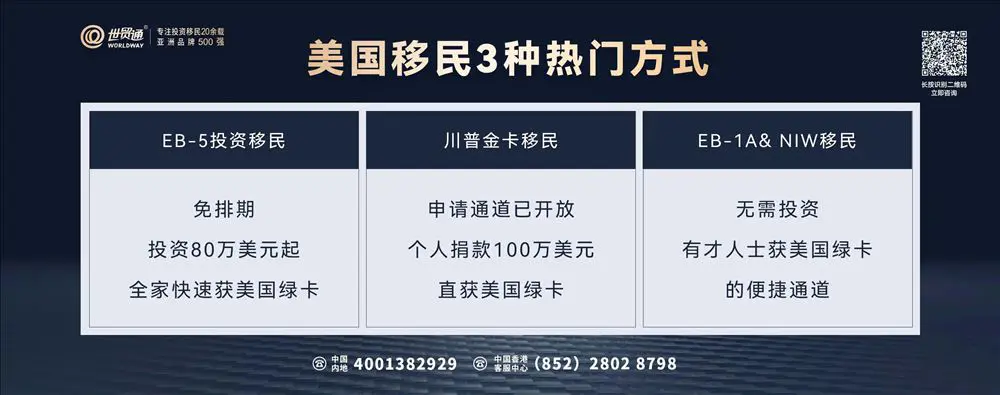
• Rural EB-5 projects exempt from waiting periods, dual submission, priority approval
Because of this, EB-5 has become one of the most commonly chosen and easily implemented methods for high-net-worth families, business owners, and families focused on children's education when planning for U.S. identity.
WorldWay holds two high-quality EB-5 rural projects, assisting investors in achieving U.S. identity planning safely, without waiting periods, and efficiently, quickly stepping onto the path of a new life in the U.S. Global quotas are limited, and spots are scarce; first come, first served!




In addition, the Trump Gold Card immigration program has officially opened for applications, and WorldWay has taken the lead in launching Gold Card acceptance services, helping applicants efficiently advance their application process and seize key time windows.
For detailed inquiries, please contact mainland China: 400-138-2929, Hong Kong customer service center: (852)2802 8798