





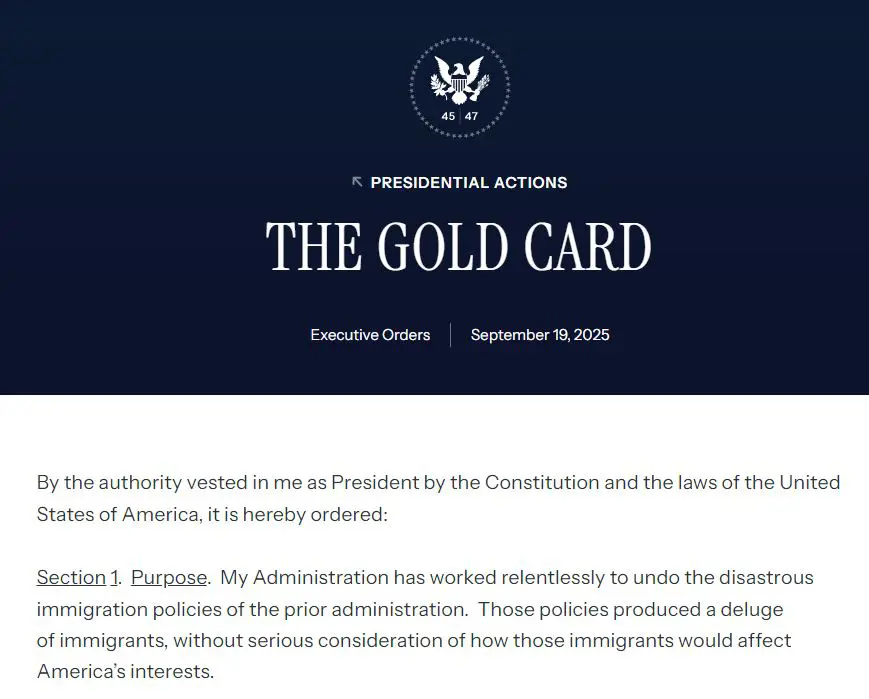
On September 19, 2025, U.S. President Trump signed an executive order for a program dubbed the "Gold Card," stating it would open a new visa pathway for "foreign nationals with extraordinary ability who are willing to support the United States."
The program is divided into three categories: Individuals who contribute $1 million and meet certain conditions can obtain regular Green Card status; companies must contribute $2 million to sponsor employees; and a $5 million "Platinum Card" tier is available, with holders exempt from U.S. domestic taxes. The executive order requires the Secretary of Commerce, the Secretary of State, and the Secretary of Homeland Security to establish and implement the program within 90 days.

Individual Gold Card: $1 million regular Gold Card and $5 million Platinum Card

Corporate Gold Card: $2 million
Although the White House has promoted this move as a significant means to attract "top talent" and generate revenue for the national treasury, a careful analysis of the policy details and legal background reveals that the "Gold Card" program actually faces numerous limitations, and its appeal may be far less attractive than advertised.

The "Gold Card" is essentially still a regular Green Card
No special status advantages
According to the executive order, except for the tax-exemption privilege of the $5 million "Platinum Card," the "Gold Card" is essentially a regular Green Card and has no substantive difference in legal status from other immigrant visas.
Under the provisions of the executive order, for applicants who donate the required amount for the Gold Card, the act of donation itself will be considered strong evidence that they meet the conditions for the following three common categories of extraordinary ability immigrant visas:
• 8 U.S.C. 1153(b)(1)(A) (EB-1A - Extraordinary Ability Visa)
• 8 U.S.C. 1153(b)(2)(A) (EB-2 - Advanced Degree Professionals or Exceptional Ability Visa)
• 8 U.S.C. 1153(b)(2)(B) (NIW - National Interest Waiver)

This means that the "Gold Card" program will utilize existing EB-1 and EB-2 (including National Interest Waiver NIW) visa category quotas. Applicants from countries such as China and India will face the same backlog issues as existing applicants. Currently, the backlog for the EB-1/EB-2 categories for these countries is as long as 5-10 years; even if an applicant is willing to pay $1 million, they will still face a long wait before obtaining a Green Card.
Limited Presidential Power
Cannot break through the existing immigration law framework
At the signing ceremony, Trump compared this policy to a "signing bonus in football or baseball" and predicted that the program would bring more than $100 billion in revenue to the U.S. Treasury in the future. However, this move once again demonstrates that presidential executive power cannot bypass the existing immigration legal framework.
To achieve substantive reform of the Green Card system, one must either strictly follow existing laws or push for legislative changes, the latter of which faces significant resistance and dim prospects in reality. Therefore, the government can only seek limited adjustments within the existing EB-1/EB-2 mechanism.
EB-5 is a more robust choice
Compared with the existing EB-5 investment immigration program, the "Gold Card" program appears less attractive in several aspects:
• Capital handling: EB-5 requires an $800,000 investment in a commercial project, with the opportunity for return after meeting conditions; funds for the "Gold Card" program are direct donations to the U.S. government and cannot be recovered.
• Backlog issues: The current new policy EB-5 program has no backlog and allows for the concurrent filing of I-526E and I-485 applications, achieving "concurrent filing" to stay in the U.S. early. Rural projects also enjoy priority processing for rapid Green Card acquisition; whereas the "Gold Card" program uses the EB-1/EB-2 categories and faces significant backlogs.
• Legal stability: The EB-5 investment immigration program was established by Congressional legislation and has a history of over 30 years since its inception in 1990. The current EB-5 program was reauthorized in 2022. According to the act, EB-5 is explicitly written into law and includes a "Grandfather Clause" that protects all EB-5 applications submitted before September 30, 2026, from being affected by future changes in law and policy. The "Gold Card" program is launched based on an executive order and may change with shifts in government.
Wise immigration decisions are often built on predictable institutional guarantees. As an immigration pathway passed by Congressional legislation, the EB-5 program has remained stable through multiple changes in government; this level of legal certainty provides long-term security for applicants. For Chinese families seeking overseas development, seizing the current policy window of the EB-5 no-backlog period and locking in existing policies through the "Grandfather Clause" is undoubtedly a more prudent choice. On the path of immigration, rather than chasing the uncertainty of new policies, it is better to choose a reliable path that has been verified by time; this is the wisest move to realize overseas development plans.
Now is the best time to immigrate via the EB-5 route.
Nineteen years of glorious history, grateful to walk with you.
WorldWay 19th Anniversary Celebration of U.S. Investment Immigration Gloriously Begins
September 1, 2025 to September 30, 2025
Process U.S. immigration projects
Enjoy exclusive premium offers
Seize the opportunity, act now, and process as soon as possible!


For inquiries in Mainland China: 400-138-2929, Hong Kong Customer Service Center: (852)2802 8798
Note: 1. Within the scope permitted by law, the right of final interpretation of this promotional activity belongs to WorldWay Group. 2. Investment involves risks; the above information is for reference only.