On January 20, U.S. President Donald Trump signed an executive order at the White House stating that children born in the U.S. to illegal immigrants or temporary visa holders will no longer automatically receive U.S. citizenship. The executive order will take effect 30 days after its issuance and will apply to relevant individuals born in the U.S. at that time.

Core Content of the Executive Order
The executive order states, "According to the definition in the executive order, the following two categories of individuals will no longer automatically enjoy the privilege of U.S. citizenship: individuals whose mother is residing in the U.S. illegally and whose father is not a U.S. citizen or lawful permanent resident at the time of their birth; and individuals whose mother's residence in the U.S. is legal but temporary in nature (such as through the Visa Waiver Program or entry on student, work, or tourist visas), and whose father is not a U.S. citizen or lawful permanent resident at the time of their birth." The executive order sets a clear effective date, but it remains unknown whether the order has retroactive effect, how the citizenship status of immigrant children born before the policy takes effect will be determined, and whether citizenship will also be revoked for children born to undocumented immigrants in the U.S.
In fact, Trump intended to cancel birthright citizenship during his first term, but ultimately did not issue such an executive order. Now, in his second term, Trump signed an executive order on his first day in office to abolish "birthright citizenship."
The 14th Amendment to the U.S. Constitution stipulates that all persons born in the United States or subject to its jurisdiction are entitled to U.S. citizenship. This amendment was passed in 1868 and is the primary legal basis for those who support "birthright citizenship." This means that as long as a child is born on U.S. soil, even if their parents are not U.S. citizens or permanent residents, the child automatically acquires U.S. nationality.
When signing the executive order, Trump stated that this system has been widely abused, providing improper incentives for illegal immigrants and temporary visa holders, and exacerbating the burden on the immigration system. Regarding the legal challenges that might arise from unilaterally canceling this right, Trump has previously indicated that he would consider amending the Constitution.
Trump believes that many illegal immigrants abuse this policy through so-called "birth tourism" or "border births" to obtain U.S. nationality for their children, and thereby legalize the status of their entire family through "chain migration." "This executive order is intended to protect the interests of U.S. citizens and uphold the original intent of the Constitution."
Birth Tourism Becomes History
Once the executive order was issued, it immediately caused an uproar.
On the 21st, attorneys general from 22 U.S. states filed a lawsuit against President Trump's attempt to terminate "birthright citizenship." The lawsuit was initially filed by 18 Democratic attorneys general, accusing Trump of attempting to abolish a "deeply rooted, long-standing constitutional principle" through an executive order. Subsequently, four more states filed similar lawsuits, requesting that federal courts block the implementation or enforcement of the executive order, bringing the total number of states involved in the litigation to 22.
The lawsuit states: "For the plaintiffs and families across the country, this executive order attempts to strip their children of their citizenship... This will leave them facing a lifetime of inability to integrate into society and the fear of deportation."
Reports indicate that this lawsuit "is expected to trigger a long and unprecedented legal battle." Democratic attorneys general and immigrant rights advocates argue that the issue of "birthright citizenship" is established law, and "while the President has broad powers, he is not a king." New Jersey Attorney General Matthew Platkin stated: "The President cannot simply wipe the 14th Amendment off the books with the stroke of a pen."
The White House responded by saying it is prepared to meet in court.
The international community has also reacted strongly to this policy, especially countries with close immigration ties to the United States. Governments in countries such as Mexico and El Salvador expressed regret over Trump's decision and called on the U.S. to respect the rights of immigrants. At the same time, human rights organizations believe that this move may violate international law and undermine the U.S. reputation in the field of human rights protection.
Meanwhile, the implementation of the executive order also faces practical difficulties: how to verify the immigration status of parents, handle the potential problem of stateless children, and address the border crisis that may be triggered as a result, are all major challenges in the implementation of the policy.
A Turning Point for the U.S. Immigration System?
Trump's executive order to cancel birthright citizenship signals that the U.S. immigration system is entering a more restrictive and exclusionary era. If this policy is fully implemented, it will fundamentally change the definition of U.S. citizenship and profoundly affect future patterns of immigration flow.
Trump's supporters believe that this executive order will effectively curb illegal immigration, reduce the pressure on public resources, and restore the original intent of the "birthright citizenship" system. Conservatives emphasize that U.S. citizenship should not be a "reward" for illegal immigrants, and that reform is a key step in maintaining the fairness of the immigration system. Critics worry that this policy could tear society apart and undermine the long-standing American tradition of immigration. It is foreseeable that this executive order will become one of the most controversial and politically risky decisions of Trump's second term.
U.S. immigration policy, because of this decision, may be undergoing a historic reshaping. This legal and social debate surrounding birthright citizenship is destined to continue to ferment. Worldway Group will continue to monitor the situation and will share new information with everyone as soon as it becomes available.
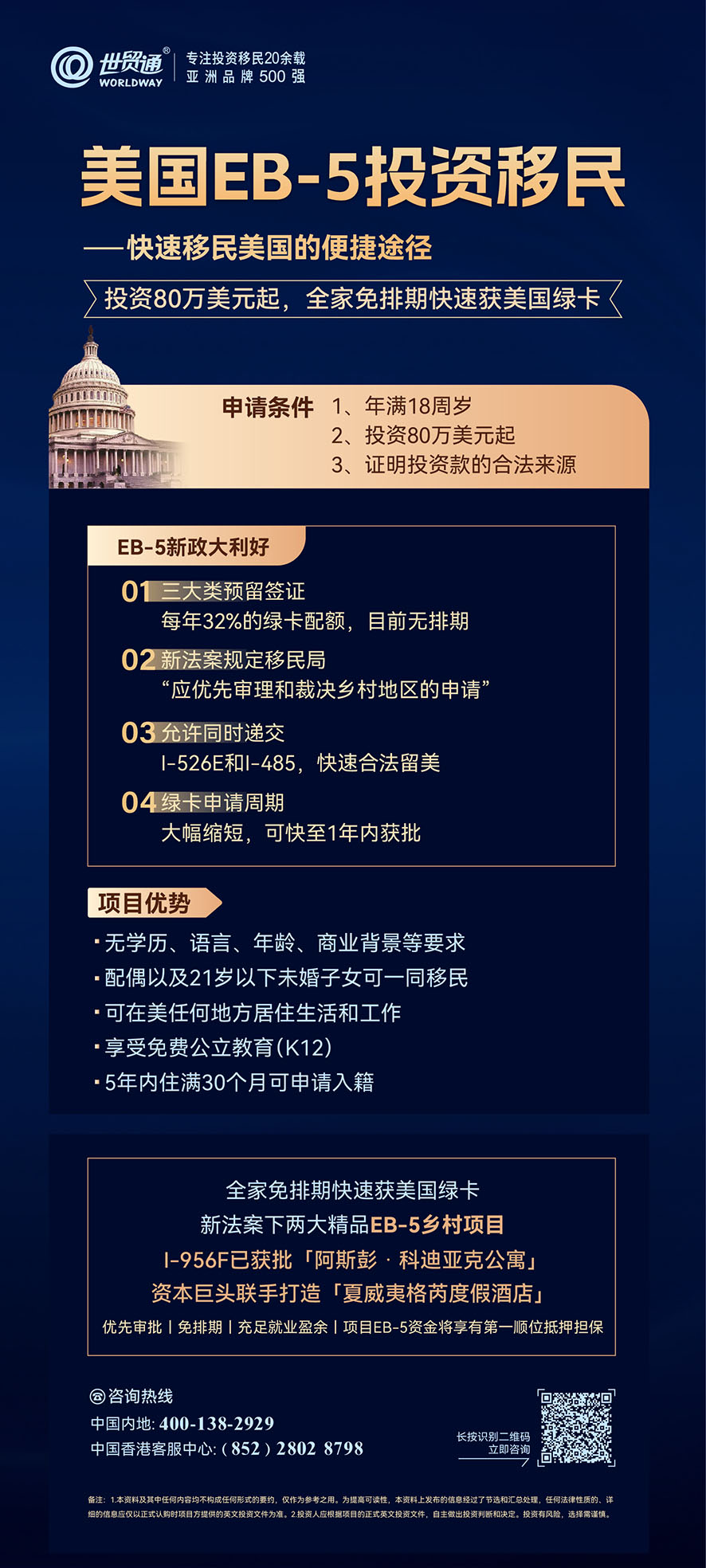
Given the many uncertainties in the future, it is undoubtedly a wise move for immigrant families to plan their status as early as possible. Currently, the U.S. EB-5 investment immigration program is one of the effective ways to quickly obtain a U.S. green card. The EB-5 investment immigration program has no restrictions on age, education, language, business, or work experience background. One person applies, and the whole family can immigrate to the U.S., living and working anywhere in the U.S. Children enjoy free public education (K-12), and spouses and unmarried children under 21 can immigrate together, among many other advantages.
Under the new act, investing in an EB-5 project under the reserved visa category for EB-5 rural projects is exempt from visa backlogs and has priority processing rights from the USCIS. At the same time, EB-5 applicants within the U.S., including international students, can perform "concurrent filing" in the U.S., meaning that applicants without a backlog can simultaneously submit their I-526E immigration petition and I-485 adjustment of status application. They can also apply for a travel permit (I-131) and a work permit (I-765) to legally reside, study, and work in the U.S., enjoying the freedom of a quasi-green card in advance and quickly resolving the issue of legal status in the U.S.