Recently, the U.S. Department of Homeland Security (DHS) announced a series of latest reforms for the H-1B visa program, including: expanding the exemption from the lottery, allowing entrepreneurs to apply for H-1B, extending the Cap-Gap period, and redefining the requirements for "specialty occupations". The new regulations officially took effect on January 17 and apply to the electronic lottery in March 2025.
In an interview with the New York Post, Donald Trump expressed his support for the H-1B visa program, stating, "I have always liked the H-1B visa; I have always supported people coming to America legally on a visa. Many H-1B visa holders work in my industry. I have always recognized the H-1B visa as a great program."
Despite this series of announcements signaling positive developments for H-1B policy, the reality makes it difficult to remain optimistic.
What are the challenges of H-1B for those staying in the U.S.?
For those currently considering or planning to develop long-term careers in the U.S., H-1B is no longer an ideal option.
● Limited quotas: The regular quota for H-1B visas in the U.S. is 65,000 per fiscal year, with an additional 20,000 for applicants with advanced degrees, totaling 85,000. There is high demand relative to supply. ● High application numbers: From the fiscal year 2014 to 2023, the number of H-1B applications increased by 300%. In the 2024 fiscal year, there were 780,884 applications, with 758,994 valid registrations; for the 2025 fiscal year, the total number of H-1B registrations was 479,953, with 470,342 valid registrations.
● Low selection rates for H-1B: In the 2025 fiscal year, after two rounds of lottery, the total number of selected individuals was 135,137, resulting in an overall selection rate of 28.73%; in the 2024 first round, the selection rate was about 25%; in the 2023 first round, the selection rate was 14.7%, with an overall selection rate of approximately 24.8% for both rounds. The selection rate for Chinese students is even lower, at almost under 10%.
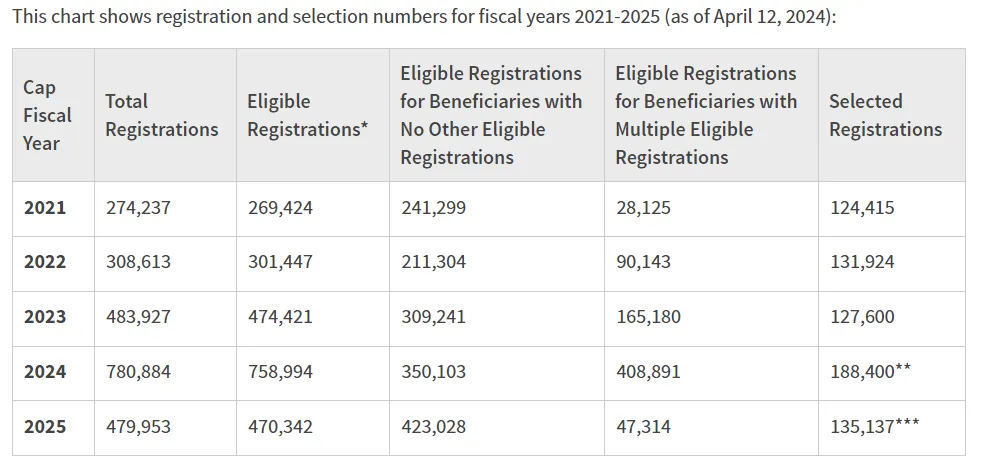
H-1B Historical Registration and Selection Numbers
● H-1B is subject to employer restrictions: Changing employers entails numerous limitations and cumbersome procedures; additionally, the nature and content of the job must align with the position and specialty at the time of the application, providing a relatively narrow scope for job changes; if unemployed, the H-1B visa status becomes invalid. Without switching to a legal visa status, one must leave the U.S.
● Limitations on visa validity: This is the most critical point. The H-1B visa is a non-immigrant visa with validity limitations. For those wishing to develop their careers and maintain families in the U.S., the H-1B visa status is restricted. Holders of H-1B visas can work in the U.S. for 3 years, which can be extended for another 3 years. If the visa holder's status has not changed after 6 years, they must leave the U.S.
How long does it take to transition from H-1B to a green card?
Generally, for international students in the U.S. applying for green cards through the H-1B visa, they face "three mountains": OPT phase — H-1B phase — EB2/EB3 green card transition phase.
To apply for an EB2 or EB3 green card, one must first obtain a PERM labor certificate. Importantly, whether through EB2 or EB3, there are priority dates. According to the December 2024 priority date chart B, the EB2 priority date is October 1, 2020, and the EB3 priority date is November 15, 2020, estimating a waiting period of about 4-5 years for these two categories.
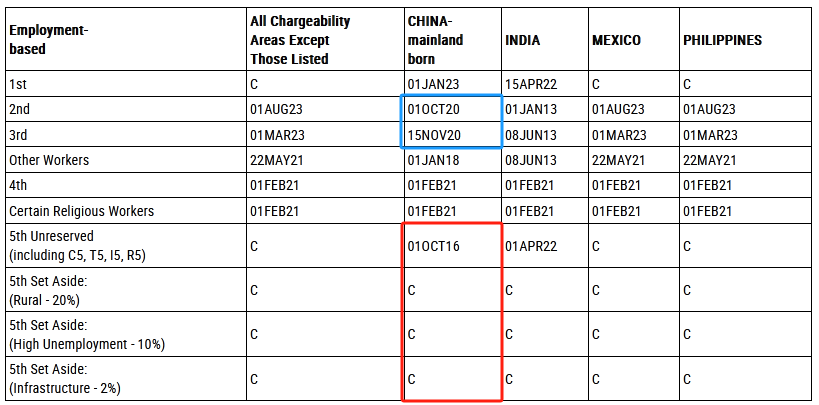
In other words, not counting the time waiting to start the H-1B application, from the time of initiating the EB-2/3 green card application process, it generally takes about:
• PERM application (about 2 years)
• Submission of I-140 + other waiting periods (about 4-5 years)
• I-485 approval period (about 1.5 years)
\• Total duration approximately 7-8 years
Under the current immigration policy framework, if the applicant is successful and does not encounter the risk of job changes or layoffs midway, and does not have to restart the green card application process, the overall duration from the start of the application to final approval is about 7-8 years! If the H-1B holding period is included, and the employer only initiates the application process in the 6th year, combined with the uncertainty of waiting times (it may take longer for applicants from China), transitioning from H-1B to a green card is estimated to exceed 14 years!
It can be seen that whether for graduates participating in the H-1B lottery or those who already hold H-1B visas seeking to obtain a U.S. green card through EB2 or EB3 routes, this path is filled with challenges and is exceptionally difficult.
The Implementation of the New H-1B Policy: Opportunities and Challenges
As one of the common pathways for international students to stay in the U.S., reforms to the H-1B policy will undoubtedly have widespread implications, necessitating deeper considerations.
1. Uncertainty: The new policy was promulgated just before Trump was about to take office, and whether it would be obstructed by the Trump administration or whether even stricter policies will be enacted remains uncertain. Trump has taken a hard-line stance on immigration policy and promoted an approach to attract foreign talent on a "merit-based" system. It is also uncertain if he will push to raise the H-1B wage standards with a salary-priority-based visa allocation reform.
2. Establishing a company for self-employment to apply for H-1B: The new regulation allows H-1B applicants to establish qualifying U.S. companies and apply for H-1B on their own behalf, which is excellent news. However, they still must obtain the H-1B visa through the lottery; the new policy only provides a chance for the lottery.
3. Low selection rates for H-1B: In March 2024, the immigration bureau implemented a "one entry per person" policy for H-1B, which, while reducing cheating and violations to some extent, still sees the actual selection rate for Chinese students at just under 10%, a disheartening figure.
4. Increased difficulty in applying for green cards: Due to frequent denials of H-1B visa applications, some U.S. companies are unwilling to invest resources into applying for work visas for overseas talent. Major tech companies in Silicon Valley have started reserving H-1B visa slots for core technical positions, making it increasingly difficult for graduates in non-STEM fields to find job opportunities.
Based on the current situation, once the transition of administrations is complete, the H-1B program is bound to undergo changes, whether tightening or loosening regulations, with unclear impacts on international students.
In the face of uncertainty, what we can do is proactively engage in identity planning. For families with children already studying in the U.S. or those planning to study in the U.S., if you wish to stay and work there without being troubled by the H-1B visa, it is advisable to plan ahead: obtaining a green card can allow both study and residency! For instance, through U.S. EB-5 investment immigration, you can rapidly acquire a U.S. green card by selecting the EB-5 reserved visa program, investing $800,000, and simultaneously submitting I-526E and I-485 applications. Within approximately 3 months, you can receive a Combo Card, and the waiting period for the green card does not affect entry and exit, allowing for legal residency, study, and work in the U.S. without employer sponsorship, enjoying quasi-green card freedoms in advance.
Currently, two hot-selling premium EB-5 projects on the market, the "Aspen Kodiak Apartments" which has received I-956F approval and the "Hawaii Grand Resort Hotel" developed by capital giants, are both quality EB-5 rural projects carefully selected and rigorously vetted by WorldWay Immigration Group. They represent excellent choices for those looking to quickly immigrate to the U.S. These two premier EB-5 projects meet the new law's rural TEA project requirements, not only providing EB-5 visa reserved slots but also obtaining priority processing from the immigration bureau, offering many advantages such as waiving waiting periods, priority approvals, and first-position mortgage guarantees for EB-5 funds. The whole family can quickly obtain a U.S. green card without a waiting period, with limited slots available, so swift action is encouraged.