





In the application process for the EB-5 investment immigration program in the United States, the age of children as derivative applicants has always been a focal point of concern for investors. Many applicants, when starting the immigration process for their minor children, did not anticipate the potential crisis of "aging out". In such cases, how can the issue of age exceeding the limit in the immigration application be resolved?
Recently, the U.S. Citizenship and Immigration Services (USCIS) has brought good news by further relaxing the conditions for locking in children's ages, providing new hope and opportunities for many EB-5 families. Next, let’s take a look at the latest policy updates regarding the aging out of children in U.S. immigration and the corresponding strategies with the WorldWay Immigration Group.
What is Aging Out?
According to U.S. immigration law, unmarried children under the age of 21 can immigrate with the principal applicant. If a child's age exceeds 21 years, they are considered "aged out". If the applicant's child turns 21 during the waiting period for immigration processing, they will lose their eligibility as a derivative applicant. Aged-out children will not be able to continue processing EB-5 investment immigration with the principal applicant. Therefore, how can parents ensure that their children’s age does not exceed the 21-year threshold during the immigration process, and how is the age calculated...? This has become a major concern for many families.
What is the Child Status Protection Act (CSPA)?
The USCIS has long been concerned about and has worked to address the "aging out" issue for immigrant applicants' children. To this end, Congress passed the Child Status Protection Act (CSPA) in 2002, which aims to protect children who age out due to prolonged processing times by the USCIS. The CSPA does not change the definition of a child but provides a method for calculating age to determine whether someone meets the definition of a child under immigration law.
Age Freezing
In the EB-5 investment immigration process, when the principal applicant submits the I-526/E (the application form for EB-5 investment immigration), the child's age enters a "frozen" state. The approval time is calculated from the date of submission until the I-526/E is approved. Once the I-526/E is approved, the child's "frozen" status is lifted, and their age begins to increase normally. If there is a visa backlog at that time, the applicant will need to wait for the visa to become available.
CSPA Age Calculation Method
◆ Unmarried children under 21 can immigrate with their parents.
◆ The method for calculating aging out is that the actual biological age on the first day of the month when the visa backlog is reached minus the time during the I-526/E processing period is less than 21 years, which is the protected age, thus the child is not aged out.
Overview of Changes in USCIS Age Lock Policy
1. On August 6, 2002, the CSPA took effect until February 13, 2023, calculating whether a child is aged out under conditions of available visa quotas. During this period, the Obama administration's new policy in 2015 established separate priority dates as Table A and Table B. In 2018, the USCIS announced that it would use Table A to lock in children's ages.
Table A: Final Action Dates For Employment-Based Preference Cases
(Note: U.S. consulate interviews & USCIS submission of AOS applications)
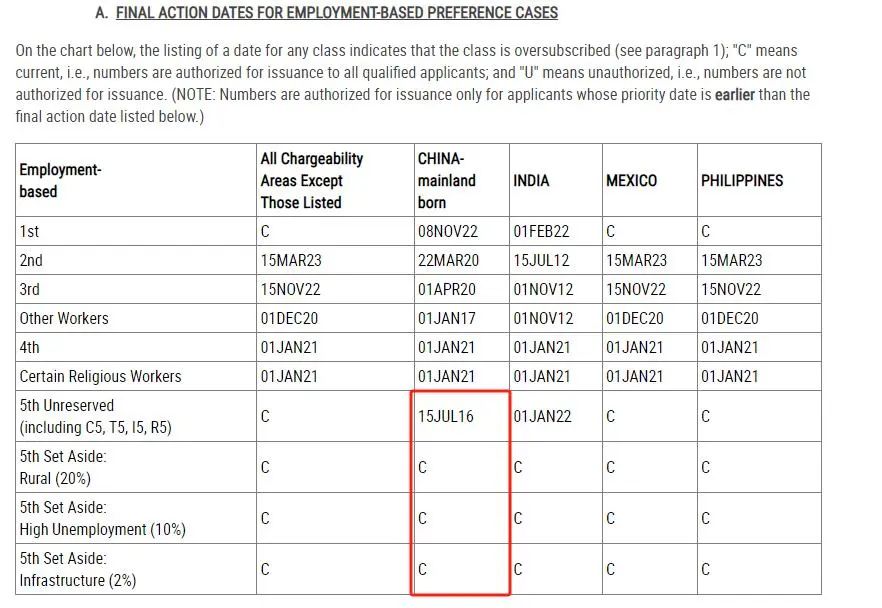
Table B: Dates For Filing Of Employment-Based Visa Applications
(Note: Legally residing in the U.S. and meeting relevant conditions, submitting AOS applications to USCIS)
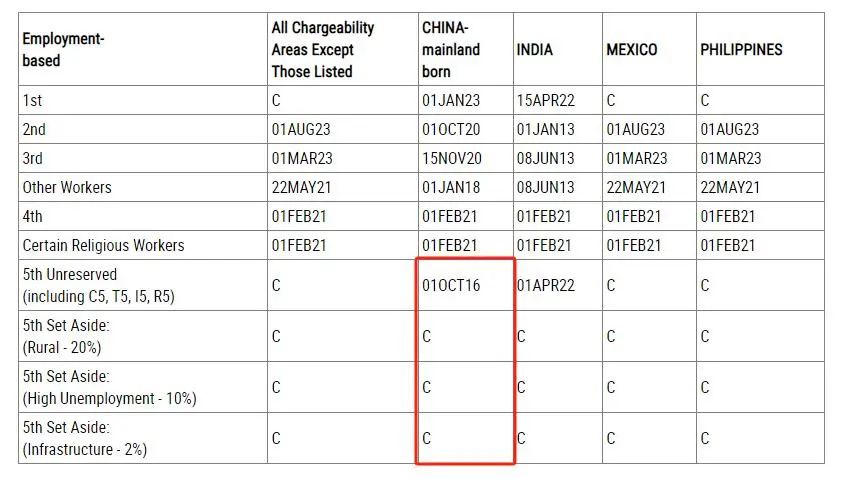
2. On February 14, 2023, the USCIS announced that age locking can also be done based on Table B. If the age is calculated to be under 21 years based on the priority date of Table B, and within one year of the priority date, the child has completed the NVC fee payment or submitted the DS-260 or submitted the AOS application, they can be submitted as a derivative applicant for the I-485 application until the priority date of Table A is reached, and the I-485 is approved and the green card is issued.
3. On August 24, 2023, the USCIS updated the adjudication manual, establishing the new policy of age locking based on Table B from February 14 as a special circumstance, allowing exemptions for those children who, due to policy changes, were unable to submit the I-485 within one year to complete the "seek to acquire" action.
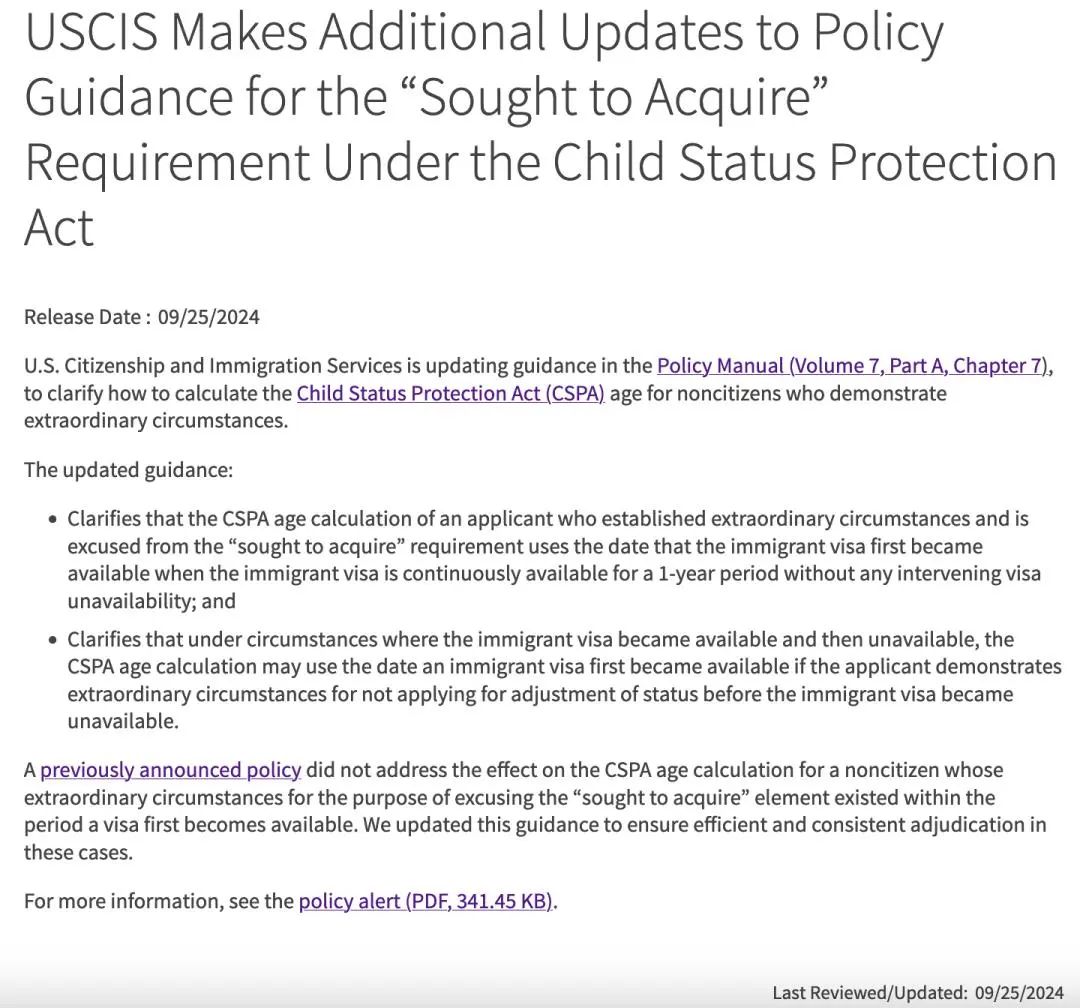
4. On September 25, 2024: The USCIS updated the CSPA policy regarding Sought to Acquire. The latest policy changes interpretation:
(1) For applicants exempt from the "Seek To Acquire" requirement due to "special circumstances", when calculating their CSPA age, if the visa continues to be backlogged within one year, the date of the first backlog will be used.
(2) If Table B retrogresses and the priority date becomes unavailable again, if the applicant can prove that they were unable to submit the I-485 before the retrogression due to "special circumstances", the CSPA age calculation can use the date of the first backlog. Otherwise, it will be based on the date after the retrogression.
(3) The USCIS recognizes exemptions for the "Seek To Acquire" requirement within one year for "special circumstances" such as:
a. Severe physical or mental illness within the year;
b. Rejection of the I-485 due to incorrect submission and resubmission within a reasonable time; c. Death or serious illness of the applicant's agent, legal representative, or immediate family member; d. Invalid assistance from an agent or legal representative under specific requirements.
By reviewing past policies, we can understand that on February 14, 2023, the USCIS announced that if Table B is open, submitting the I-485 can lock in the child's age according to Table B. In August of the same year, the USCIS updated the policy guidelines again, establishing the new policy of age locking based on Table B from February 14 as a special circumstance. This update further explains the "special circumstances" for which applicants can prove that factors beyond their control directly led to their inability to meet the one-year "seek to acquire" requirement.
For example, if the applicant reaches the priority date according to Table B, and the child's CSPA age is three months away from aging out, but the NVC fee payment, DS-260 submission, or I-485 submission is not completed within those three months, will it lead to aging out? Can stepchildren and adopted children be included as derivative applicants for immigration? For more detailed questions, please consult the WorldWay Immigration Group. Our professional team will provide you with expert answers tailored to your specific issues.
The WorldWay Immigration Group, established in 2006, is one of the first professional immigration agencies in China promoting the U.S. EB-5 investment immigration program. With over 20 years of experience in Hong Kong and 18 years of expertise in U.S. investment immigration, we have a professional project team, documentation team, and customer service team with over 18 years of service experience, having successfully assisted over 6,000 families in immigrating to the United States, with extensive experience in processing thousands of U.S. green cards.
As one of Asia's top 500 brands, the WorldWay Immigration Group has focused on investment immigration for over 20 years, proposing the concept of selected projects early in the EB-5 industry and establishing a professional analyst team. We emphasize the importance of project selection in U.S. EB-5 investments and sincerely treat our clients. The WorldWay Immigration Group has repeatedly won the "Best Immigration Agency Award" at the annual EB-5 conference in the U.S. Our senior management has met with several U.S. Congress members and maintains friendly interactions with various U.S. lawmakers, governors, mayors, and well-known figures in the EB-5 industry, making us a reliable choice for your U.S. immigration needs.
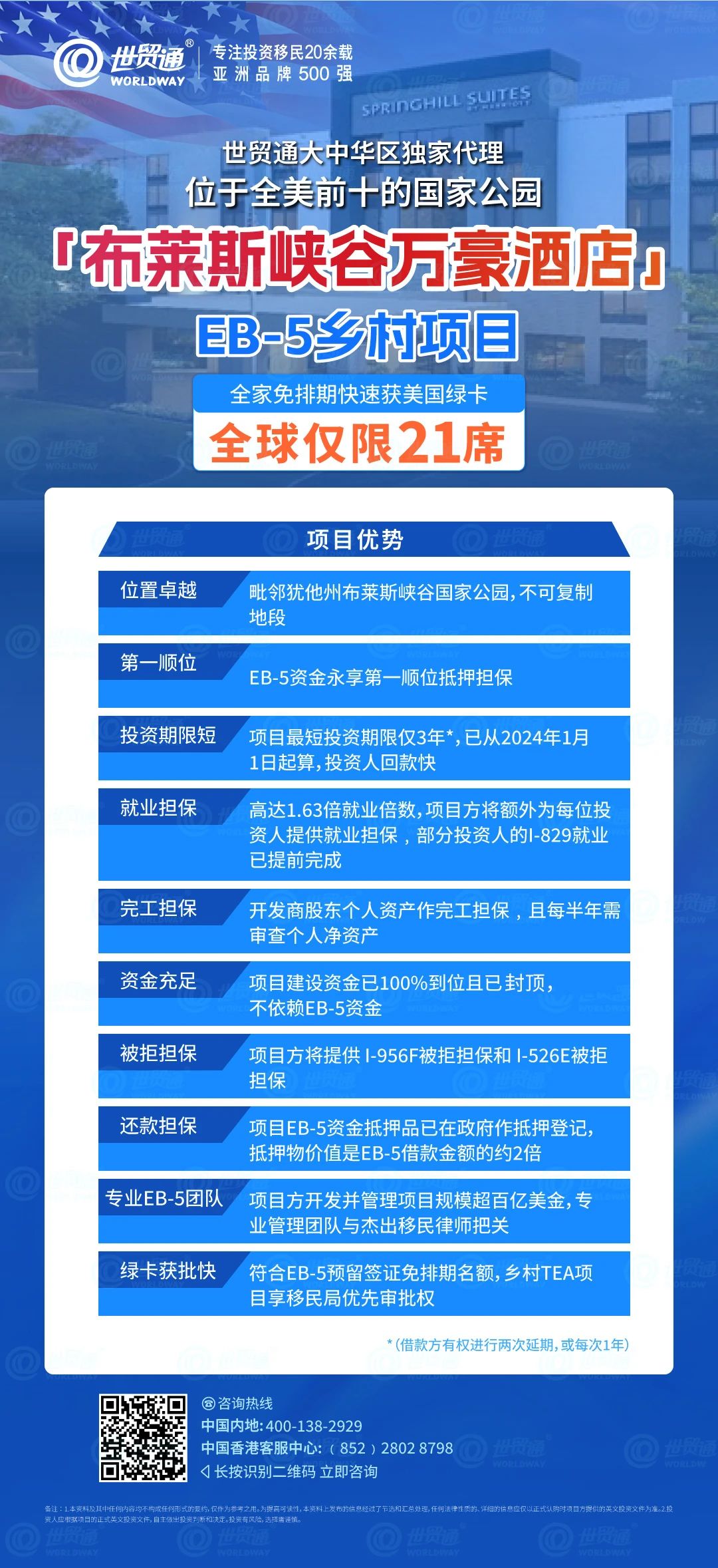
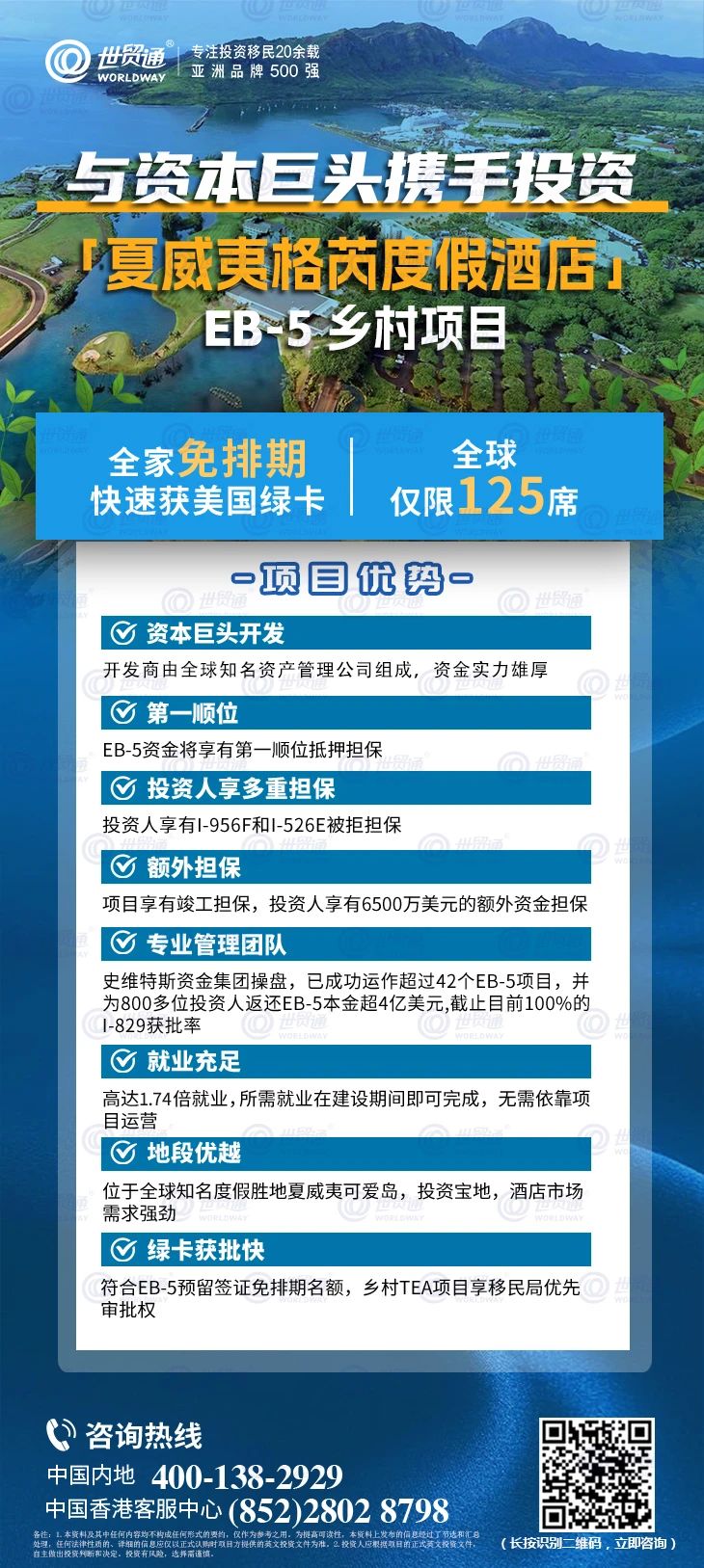
Currently, it is an excellent time to immigrate to the United States through the EB-5 program. Interested applicants should act quickly to seize the opportunity, apply early, get approved early, and benefit early! The two most popular EB-5 projects on the market, exclusively represented by the WorldWay Immigration Group in the Greater China region, are the "Bryce Canyon Marriott" located in one of the top ten national parks in the U.S. and the "Hawaii Grand Resort" developed by capital giants. Both are high-quality EB-5 rural projects that have undergone rigorous selection and scrutiny by the WorldWay Immigration Group, making them excellent choices for quick immigration to the United States.
Important Reminder
2025 New Fiscal Year U.S. Immigration Fast Track
"Bryce Canyon Marriott" EB-5 Rural Project
National Tour Launch Event Coming Soon
Five Cities Linked • Grand Debut in China
October 18 in Hong Kong, October 19 in Beijing
October 20 in Qingdao, October 26 in Shenzhen
October 27 in Shanghai
Renowned U.S. immigration lawyers and senior project representatives
Many distinguished guests will be present to provide insights
They will deeply analyze the latest trends in EB-5
If you want to learn more about the "EB-5 New Policy Dual Submission" policy
Come to the event, and you will get the answers you need
The registration channel for the launch event is now open
Please hurry to register

For inquiries in mainland China: 400-138-2929, Hong Kong customer service center: (852)2802 8798
This article is copyrighted by the WorldWay Immigration Group. If you need to reproduce, link, repost, or copy this article in any other way, please be sure to indicate that the copyright source is the WorldWay Immigration Group. Violators will be held legally accountable. * Investment involves risks; the above information is for reference only.*