





South Korea is no stranger to us. As a neighboring country in close proximity, the shortest distance between South Korea and China is only 190 kilometers, with a time difference of just one hour and flight times of only 1-3 hours from most first-tier cities. With its close proximity, similar culture, and large Chinese population, South Korea can be considered an ideal choice for many investors looking to relocate.
In 2021, South Korea was recognized by the United Nations as a developed country. Its GDP that year was approximately 1.8 trillion USD, ranking tenth in the world, with a GDP per capita of approximately 35,000 USD. South Korea has become the 32nd member of the developed countries and is also the world's tenth-largest economy. South Korea's economy is highly developed, ranking it as one of the "Four Asian Tigers." As one of the developed countries closest to us, South Korea has long been a destination for Chinese citizens to relocate. According to statistics, there are currently 750,000 Chinese people in South Korea, accounting for 44% of the foreign population in the country. So, what are the welfare policies in South Korea, such as those regarding childbirth, education, healthcare, and elderly care?
Childbirth Incentive Policies
Although South Korea currently has the lowest fertility rate in the world, its childbirth benefits are substantial. To encourage young people to have children, the government provides birth grants and childcare allowances from pregnancy through the child's schooling.
Maternity benefits: Once pregnancy is confirmed, one can apply for the National Happiness Card, which contains 1 million KRW that can be used for prenatal check-ups. Extended maternity leave: In addition to the statutory maternity leave, one can apply for a one-year childcare leave, with salary compensation provided by the state. Child-rearing subsidies: The state subsidizes all daycare costs.
Education
South Korea implements a 12-year compulsory education system. During early childhood, the government provides various types of daycare centers. Education for the three years before a child enters elementary school is completely free, and all children aged 3-5 can enjoy education subsidies upon enrollment. South Korea's educational curriculum includes 6 years of elementary school, 3 years of middle school, 3 years of high school, and 4 years of university. The 6 years of elementary school, middle school, and high school are part of the compulsory education stage, with all fees waived, which eases the burden for many families.
Sound Healthcare and Elderly Care System
South Korea possesses advanced medical technology and many medical examination centers with state-of-the-art equipment; tens of thousands of foreigners travel to South Korea for medical check-ups every year. With a South Korean long-term residence permit, one can join the National Health Insurance of South Korea and enjoy the same treatment as locals. In addition, there is the National Pension system for the elderly; those with a long-term visa can enjoy South Korea's elderly care benefits by contributing to the pension.
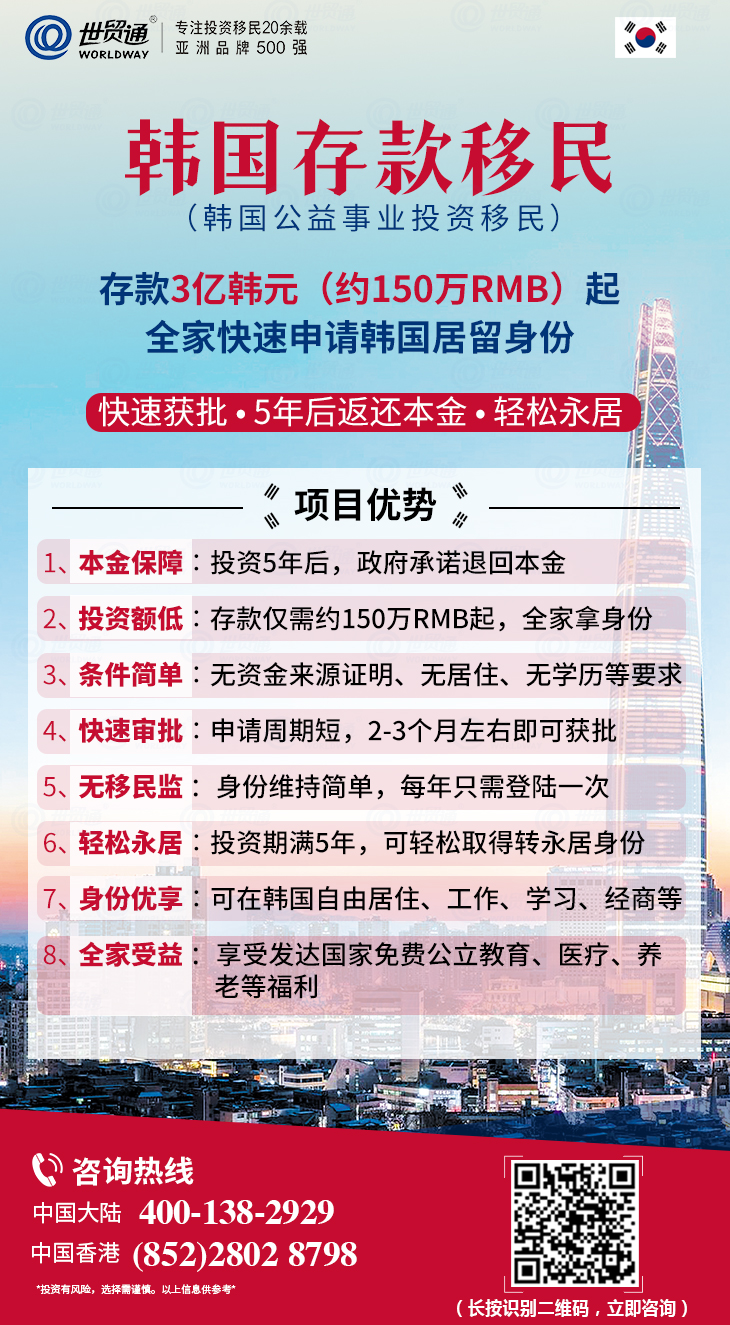
If you are interested in immigrating to South Korea, the South Korea Deposit-based Immigration program is a great option. It features simple application procedures, fast approval, and quick acquisition of status, truly saving time, effort, and worry. The South Korea Deposit-based Immigration program, officially known as the Public Business Investment Immigration Program, was launched in May 2013. Through investment methods designated by the South Korean Ministry of Justice (Government Public Business Investment Immigration Fund), investors can obtain an F2 residence visa. After meeting the corresponding conditions, they can apply for permanent residency (F5 visa) and nationality. Backed by the government, the principal is returned without interest after five years!
Investment Methods:
1. Invest 300 million KRW: For investors aged 55 and above, a deposit of 300 million KRW (approximately 1.5 million RMB) is required, along with proof of holding assets worth more than 300 million KRW domestically or abroad. This grants an F2 residence visa, with the deposit returned after 5 years and the acquisition of permanent residency (F5 visa);
2. Invest 500 million KRW: For investors under 55 years old, a deposit of 500 million KRW (approximately 2.5 million RMB) is required to obtain an F2 residence visa, with permanent residency obtained after 5 years and the deposit returned;
3. Deposit 1.5 billion KRW: A deposit of 1.5 billion KRW (approximately 7.5 million RMB) is required. There is no age limit for investors, and they can obtain permanent residency (F5 visa) in one step. After 5 years, the funds can be withdrawn while the status is permanently retained.
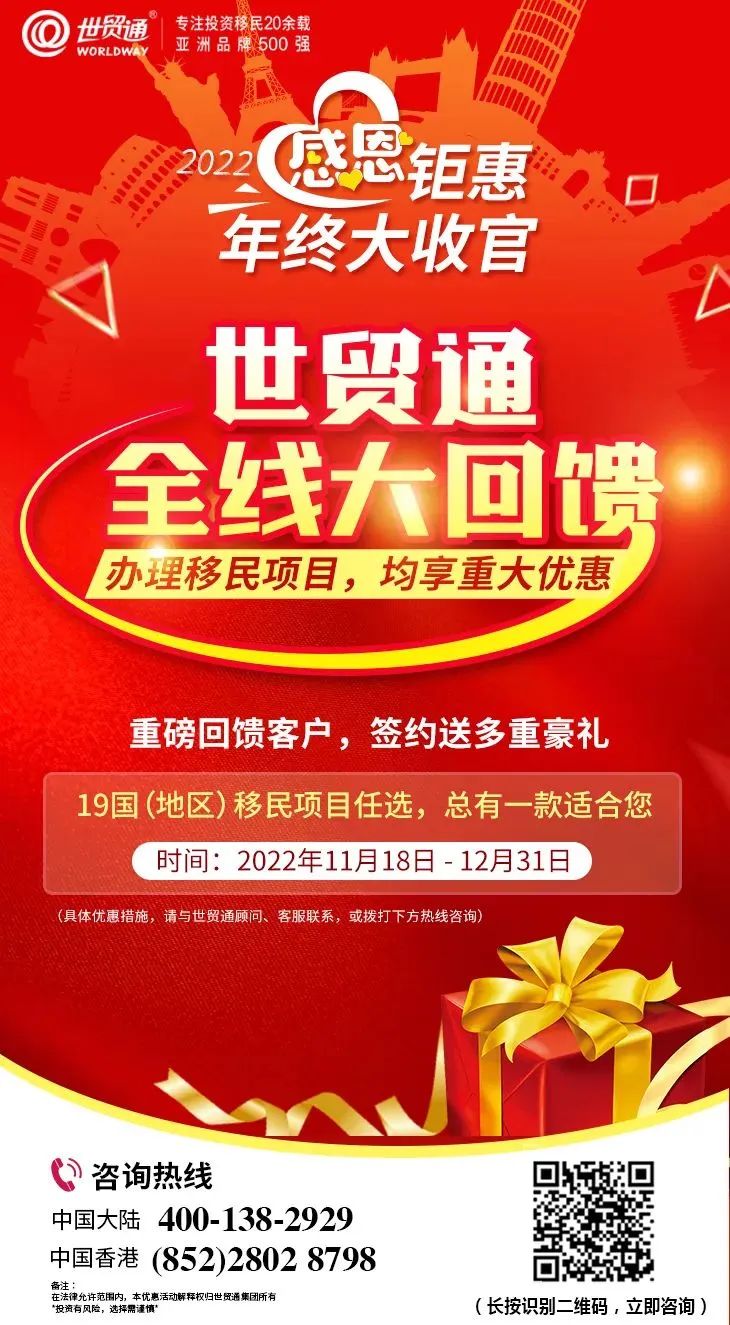
Great news! 2022 Thanksgiving Mega Sale, year-end finale, Visas Consulting Group (VCG) offers full-line rewards! From November 18 to December 31, 2022, all immigration projects handled will enjoy major discounts. We are giving back to customers with heavy rewards, and signing contracts comes with multiple luxury gifts. Choose from immigration projects in 19 countries (regions), there is always one that suits you. Opportunities are rare, don't miss out! Limited-time rewards, act fast!
For more details, please send us a private message in the comment section or call the Visas Consulting Group service hotline. Mainland China: 400-138-2929, Hong Kong, China: (852)2802 8798
Some materials in this article are sourced from the internet, and the copyright belongs to the original author. If there are any copyright issues, please contact us for removal.
Note: 1. Within the scope permitted by law, the right of final interpretation of this promotional activity belongs to Visas Consulting Group. 2. Investment involves risks, please choose carefully.