





Recently, the China Consular Affairs website issued an important notice: reminding Chinese citizens traveling to the United States to be aware that U.S. border law enforcement agencies are inspecting the electronic devices of inbound and outbound travelers.
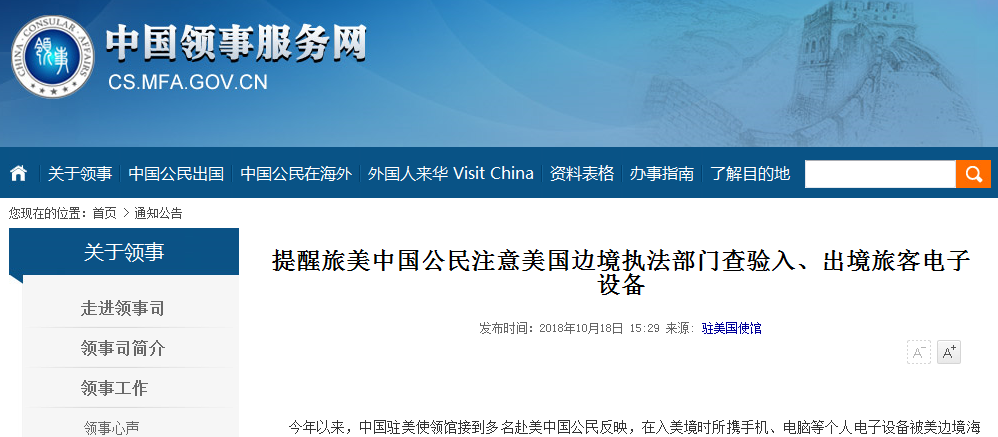
The full text of the reminder is as follows:
Since the beginning of this year, Chinese embassies and consulates in the United States have received reports from multiple Chinese citizens traveling to the U.S. stating that their personal electronic devices, such as mobile phones and computers, were inspected by U.S. border customs law enforcement officers upon entry. During the same period, local U.S. media reported several cases where individuals entering the U.S. were found to have information related to overstaying, illegal employment, or pornography on their electronic devices, resulting in the individuals being denied entry or even prosecuted.
The Chinese embassies and consulates in the United States hereby remind you that according to U.S. law, U.S. border customs law enforcement officers have the authority to inspect the nationality, purpose of entry, and carried items of travelers (including U.S. citizens) entering or leaving the United States, including luggage, electronic devices, and vehicles. This inspection authority is not subject to the Fourth Amendment of the U.S. Constitution and does not require a prior search warrant.
Recently, U.S. border law enforcement agencies have further clarified regulations regarding the inspection of electronic devices of travelers entering or leaving the United States. According to these regulations, U.S. border law enforcement officers may search a traveler's mobile phone or other electronic devices without suspicion. If there is a reasonable suspicion that the traveler is involved in illegal or criminal activities, an advanced search of their electronic devices may be conducted. Inspection methods include requiring the traveler to provide passwords for applications on the electronic device, backing up information from the device, and detaining the electronic device (generally for no more than 5 days).
Please be aware of the above situation to avoid inconvenience and losses caused by the inspection and detention of electronic devices.
As is well known, U.S. entry screening has become increasingly strict in recent years, and cases of deportation for various reasons are emerging one after another. For example: a Chinese female student was strip-searched and immediately deported due to a comment on Facebook; a student was deported after WeChat chat records revealed they told a friend, "I don't like this school, I'm just using it to maintain my status"; and individuals were deported on the spot and barred from entering the U.S. for five years after WeChat discussions about buying property in the U.S. or children attending school in the U.S. were interpreted as having immigrant intent.
According to data from U.S. Customs and Border Protection, the number of electronic device searches at the border has grown rapidly, increasing by 50% from 2016 to 2017, with approximately 30,200 electronic devices searched in 2017.
U.S. Customs supervision is becoming increasingly stringent! Worldway Group reminds everyone again: while complying with all regulations, please carefully check your mobile phones and computers before passing through customs. Review your Twitter, FB, Weibo, WeChat, QQ, text messages, etc., and do not let social media cause unnecessary trouble!
As everyone knows, going abroad today is not just for tourism or study; more and more people are achieving global asset allocation. The combination of investment and immigration has been well-received by many in recent years. With its prosperous charm, superior environment, advanced technology, and excellent education, the United States attracts a large number of Chinese people. The U.S. EB-5 investment immigration program has become one of the most well-known and cost-effective ways to immigrate to the United States due to its relatively low capital requirements, no requirement that assets must be derived from business operations, and no language or academic requirements.
If you are interested in immigrating to the United States, please call us as soon as possible: 400-138-2929.