





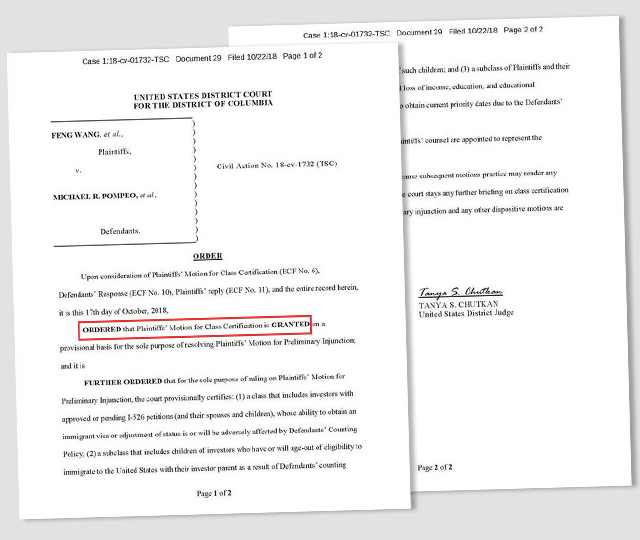
EB-5 retrogression has been a focal point for EB-5 investors and prospective investors from mainland China in recent years. To address the plight of Chinese EB-5 investors and secure more reasonable visa quotas, over 450 EB-5 investors engaged senior U.S. attorneys to file a lawsuit in the U.S. District Court for the District of Columbia on July 25. This lawsuit has recently seen a glimmer of hope, as the U.S. Federal Court ruled that the application for a Preliminary Injunction in the retrogression lawsuit filed by Chinese EB-5 investors is granted Class Action status. This is undoubtedly great news for Chinese EB-5 investors currently facing retrogression!
This federal court ruling signifies that the judge acknowledges the current visa quota calculation method may have harmed the collective interests of the relevant investors and recognizes the case as a class action. This breakthrough is expected to allow all Chinese investors currently in the retrogression queue to enjoy the equal treatment and rights resulting from the final judgment of the lawsuit.
In the retrogression class action, the investors' common demand is: if the visas for an investor's spouse and children do not count against the annual quota of 10,000, the number of investors who can receive visas each year would increase significantly, thereby shortening the retrogression period.
It is reported that the presiding judge for the retrogression lawsuit, Tanya Sue Chutkan, is a first-generation immigrant herself. Her background makes her sympathetic to immigration issues, and it can be said that her support effectively facilitated the ruling of this case as a "class action," while also laying a foundation for the smooth progress of future proceedings! This has further increased the confidence of Chinese EB-5 investors in resolving the retrogression issue.
In fact, all parties in the United States attach great importance to the issue of retrogression. The U.S. Congress and the USCIS are committed to the reform of the EB-5 Regional Center Program from both legislative and administrative levels, continuously proposing feasible solutions to resolve retrogression. For example, the Department of State's Visa Office has proposed a one-time use of unused visas accumulated over previous years; Congress has proposed legislation to clarify that EB-5 visa quotas should not include the principal applicant's spouse and children (counting only the principal applicant). If calculated at 2.7 visa quotas per family, this would mean the capacity for EB-5 applications would expand by 2.7 times. The USCIS has also proposed many solutions at the administrative level, which we will not list here one by one.
It is not difficult to see that both the various sectors in the United States and EB-5 investors are working hard to resolve the retrogression issue. We also believe that with the efforts of all parties, the U.S. EB-5 retrogression issue will eventually be fundamentally resolved.
In the current relatively optimistic and favorable context for resolving retrogression, it is still necessary to remind investors that because the issuance of EB-5 visas has always followed a "first-come, first-served" queuing principle, the only solution for investors intending to immigrate to the United States is: choose high-quality projects, submit applications as early as possible, and secure priority for EB-5 visa issuance with an earlier "priority date" to land in the United States as soon as possible! Waiting and hesitating will only delay your journey to the United States.
The unchanging "golden rule" of the immigration world: Immigrate early! Currently, the U.S. EB-5 Regional Center Program is set to expire on December 7. The USCIS administrative reform regulations for an EB-5 "price hike" may be released in November. This means the era of low-cost immigration to the United States for $500,000 may soon become history. Under such circumstances, investors should seize the opportunity, choose high-quality projects, plan ahead to obtain U.S. permanent residency, reduce the impact of fluctuating U.S. policies, and remain steadfast in the face of change.
If you are interested in immigrating to the United States, please call us as soon as possible: 400-138-2929.