





Fire, fire, fire! This year, California seems destined to be plagued by fire, as wildfires have spread from Northern California to Southern California.
These fires are consuming not only the natural accumulation of flora and fauna but also the property and memories that people have spent years building with their hard-earned efforts.
On December 5, after Governor Brown declared a state of emergency, the California government deployed thousands of firefighters to join the efforts. However, following a fierce wind last night (gale-force winds reaching 85 mph), the wildfires have not shown any signs of stopping; instead, they are burning more intensely and erratically.
Tragic! Southern California Wildfires Burning More Fiercely
Latest News:
200,000 residents forced to evacuate overnight
43,000 households without power
110,000 acres of land destroyed
The area is equivalent to 1/2 of Silicon Valley, 1 Beijing Haidian District, or 7 Manhattans
Four Major Areas in Southern California Become Fire Zones
Disaster reports are coming in from all over Southern California. Although the UCLA (University of California, Los Angeles) campus is not currently under threat, all afternoon and evening classes have been canceled, and all on-campus activities have been suspended. The total number of schools closed this week will reach over 200!
The fire is spreading rapidly across four major residential areas. After a night of firefighting, only a small portion of the areas have been contained, while the fire continues to rage in most regions.
Thomas Fire (Ventura County)
Ventura County is the area most severely affected by this fire.
Road closures: Highways 150 and 33 are closed.
Buildings destroyed: 1,200 buildings are in jeopardy.
Land burned: 90,000 acres of land destroyed.
Evacuation status: 50,000 residents evacuated in an emergency
Containment: 5%
Skirball Fire (Bel-Air)
Not only is this the newest ignition point, but it is also the closest to the Los Angeles city area. The raging fire that broke out on Wednesday afternoon is located in one of the most famous luxury residential areas in Los Angeles. Bel-Air is a renowned neighborhood where many billionaires and celebrities reside. With the fire reaching this area, every second is worth millions!
Road closures: The 405 freeway has reopened, but some sections remain closed.
Buildings destroyed: Approximately 4 to 6 homes destroyed, 11 buildings damaged.
Land burned: Nearly 500 acres of land destroyed.
Expected evacuation area: 4,600 residents in Mandeville and Sullivan Canyons are prepared to evacuate at any time.
Containment: 5%
Creek Fire (Sylmar)
This is currently the second most severely affected wildfire area. Due to the intensity of the fire, seven firefighters were injured in this area, and the fire has now spread near the National Forest area.
Buildings destroyed: Approximately 4 to 6 homes destroyed, 11 buildings damaged.
Land burned: 12,000 acres of land destroyed.
Expected evacuation area: 150,000 people evacuated, 2,500 households under threat
Containment: 5%
Rye Fire (Santa Clarita)
Land burned: 7,000 acres burned.
Evacuation status: 1,300 households in the west evacuated
Containment: 5%
Wildfires Cause Severe Air Pollution
Government advice: Reduce time spent outdoors!
The most direct impact of the fires on people's lives is the decline in air quality. Southern California is currently mired in severe pollution, and even neighboring Arizona has been affected~
Areas with Severe Air Pollution
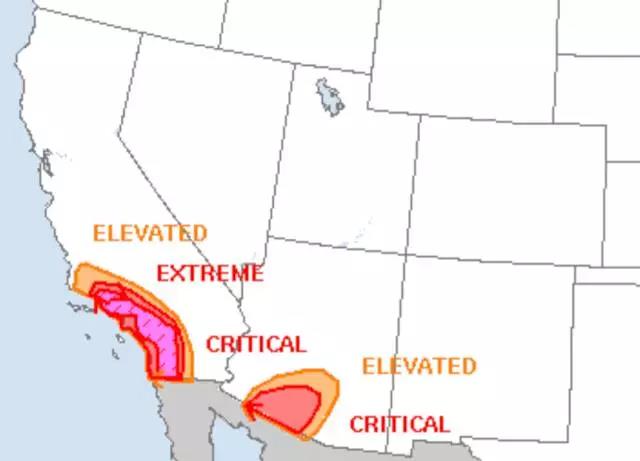

Severe Pollution Zones
Santa Ana
Anaheim
Riverside
Glendale
San Bernardino
Extreme Pollution Zones
Los Angeles
San Diego
Long Beach
Chula Vista
Huntington Beach
Carbon monoxide, hydrocarbons, carbides, nitrogen oxides, and particulate matter, as well as toxic particles released from burned plastics, electrical appliances, and other items, are suspended in the air. These fine particles enter the human lungs directly and are difficult to expel. They bypass the body's normal filtration systems and can even enter the bloodstream, triggering respiratory diseases such as asthma.
Regardless of whether you are located directly in the wildfire area, even if you look out the window and the sky still appears blue, tens of thousands of hectares of wildfires have been burning for three full days. The air quality across the Greater Los Angeles area has plummeted, with many particulate matters floating in the air. We advise friends to take care of your health: wear a mask when going out; keep car windows closed while driving and set the air conditioning and ventilation system to internal circulation; clean yourself thoroughly after returning home; do not light candles or smoke at home to avoid lowering indoor air quality. If you experience persistent coughing, difficulty breathing, asthma, dizziness, rapid heartbeat, nausea, or other symptoms, be sure to contact your doctor immediately or go to the emergency room for medical treatment.