





Immigration News
Stay informed on global immigration policy trends — professional insights on every opportunity and change.
Major Changes Coming to U.S. Student Visas! Seize These Shortcuts for Staying in the U.S.
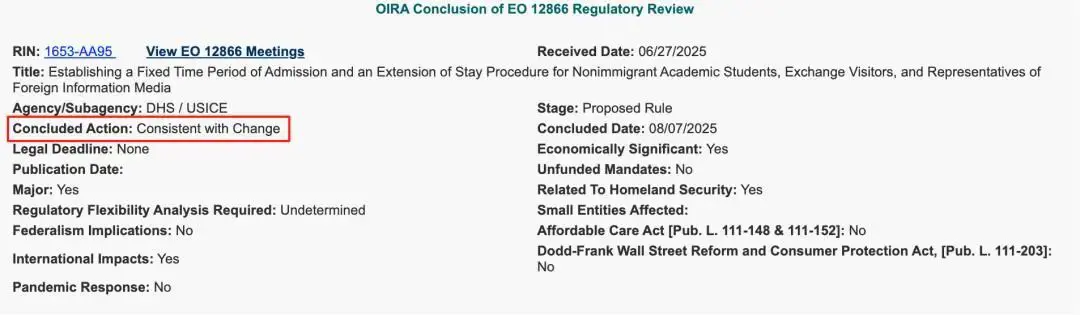
Recently, a significant visa reform proposal submitted by the U.S. Department of Homeland Security (DHS) has completed White House review and is about to be opened for public comment. If the proposal is implemented, the current international student visa system will undergo fundamental changes: F-1 students and J-1 exchange visitors will bid farewell to the "Duration of Status" (D/S) model and switch to a fixed expiration date.

Panama, Central America: A New Immigration Choice Favored by Many Investors
As the jewel of Central America, the Panama immigration program has become a popular choice for global high-net-worth individuals and middle-class families in recent years, thanks to its unique triple-value matrix of "policy stability + permanent status + tax benefits." Since 2012, Panama's immigration policy has maintained a high degree of continuity and transparency, with application requirements and approval processes clearly enshrined in law, providing investors with long-term, stable immigration planning strategies...
H-1B Visa New Policy Alert: The Green Card is the True "Amulet" for Staying in the U.S.
Since Donald Trump's second term began, the H-1B visa has undergone several new regulations and adjustments. According to a recent announcement from the U.S. Department of State, starting September 2, 2025, the renewal of H-1B visas will be significantly tightened, with the vast majority of applicants required to return to their home country for an in-person interview, eliminating the convenience of "third-country renewals." This marks the most stringent adjustment to the H-1B visa in a decade, and cross-border workers may face a "hell mode" for renewals.
Changes to Japan's Business Manager Visa are Imminent! Seize the Final Golden Window for Immigration
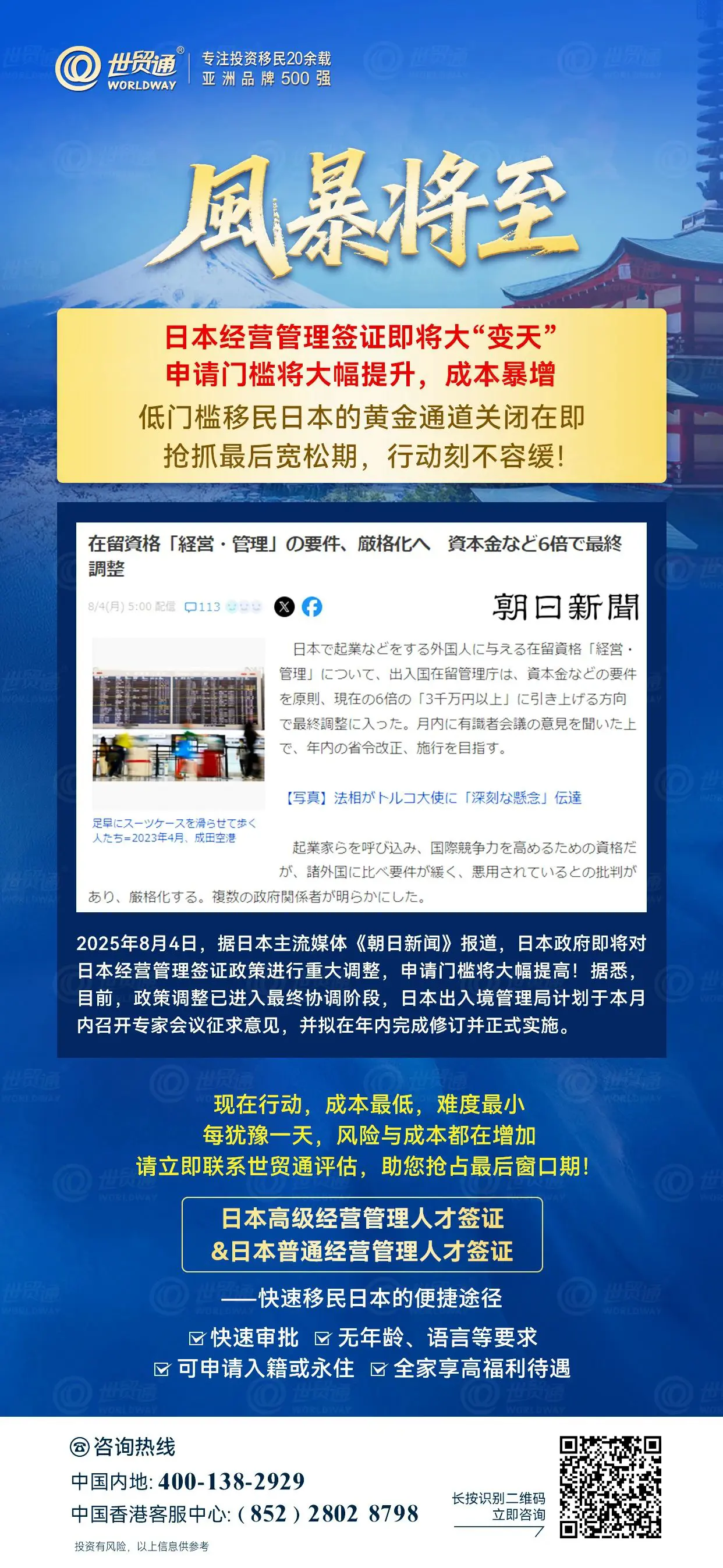
“Still waiting to immigrate to Japan? The ‘starting gun’ for policy tightening has already been fired!” The winds of change are blowing! Japan, a country that is both traditional and modern, is quietly closing the door on ‘relaxed immigration.’ Global immigration policies are tightening, and Japan is no exception. According to the latest reports from major Japanese media: the application threshold for the Japan Business Manager Visa is about to be significantly raised—higher capital requirements, stricter...

Making Industry History! Worldway Group Successfully Assists First Batch of Chinese Investors in Obtaining Nauru Passports
Worldway Group has once again made history in the immigration industry, becoming the creator of the first successful Nauru passport cases under the new investment citizenship program for Chinese investors! Following the Nauru government's official approval of the "Nauru Economic and Climate Resilience Citizenship Program" for the first batch of immigration clients from Worldway, these clients have recently successfully received their Nauru passports and citizenship certificates, becoming the first in China to obtain Nauru passports through this program...
US EB-5 Latest Policy Interpretation: A Must-Read for 2025 Applicants
The introduction of the latest 2025 US EB-5 investment immigration policy not only paves a smoother path for applicants aspiring to realize their American dream through investment, but also effectively addresses many pain points and obstacles in previous applications through a series of targeted optimization measures. These optimization initiatives are committed to improving application efficiency, shortening waiting times, and lowering entry barriers, making the US EB-5 investment immigration program...
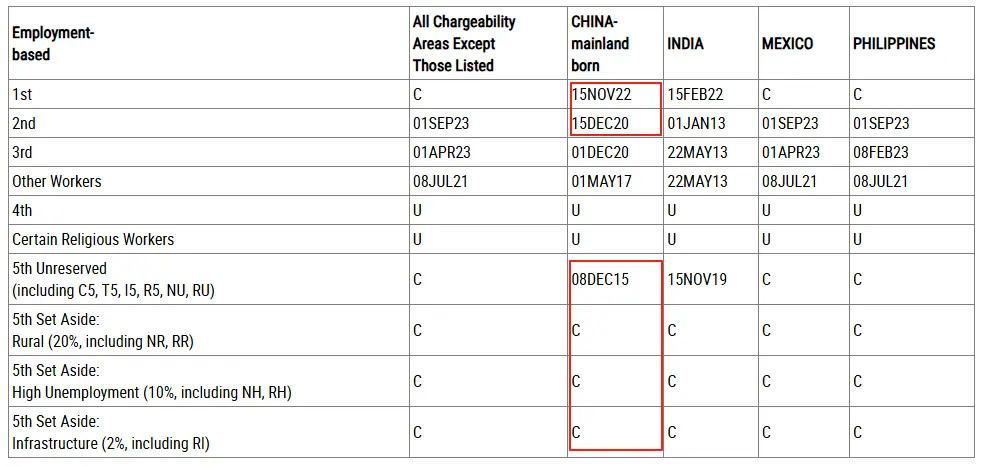
Is the EB-5 Rural Project Still Exempt from Waiting Periods? Interpretation of the New U.S. Immigration Visa Announcement
The U.S. Department of State's Visa Office has officially announced the immigration visa bulletin for the last month of fiscal year 2025 (September 2025). Under the old law, there is no change in the waiting periods for the EB-5 A and B categories this month, and under the new law, the reserved EB-5 visas still have no waiting period. The B category has been closed. The latest results show that the A category remains unchanged, with the direct investment categories C5 and T5 consistent with the non-reserved visa categories I5 and R5 of the regional center projects, maintaining the date of December 8, 2015; the B category remains unchanged, with the direct investment categories C5 and T5 consistent with the non-reserved visa categories I5 and R5 of the regional center projects, maintaining the date of October 1, 2016.
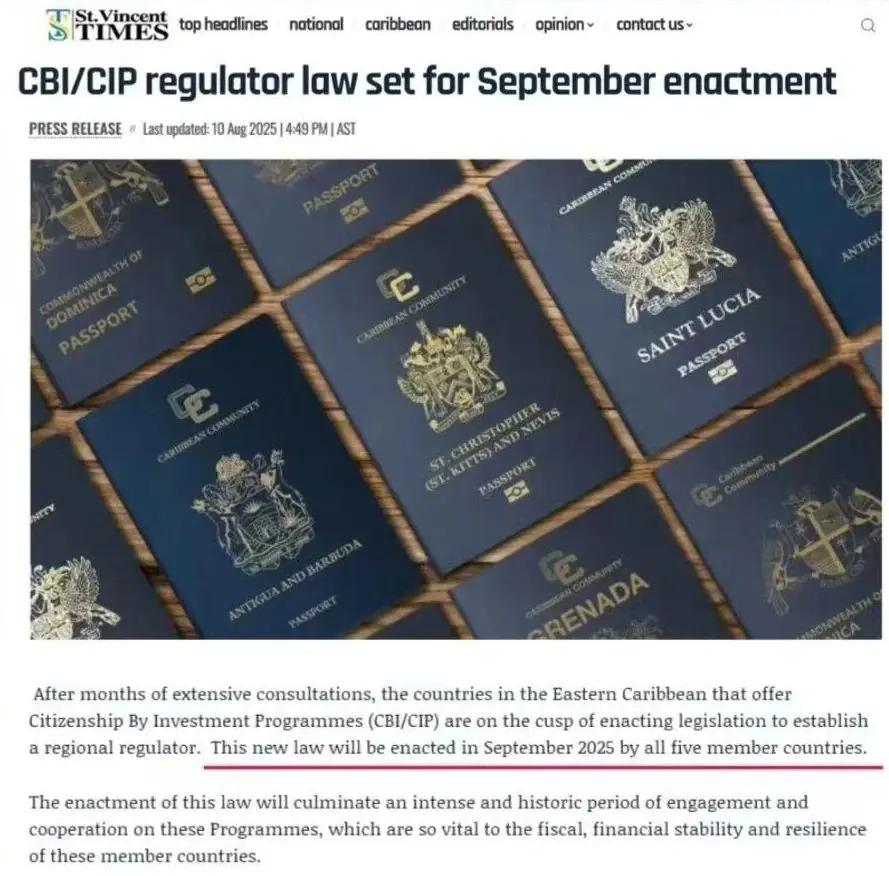
Seize the Opportunity! The Investment Citizenship Policies of Five Caribbean Countries Will Be Collectively Tightened
Breaking news, the investment citizenship policies of the five Caribbean countries are about to undergo significant adjustments! According to the St. Vincent Times, after months of extensive consultations, the Eastern Caribbean countries offering Citizenship by Investment (CBI/CIP) programs are set to enact legislation to establish a regional regulatory body. All five member countries (Saint Lucia, Saint Kitts and Nevis, Antigua and Barbuda, Dominica, Grenada) will enact this new law in September 2025…

Historical Evolution and Contemporary Community Culture of the 'Ten-Farmer Route' Chinatowns in the United States
The 'Ten-Farmer Route' is not a literal maritime path, but a folk term for the routes taken by Chinese laborers—primarily farmers from the Pearl River Delta—to the United States since the mid-19th century. Using this route as a narrative thread, this article examines the century-long evolution and contemporary cultural landscape of its destination: a typical Chinatown on the U.S. West Coast. Through archives, oral histories, and field research, this article seeks to answer: How did a maritime route shape a Chinatown, and how does the Chinatown, in turn, rewrite the memory of that route?

Ten Waves Across the Pacific: A Study of the "Ten Waves of Chinese Immigration to America" and Sino-American Social Interaction in the 19th and 20th Centuries
From the mid-19th century to the 1930s, approximately 300,000 Chinese laborers from the Pearl River Delta crossed the Pacific in ten waves, leaving behind the folk saying of "Ten Waves of Chinese Immigration to America" on the North American continent. This article uses the "Ten Waves" as the main thread and the interaction between Chinese people and American society as the weft, employing quantitative population history, transnational history, and cultural memory research methods to attempt to answer three questions: First, how do the Ten Waves present different aspects in terms of time, space, occupation, and institutions? Second, how did these waves of immigration reshape the labor market, urban forms, and ethnic politics in the American West? Third, after the end of the Chinese Exclusion Act, how has the historical memory of the Ten Waves been reproduced, contested, and forgotten? Through multiple corroborations of archives, newspapers, oral histories, and GIS data, this article aims to provide a historical mirror for today's immigration policies.

Breakthrough Progress! Frequent Success Reports for the "Triple-Approved" EB-5 Rural Project
Following the exciting news of multiple investors receiving rapid I-526E approvals and successfully passing their interviews at the U.S. Consulate General in Guangzhou (for details, please click to view Worldway's previous report: From Rapid I-526E Approval to Successful Visa Interview, How Did They Succeed?), the "Florida Lakeside Jewish Community" EB-5 rural project, which has achieved triple approval of I-956F/I-526E/Green Card, brings more good news—the project construction has made breakthrough progress!...

Breaking! USCIS Eliminates 'Table B' Age-Locking, Triggering Over-Age Alert for Children
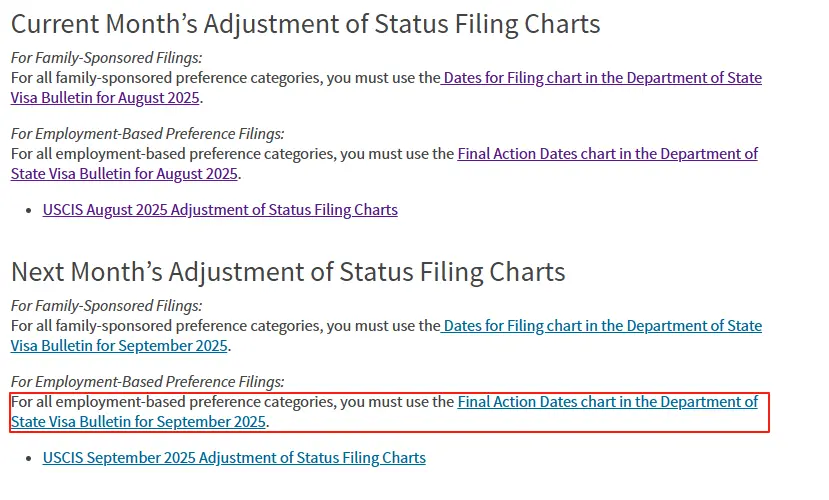
On August 8, 2025, U.S. Citizenship and Immigration Services (USCIS) suddenly announced a major policy change: effective August 15, 2025, it will comprehensively change the age calculation method under the Child Status Protection Act (CSPA), eliminating the use of 'Table B' (Dates for Filing) for age-locking. This new rule means that all adjustment of status applications filed on or after August 15 will uniformly use the 'Final Action Dates' (Table A) in the Department of State's Visa Bulletin to calculate whether a child has aged out.