





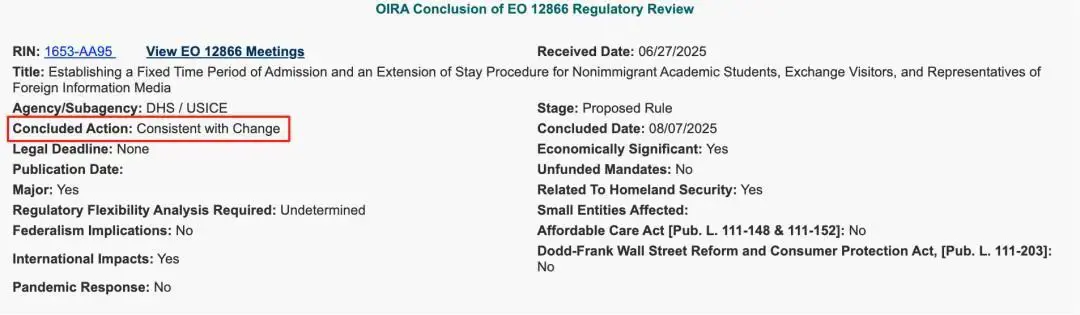
Recently, a significant visa reform proposal submitted by the U.S. Department of Homeland Security (DHS) has completed White House review and is about to be opened for public comment. If the proposal is implemented, the current international student visa system will undergo fundamental changes:
F-1 students and J-1 exchange visitors will bid farewell to the "Duration of Status" (D/S) model and switch to a fixed expiration date.
This means that students who have not completed their studies by the time their visa expires must leave the country or apply for a visa extension; otherwise, they will lose their legal status in the U.S.
Disruptive Changes to the Visa System
From Flexible to Strict
The current F-1 visa operates under the "Duration of Status" (D/S) model, allowing international students to remain legally in the U.S. as long as they maintain full-time student status, regardless of the date on their visa page. After graduation, they can apply for programs like OPT.
However, the new proposal will completely eliminate the D/S model, replacing it with a fixed-term system: most student visas will be valid for 4 years, while students from specific countries or sensitive fields will only have 2 years (including countries identified by the U.S. as "supporting terrorism," countries with over 10% visa overstay rates, and students in special programs). After the term expires, students must reapply for an extension or obtain a new visa to continue their studies or participate in internships.
The U.S. Department of Homeland Security explained that setting a hard deadline helps strengthen national security, reduce visa overstays, and facilitate tracking the duration of stay for visa holders within the country. According to the process, this proposal will be published in the Federal Register and open for a 30-60 day public comment period. If it proceeds as a "proposed rule," there will still be room for modification; however, if it is issued as a "temporary final rule," it may take effect immediately without a public comment period.
Multiple Challenges Faced by International Students
If the new proposal is implemented, it will bring unprecedented challenges to international students currently in the U.S. or planning to come, directly affecting academic progress, career planning, and economic costs:
• Risk of Academic Interruption: Students in long programs such as doctoral or research-based master's degrees may be forced to apply for extensions midway. If they encounter administrative delays, requests for additional materials, or failed reviews, they will face academic interruptions or even forced departure.
• Impact on OPT and Internship Opportunities: OPT applications depend on valid F-1 status; if the visa expires and the extension application is denied or still under review, OPT will not be approved. The 3-year OPT extension for STEM majors may be shortened, weakening competitiveness in the H-1B lottery.
• Increased Time and Economic Costs: Higher frequency of visa extensions means more frequent preparation of materials, longer waiting times, and increased risk of denial, along with potentially rising application fees, and facing stricter background checks and two-year short-term visa restrictions.
How to Respond?
In fact, the tightening of U.S. visa controls for international students has shown a clear trend: the new Director of the Immigration Bureau, Joseph Edlow, publicly stated during his Senate nomination hearing in May that the employment authorization for F-1 students (OPT) should be eliminated. Shortly after taking office, USCIS launched a special operation to combat fake employers and fraudulent pay stubs related to OPT.
These actions indicate that future policies related to F-1 visas, OPT, and other international student matters will continue to become stricter, and the risk of relying solely on the "F-1→OPT→H-1B" pathway for long-term development in the U.S. is increasing. For those planning to come to the U.S. or already in the U.S. and seeking stable status, developing a long-term, stable immigration plan is the core solution for obtaining a sense of security regarding status, and currently, the EB-5 investment immigration program is becoming a more efficient breakthrough option.
• Relaxed Application Conditions: No restrictions on age, education, language, business, or work experience; one person can apply, and the whole family can immigrate to the U.S., living and working anywhere in the U.S., with children enjoying free public education (K12), and spouses and unmarried children under 21 can immigrate together, among many other advantages.
• Ample Quotas & No Waiting Period: Under the new law, the EB-5 rural project under the reserved visa category for investment EB-5 is exempt from waiting periods and has priority processing rights from the immigration bureau.
• Dual Submission: EB-5 applicants within the U.S., including international students, can conduct "dual submission" in the U.S., meaning that applicants without waiting periods can simultaneously submit the I-526E immigration application and the I-485 adjustment of status application, and can also apply for travel permission I-131 and work permission I-765 at the same time, legally residing, studying, and working in the U.S., enjoying the freedom of a quasi-green card in advance, and quickly resolving legal status issues for staying in the U.S.
• "Age Lock" Channel: Starting from August 15, 2025, the age calculation method under the Child Status Protection Act (CSPA) will no longer use "Table B" (Dates for Filing) for age locking. It will uniformly adopt the "Final Action Dates" (Table A) in the State Department's visa bulletin to determine whether children are overage. The reserved visa projects under the new EB-5 law will still maintain a "Current" (no waiting period) status in Table A. Thanks to this unique window period, applicants can use the "dual submission" (I-526E and I-485 submitted simultaneously) strategy, which is currently the most direct and effective way to lock in the age of children.
Currently, the "Great Smoky Mountains - Marriott Hotel" EB-5 rural project is in high demand. This project is becoming a popular choice for EB-5 investment due to the following core advantages:
☑ Approximately 1.5 times real estate first-priority guarantee + developer shareholders providing personal asset joint liability repayment guarantee
☑ A billion-dollar fund providing guarantees for I-956F denials, I-526E denials, and job creation guarantees
☑ Project employment multiplier as high as 1.7 times
☑ Located in the Great Smoky Mountains National Park, which attracts tens of millions of visitors, far surpassing Yellowstone
☑ Situated in the prime town of Gatlinburg, where real estate is in high demand
☑ The project has commenced construction, and hotel development has entered a substantial construction phase, with transparent supervision and regular progress updates

In addition, the EB-1A Extraordinary Ability and NIW National Interest Waiver programs have advantages such as fast approval and expedited processing; one person can apply, and the whole family can immigrate; no investment is required, with low costs; and obtaining a U.S. green card in one step. If you are interested, you can contact WorldWay Immigration for qualification assessment and personalized program customization services.

For inquiries in mainland China: 400-138-2929, Hong Kong customer service center: (852)2802 8798