


A single proposed rule,
has once again put OPT at the center of attention in U.S. immigration policy.
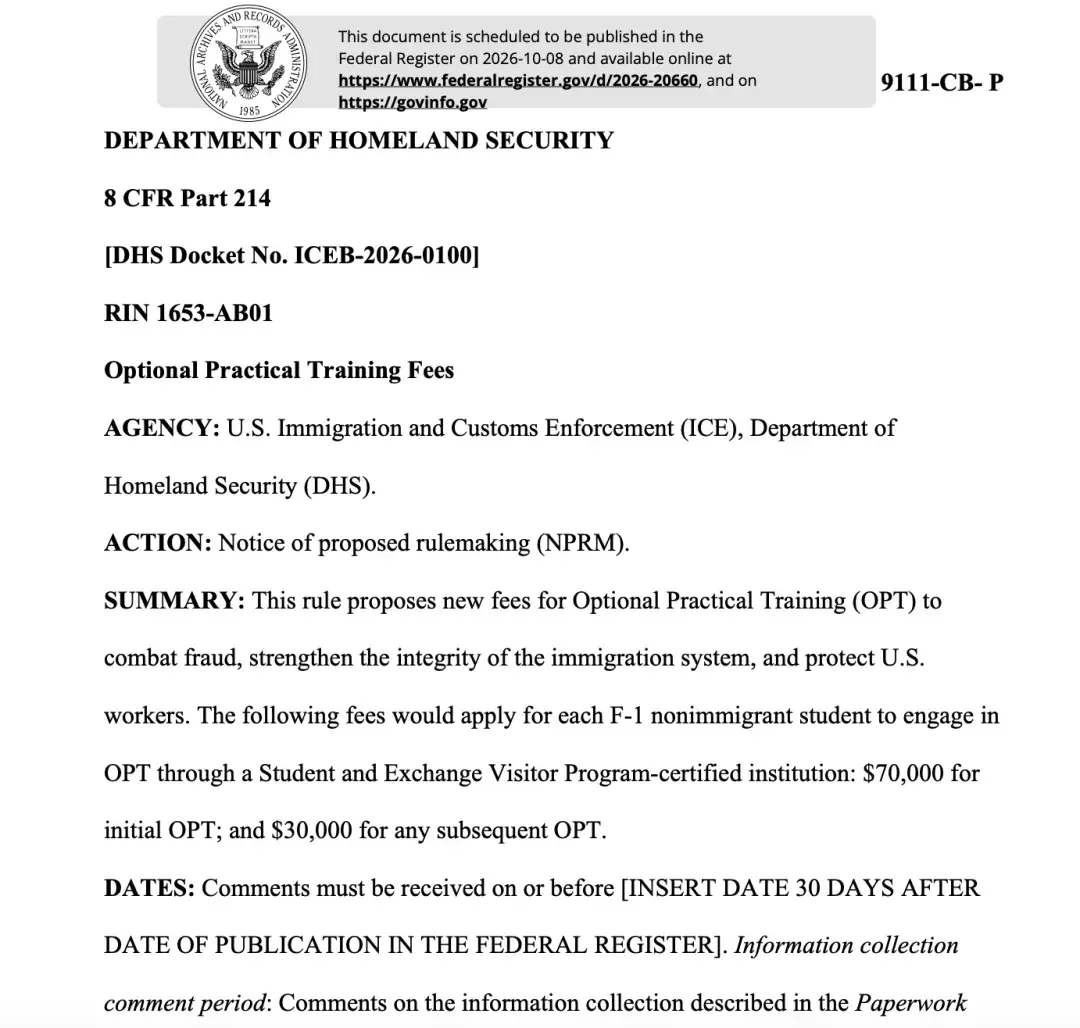
WorldWay Immigration noted that on October 7, local time, the U.S. Department of Homeland Security (DHS) announced a proposed new rule on OPT fees: Schools must pay $70,000 the first time they issue an OPT recommendation for an F-1 student; each subsequent OPT recommendation will incur a fee of $30,000.
PART 1
Proposed New OPT Fee Rule
According to the draft released by DHS, the fee changes mainly involve the following aspects:
1. $70,000 for the First Time, $30,000 for Each Subsequent Time
The fee structure is not simply divided between standard OPT and STEM OPT; rather, it is determined by the number of OPT recommendations issued after the new rule takes effect.
Whether it is pre-completion OPT, post-completion OPT, or STEM OPT extensions, all could be impacted.
2. Schools Pay the Fee, but Costs May Be Passed On
Under the draft rule, the entities responsible for payment are SEVP-certified schools. Schools must pay the fee before the Designated School Official (DSO) completes the OPT recommendation.
However, schools may pass these associated costs on to international students, other students, or OPT employers.
This means that while nominal payment falls on the school, the ultimate burden of these high fees will likely still be borne by students or employers.
3. No Retroactive Fees for Previously Approved OPT
The new rule is intended to charge fees for OPT recommendations after it takes effect. OPT applications that have already been approved and are currently ongoing will not be required to pay retroactive fees.
Additionally, if a student fails to obtain an OPT work authorization, the school may apply for a refund in accordance with the provisions of the draft rule.
It should be noted that the new rule has not yet taken effect. On October 8, the proposed rule was officially published in the U.S. Federal Register, with the public comment period ending on November 9. WorldWay will continue to monitor the situation closely and share updates as soon as new information becomes available.
PART 2
Policy Considerations Behind the Proposed OPT Fee Rule
The official reason provided by DHS is to crack down on OPT fraud, strengthen program oversight, and protect the domestic U.S. labor market.
However, when viewed in conjunction with a series of recent immigration policies, this OPT fee proposal is not an isolated event.
Previously, the Trump administration introduced or proposed high fee measures targeting certain H-1B applications, and now attention has turned toward OPT.
DHS explicitly stated in the draft rule that it aims to prevent companies from utilizing the OPT program to circumvent H-1B requirements.
In other words, as the cost of H-1B employment rises, companies might turn to hiring international graduates through OPT instead; this proposed fee is intended to further increase the cost of this alternative route.
From H-1B to OPT, raising the cost of employing foreign talent in the United States is becoming a key direction in this series of policy adjustments.
PART 3
Nearly 300,000 International Students May Be Affected
The reason OPT attracts so much attention is that it has long served as an important bridge for international students transitioning from campus to the U.S. workplace.
According to Open Doors 2025 data, during the 2024–2025 academic year, a total of 294,253 international students in the U.S. participated in OPT, a year-on-year increase of 21%.
Standard F-1 graduates can typically apply for up to 12 months of OPT, and eligible STEM graduates can also apply for an additional 24-month extension.
For many Chinese international students, the traditional path to remaining in the U.S. is:
F-1 Studies → OPT Employment → H-1B → Employment-Based Green Card
Once OPT fees reach tens of thousands of dollars, the cost for companies to hire international graduates will increase significantly.
Imagine a company choosing between two graduates with similar qualifications: if hiring one of them means incurring tens of thousands of dollars in extra costs, will they still be willing to offer the job opportunity? This may be the real concern for international students. Beyond that, U.S. universities may also face new financial pressures and administrative costs.
If implemented, this policy will impact far more than just an OPT work permit—it is likely to reshape the post-graduation employment landscape for international students.

PART 4
Tightening OPT Policies
International Students Need to Plan Immigration Status in Advance
From H-1B to OPT, the recent ongoing adjustments in U.S. employment-based immigration policies serve as a reminder to families hoping for long-term residency in the U.S.:
Do not stake your entire future on the single pathway of OPT and H-1B.
For families with the means, EB-5 investment immigration is a long-term status option worth exploring. EB-5 does not rely on employer sponsorship, nor does it require participating in the H-1B lottery. According to the U.S. Department of State's October 2026 Visa Bulletin, the three reserved visa categories under the new EB-5 law continue to have no visa queue (no backlog).
In particular, for applicants currently inside the U.S. who meet adjustment of status requirements, the absence of a visa backlog allows for "concurrent filing"—that is, submitting the I-526E immigrant petition and the I-485 adjustment of status application simultaneously.
It is worth noting that the current EB-5 policy window involves not only visa queues, but also future investment costs.
Starting January 1, 2027, based on the automatic inflation adjustment mechanism under the EB-5 Reform and Integrity Act (RIA), the minimum investment threshold for EB-5 Targeted Employment Areas (TEA) will be raised; based on current CPI estimates, the current $800,000 threshold is expected to increase to at least $900,000, with the final amount subject to official publication in the USCIS Federal Register.
For families seeking long-term residency in the U.S., rather than reacting passively after policy changes occur, it is better to explore different immigration status pathways early to preserve more options for the future.