The new regulations regarding U.S. international student status, originally scheduled for official implementation on September 15, 2026, were halted by a court one day before taking effect.
WorldWay Immigration notes that on local time September 14, Judge F. Dennis Saylor of the U.S. District Court for the District of Massachusetts issued an order blocking the U.S. Department of Homeland Security (DHS) from implementing the new rule on fixed periods of stay for F, J, and I nonimmigrants as originally planned.
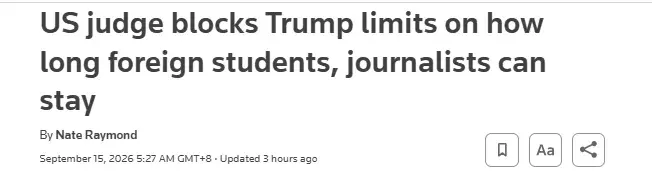
This means that the plan to "eliminate D/S and replace it with a fixed period of stay," which was scheduled for implementation from September 15, will temporarily not be enacted, and the current D/S system remains in place.

D/S System Temporarily Maintained
What Were the New Regulations Originally Going to Change?
In July this year, DHS officially published its final rule, planning to change the long-standing Duration of Status (D/S) system for F, J, and I nonimmigrants. DHS announced at the time that the rule was originally scheduled to take effect on September 15, 2026.
Under the current system, eligible F-1 students can generally stay in the United States for the duration of their academic program and lawful status, with their I-94 typically annotated as "D/S" rather than a specific status expiration date.
The new rule originally planned to replace this model with a fixed period of stay.
Under this model, the authorized period of stay for Category F international students and Category J exchange visitors would in principle be capped at a maximum of 4 years; for Category I foreign media personnel, it would generally be up to 240 days. Individuals needing to remain in the U.S. would likely have to apply for an extension according to regulations.
In other words, once implemented, international students would face more explicit time restrictions for their future studies, extension applications, and status transitions in the United States.
Now, with judicial intervention, this set of new regulations will temporarily not take effect as originally planned.

Why Was It Halted One Day
Before Taking Effect?
This case was initiated by international education and higher education organizations.
Judge F. Dennis Saylor held that in pursuing this major regulatory change, DHS failed to adequately explain why it was necessary to alter the long-standing D/S system, nor did it fully consider less restrictive alternatives.
The court also found that the new regulations could impose a significant impact on U.S. universities, international students, and the higher education system as a whole.
Consequently, the court ultimately ordered a stay on the implementation of the new regulations.
However, it should be noted that this does not mean the new regulations have been permanently canceled. Currently, the court has implemented a preliminary stay, and related litigation may continue. Whether the U.S. government will appeal in the future and whether the new rule will enter the implementation phase again remain to be seen. WorldWay will continue to monitor developments closely.
Temporary Relief Gained
Immigration Planning Still Requires Diligence
This ruling provides a degree of policy buffer for families who are currently studying in the United States, planning to apply for OPT, or preparing to study in the U.S.
At this stage, F-1 and J-1 status holders can continue to maintain their lawful status under the current rules while paying prompt attention to subsequent official notices from their university international student offices as well as USCIS and DHS.
However, the stay of the policy does not mean that uncertainty has completely disappeared.
Judging from a series of changes in U.S. study abroad policies, work visas, and lawful status management since this year, an increasingly clear trend has emerged: U.S. scrutiny and management of nonimmigrant status are becoming stricter, and the frequency of policy changes is also increasing.
Therefore, whether currently studying in the U.S. or planning to stay long-term via OPT and H-1B in the future, in addition to selecting schools and majors, the status timeline also needs to be incorporated into advance planning.

From Study Abroad Planning
To Long-Term Residency Planning
If a family has clearly decided that they want their child to continue working and living in the United States after graduation, or even for the whole family to pursue long-term development in the U.S., what needs to be considered is not just short-term changes to a specific student visa or work visa policy, but whether the entire residency pathway is stable enough.
F-1, OPT, and H-1B are essentially nonimmigrant status arrangements at different stages; however, if the family already has long-term plans to remain in the U.S., immigration pathways such as EB-5 can also be evaluated in advance.
Unlike relying on schools, employers, and nonimmigrant status extensions, EB-5 aims at obtaining U.S. permanent resident status. Qualifying investors can also include their spouse and unmarried children under 21 years of age in the same application.
From the perspective of the current policy window, on the one hand, the three set-aside visa categories under the Reform and Integrity Act EB-5 remain free of visa retrogression; on the other hand, two critical deadlines are approaching: September 30, 2026 marks a key deadline for the grandfather clause; starting January 1, 2027, the minimum EB-5 investment amount is expected to increase from $800,000 to $900,000–$950,000 or higher.
For families who have already decided to secure long-term U.S. residency through EB-5, the time remaining for project selection, capital arrangements, and application material preparation is becoming increasingly limited.
Ranked among Asia's Top 500 Brands and dedicated to immigration services for over 20 years, WorldWay Group originated in Hong Kong in 1998 and operates professional companies in both Hong Kong and Mainland China. Over the years, WorldWay has continuously monitored U.S. immigration policy changes, offering status planning and project services for families with U.S. education and long-term residency needs.

Currently, WorldWay focuses on offering the I-956F-approved "Deer Valley · Snow Country Lodge" EB-5 rural project, as well as the "Marriott · Royal Lake Bay Resort" EB-5 project launched in partnership with Peachtree Group for the fifth time, providing diverse choices for families seeking long-term U.S. status planning. From now until September 30, 2026, clients applying for EB-5 immigration can enjoy limited-time exclusive discounts from WorldWay, further lowering the processing costs during the current opportunity window.
Short-term policies will continue to change, but for families with genuine long-term goals of staying in the U.S., what matters most is incorporating education, employment, and residency status into a single comprehensive timeline as early as possible.