





U.S. higher education requirements regarding legal status are tightening further.
Recently, the Florida Board of Governors officially approved new regulations: starting from the 2027—2028 academic year, students who are “unlawfully present” in the United States will face restrictions on initial enrollment at Florida public universities for the first time. The new rule applies to all 12 public universities under the State University System of Florida.
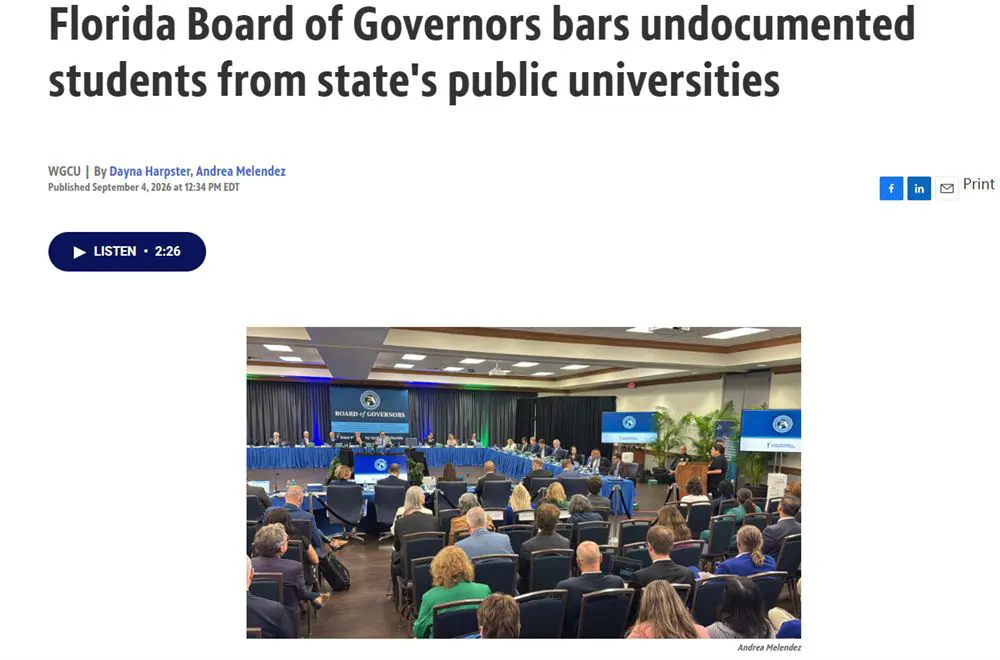
WorldWay Immigration notes that this change serves as another reminder for families planning U.S. education: beyond schools, majors, and grades, legal status can likewise impact a child's future educational and career options.

1. Florida Further Tightens
Admissions for Undocumented Students
This new regulation covers 12 public universities under the State University System of Florida, including the University of Florida (UF), Florida State University (FSU), Florida International University (FIU), University of Central Florida (UCF), University of South Florida (USF), and others.
According to the regulations, starting from the 2027—2028 academic year, if a state university did not admit all academically qualified applicants in the previous two academic years, that university will be prohibited from enrolling students who are unlawfully present in the United States.
For highly competitive institutions such as UF and FSU that reject a large number of qualified applicants each year, this regulation effectively means that it will be very difficult for undocumented students to gain admission to these Florida public universities in the future.
Moreover, this tightening is not an isolated event.
In June this year, the Florida State Board of Education passed regulations tightening admission requirements across its 28 public colleges, restricting the enrollment of undocumented students and extending the rule to GED and adult education programs.
Looking across the United States, Florida is not the first state to take such action.
Prior to this, three states had already implemented varying degrees of related restrictions:
· Alabama: Bars undocumented students from enrolling in public higher education institutions;
· South Carolina: Bars undocumented students from enrolling in public higher education institutions;
· Georgia: Restricts undocumented students from entering certain selective public universities.
With Florida joining, there are now four states that place varying restrictions on undocumented students attending public colleges and universities, with Florida being the most populous among them.
As seen from these changes, when pursuing education in the U.S., legal status is becoming a long-term factor that can increasingly less be ignored.
2. Children's Development in the U.S.
Legal Status Is an Unavoidable Hurdle
When families initially consider U.S. education, their focus is often on schools and majors.
However, after children actually arrive in the U.S., a more long-term question arises: What legal status will allow them to remain in the U.S. after graduating from college?
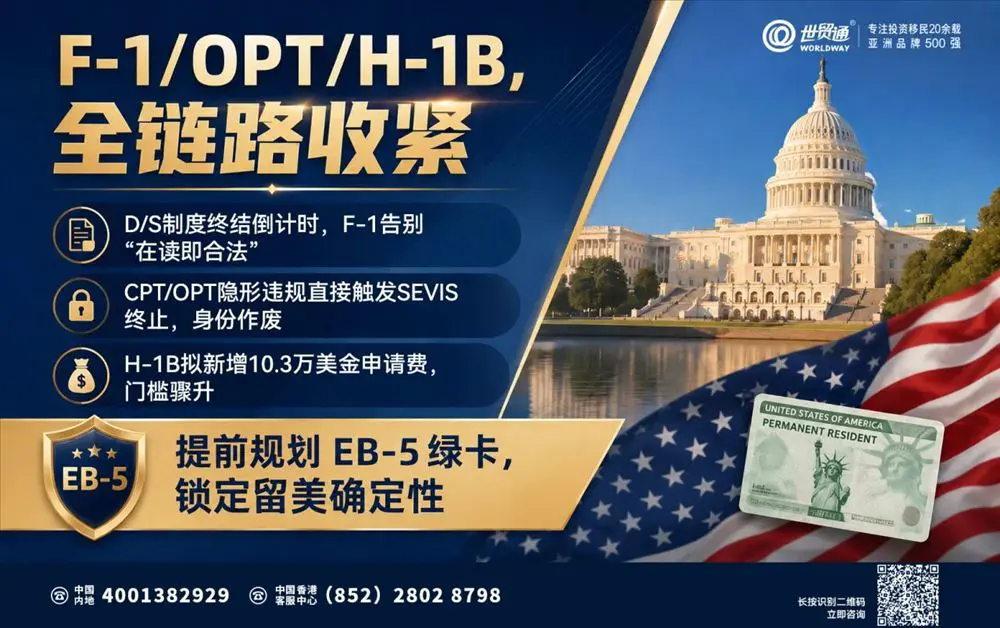
An F-1 student visa solves status issues during the study period, but it remains non-immigrant in nature. After graduation, if students wish to continue developing their careers in the U.S., they must face hurdle after hurdle, including OPT, work visas, and subsequent status adjustments.
A policy change at any of these stages could impact a child's next steps.
By contrast, if a family secures a more stable long-term legal status in advance, children will have far more flexibility and confidence in choosing schools, majors, jobs, and living arrangements in the future.
The true value of immigration status is not just solving the question of “whether one can stay,” but empowering children with more choices at critical milestones in life.
For families clear on their intention to have their children study and work in the U.S., or even settle the entire family long-term, education planning and immigration status planning should ideally be considered hand in hand.
3. Advance Planning for Legal Status
The EB-5 Window Remains Open
For this very reason, more and more families planning U.S. education are simultaneously turning their attention to EB-5 investment immigration.
Under current policy, eligible EB-5 investors can apply for U.S. permanent resident status together with their spouse and eligible unmarried children under 21.
For families seeking long-term development in the U.S. together, EB-5 provides not just a temporary study status for a child during a specific period, but a long-term status arrangement for the entire family.
Recognized as one of Asia's Top 500 Brands with over two decades of focus on immigration, WorldWay Group originated in Hong Kong in 1998 and has been deeply rooted in Hong Kong for over 20 years, establishing professional companies in both Hong Kong and Mainland China. Over the years, WorldWay has closely monitored changes in U.S. immigration and education policies, offering tailored status planning and project services to meet families' diverse needs for study abroad, legal status, and long-term development.

Currently, under the new law, the minimum investment amount for EB-5 remains at $800,000. Meanwhile, according to the latest Visa Bulletin, the three reserved visa categories—EB-5 Rural, High Unemployment Area, and Infrastructure—are all listed as “C” (Current) for applicants born in Mainland China, meaning there is currently no visa backlog, with the rural category also enjoying priority processing.
However, the current policy window is approaching a new threshold.
Under current law, starting January 1, 2027, the minimum EB-5 investment amount will increase to $900,000–$950,000 or higher. Meanwhile, September 30, 2026, serves as an important timeline node for the grandfathering clause of the EB-5 Regional Center Program.
For families who have decided to secure U.S. legal status through EB-5, project selection, financial planning, and application materials all need to be prepared in advance.
Currently, WorldWay focuses on promoting the I-956F approved “Deer Valley · Snow Ridge Residences” EB-5 rural project, as well as the “Marriott · Royal Lake Bay Resort” EB-5 project launched for the fifth time in partnership with Peachtree Group, offering more project choices for different families.
From now until September 30, 2026, applicants applying for EB-5 immigration can enjoy limited-time exclusive discounts, further lowering the application cost during the current window period.



For detailed inquiries in Mainland China: 400-138-2929; Hong Kong Customer Service Center: (852)2802 8798