





News about additional parental status checks for children applying for US passports has just drawn attention (for details, click to read WorldWay's report: Sudden Shift! New Draft Bill on US Birthright Citizenship Arrives), and new tightening signals have emerged regarding "giving birth in the US".
WorldWay Immigration noted that, according to a Newsweek report on September 3, US Homeland Security Secretary Markwayne Mullin stated in an interview with Fox News that the Department of Homeland Security is collaborating with the Department of Justice and the Department of Health and Human Services to study new restrictions on "giving birth in the US," including the possibility of restricting foreign travelers in their third trimester from entering the United States.

This regulatory effort targets what the US government refers to as "birth tourism"—where foreign nationals travel to the US primarily to give birth so their children acquire US citizenship—as well as potential issues of visa fraud and misrepresentation involved.
I. From Visa to Entry
Regulations on "Giving Birth in the US" Continue to Tighten
US restrictions on "birth tourism" are actually not new.
In 2020, the US Department of State revised B visitor visa rules. If consular officers have reason to believe that the applicant's primary purpose of visiting the US is to give birth to obtain US citizenship for the child, they may deny the Class B visa application on this basis.
The US Department of State also explicitly stated that "birth tourism," with the primary purpose of obtaining US citizenship for children, is not a permissible travel purpose under visitor visas.
On August 6 this year, Trump signed an executive order specifically targeting "birth tourism," directing relevant agencies such as the Department of State and the Department of Homeland Security to take further measures and establish corresponding rules and enforcement guidelines.
Now, regulatory focus is extending further into the actual border entry process.
If the new measures are ultimately implemented, even foreign travelers holding valid US visas may face stricter entry inquiries and screening upon arrival at US ports of entry if they are in their late pregnancy.
Just the day before, WorldWay Immigration also noted another change: the US Department of State is drafting a proposal regarding child passport screening, where parents' own citizenship or immigration status may be included in the review when applying for a US passport for a US-born child in the future.
Looking at these moves together, the trend becomes quite clear:
• When applying for a visa, checking the purpose of travel to the US;
• Upon arrival in the US, travelers in late pregnancy may face stricter entry screening in the future;
• When applying for a passport after the child's birth, parental status may also be subject to further verification.
From visas and entry to post-birth identity document processing, regulations surrounding "giving birth in the US" are covering an increasing number of stages.
II. Policies Still Under Study
But Variables Are Already Increasing
It should be noted that the new measures targeting travelers in late pregnancy are currently still under study, and the child passport screening is merely a draft proposal.
However, this does not obscure a trend becoming increasingly clear: relevant reviews are expanding from a single stage to multiple stages.
Previously, the primary consideration might have been whether a visa could be obtained; now, one may also need to navigate how the purpose of travel is evaluated at entry, whether further questioning will occur, and how identity documents will be processed after the child's birth.
In other words, although specific new rules have not been fully implemented, the variables that existing arrangements must face have already increased.
For families that already have plans for education, life, career, or long-term development in the US, this also means that residency and immigration status planning needs to be integrated into overall planning much earlier.

III. The More Changes Occur
The Earlier Long-Term Residency Should Be Planned
If a family has a clear long-term need to reside in the US, rather than basing overall arrangements on a rule subject to adjustment or a temporary status, planning a relatively clear long-term residency pathway in advance is far more beneficial for subsequent education, life, and career arrangements.
The EB-5 visa is one such option.
Targeting US permanent residency, an eligible principal applicant can include a spouse and qualifying children in the application, enabling long-term status planning from a holistic family perspective.
Currently, the September 2026 Visa Bulletin shows that under the EB-5 Reform and Integrity Act, all three reserved categories—Rural, High Unemployment, and Infrastructure—remain Current, meaning there is no visa backlog. Rural projects enjoy a 20% reserved visa quota as well as priority processing. For eligible applicants who are physically present in the US and maintaining lawful status, concurrent filing of the I-526E immigration petition and I-485 adjustment of status application is possible when there is no backlog.
Right now, EB-5 has entered a phase where application timing requires close attention. Starting January 1, 2027, the minimum EB-5 investment amount will increase from $800,000 to $900,000–$950,000 or higher. Meanwhile, the September 30, 2026 grandfather clause deadline is approaching. For families that have decided to plan US status via EB-5, project selection, capital preparation, and submission timing must all be arranged earlier.
As a Top 500 Asian Brand with over 20 years of dedication to immigration services, WorldWay Group started in Hong Kong in 1998 and has been rooted in Hong Kong for over two decades, establishing professional companies in both Hong Kong and the Chinese Mainland. Deeply engaged in the field of US immigration services for many years, WorldWay continuously tracks EB-5 policies, project approvals, and client application progress, accumulating mature experience in project screening and application services.

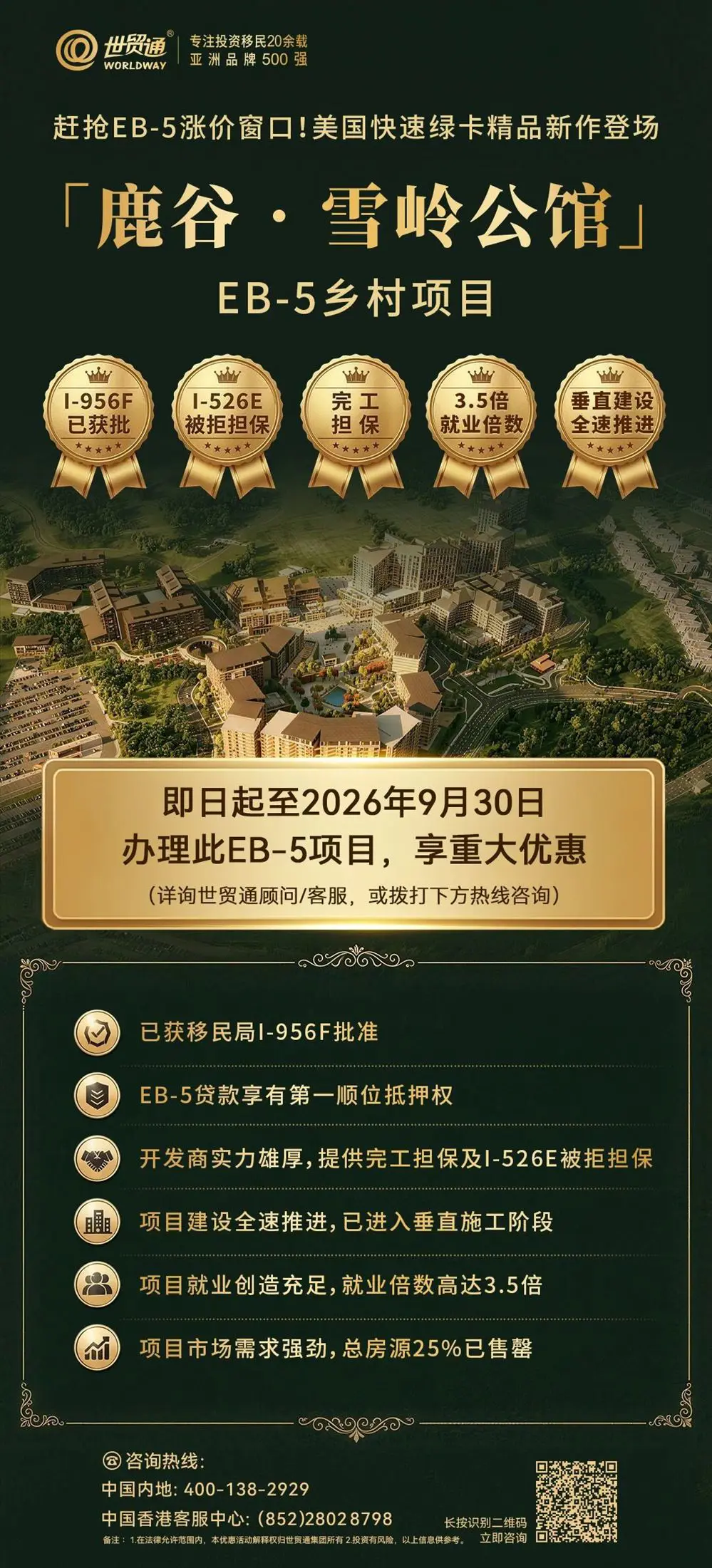
Currently, WorldWay focuses on promoting the I-956F-approved "Deer Valley · Residences at Snow Ridge" EB-5 rural project, as well as the "Marriott · Royal Lake Bay Resort" EB-5 project launched in its fifth partnership with Peachtree Group. These offer tailored choices addressing the status planning, application timing, and project preferences of different families. From now until September 30, 2026, applicants applying for EB-5 immigration can enjoy limited-time exclusive discounts, further reducing processing costs during the current window.
Policies continue to evolve. For families with clear long-term needs to reside in the US, allowing ample lead time for residency planning ensures greater flexibility and proactive control for the future.

For inquiries in Chinese Mainland: 400-138-2929; Hong Kong Customer Service Center: (852)2802 8798