





Recent consecutive changes in U.S. study abroad and immigration status policies are unsettling international students' internships, employment, and future plans.
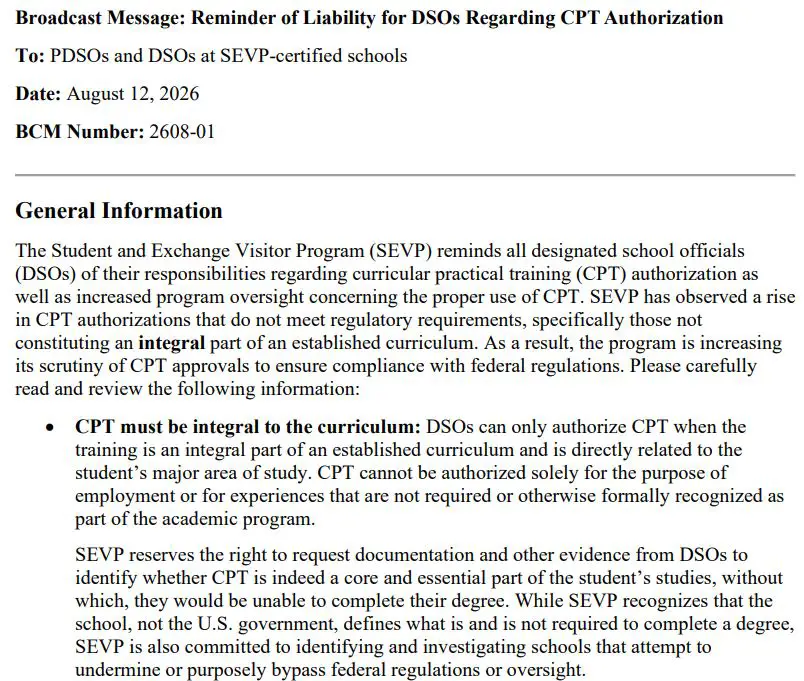
On August 12, 2026, local time, the U.S. Student and Exchange Visitor Program (SEVP) issued a new guidance notice to all Designated School Officials (DSOs) nationwide, emphasizing compliance requirements for CPT: CPT must be an integral part of an established curriculum and cannot serve merely as a vehicle for students to obtain off-campus employment.
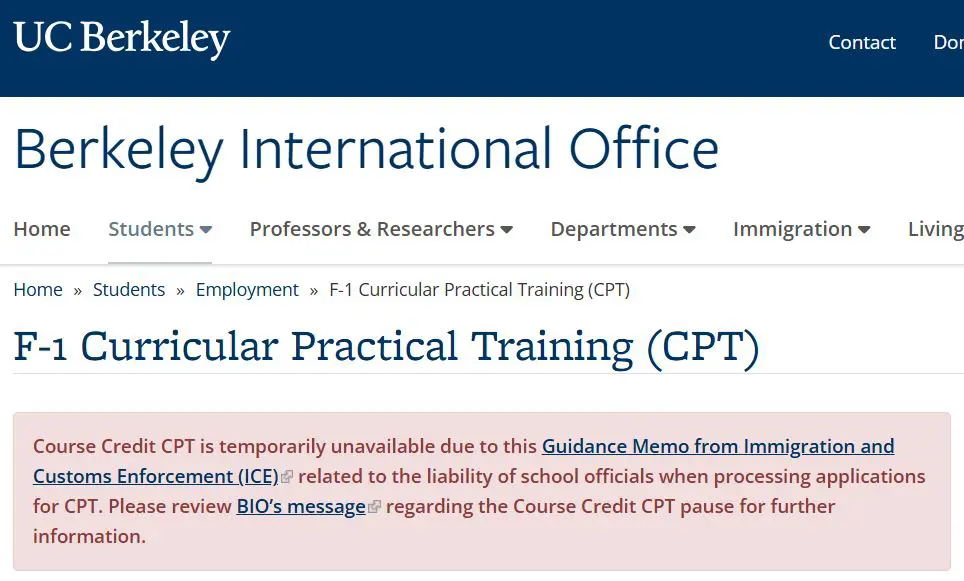
Following the announcement, the University of California, Berkeley, swiftly suspended Course Credit CPT. The University of California, San Diego, also announced a temporary halt to accepting and processing all F-1 CPT applications.

What is CPT? Why is Day 1 CPT taking the brunt of it?
CPT, short for Curricular Practical Training (Curricular Practical Training), is an authorization that allows F-1 students to engage in off-campus internships or practical work related to their major during their studies.
Unlike OPT, which is commonly used after graduation, CPT generally does not require a separate application submitted to USCIS. Instead, it is reviewed by the school's DSO and takes effect once authorized in the SEVIS system and an updated I-20 is issued.
Precisely because the process is relatively straightforward, some students in the past would secure an internship or job offer first, and then register for an "internship course" or "independent study course" to apply for CPT through that course.
Meanwhile, Day 1 CPT refers to certain graduate programs that allow students to apply for CPT right at the beginning of their enrollment, enabling them to study and work at the same time.
Consequently, some international students whose OPT is expiring and who have not yet transitioned to an H-1B visa also choose such programs to maintain their employment in the U.S. via CPT.
However, the underlying rationale of CPT should be: participating in practical training because the curriculum requires it.
If it becomes "enrolling in a CPT-providing program specifically to keep working," it easily deviates from CPT's intended purpose.
SEVP's intensified oversight this time is targeted precisely at the practice of treating CPT as a "work status substitute."
What Does the CPT "Braking" Mean for International Students?
1. Regular CPT applications may become more difficult
In the past, students could apply for CPT simply by registering for an internship course after securing a job offer. In the future, schools will focus more on whether the internship is genuinely required by the curriculum or degree program. The leeway to apply for CPT relying solely on an "internship course" is likely to shrink.
2. Day 1 CPT bears the brunt
Day 1 CPT has not been cancelled, but if a program does not genuinely require an internship and merely uses course structure to allow students to work full-time, proving its "academic necessity" will be much harder in the future. Compliance pressure is rising for "enrolling in a program offering CPT just to continue working."
3. University reviews will be more cautious
As DSOs bear greater compliance responsibility, universities may raise documentation requirements and prolong approval times. Therefore, students planning internships are advised to confirm policies in advance rather than waiting until right before their start date to apply for CPT.
4. Do not let your guard down even if CPT is already approved
CPT is usually tied to a specific employer, working hours, and authorization period. Any changes should be consulted with the DSO in advance. Additionally, note that accumulating 12 months or more of full-time CPT at the same educational level will result in losing OPT eligibility at that educational level.
Overall, this policy shift is not a cancellation of CPT, but a tightening of the leeway for "using CPT solely for employment." Students who are studying normally and participating in internships according to curriculum requirements need not panic; however, those heavily reliant on CPT—especially those using Day 1 CPT as a long-term employment buffer—do need to re-evaluate their upcoming plans.
From CPT to H-1B: The "Margin for Error" in Staying in the U.S. Is Shrinking
Looking at this change alone, CPT is what is affected.
However, for many Chinese students planning to stay in the U.S. long-term, it exposes a deeper issue:
If one's work arrangements are heavily dependent on a single temporary status, any rule change can disrupt the original plan.
A familiar path for many international students is: F-1 → CPT/OPT → H-1B → Green Card.
There is nothing wrong with this path, and it remains a normal trajectory for many students developing their careers in the U.S.
However, it has a distinct feature: every single step relies on a seamless transition from the previous one.
• CPT relies on school, curriculum, and DSO authorization;
• OPT has a strict time limit;
• H-1B is closely tied to employer sponsorship, eligibility qualifications, and subsequent career arrangements.
A disruption at any step can directly impact subsequent work and status arrangements. In particular, for those who hoped to "enroll in a Day 1 CPT program to continue working after OPT expires," this change underscores once again that basing long-term immigration planning on consecutive temporary status bridges is inherently vulnerable to policy shifts.
Don't Wait Until Immigration Status Hits a Dead End: Plan Early for Long-Term U.S. Residency
As the margin for error in temporary status pathways narrows, what truly needs to change is not just "how to apply for CPT next time," but the overall strategy for long-term U.S. planning.
For families with long-term needs to stay in the U.S., beyond the conventional pathway of F-1, OPT, and H-1B, U.S. permanent residency can be incorporated into the overall plan much earlier.
For example, the EB-5 Investment Immigration Program.
Unlike CPT or OPT, EB-5 directly targets U.S. permanent resident status—it does not rely on university approval for CPT, nor does it require a specific employer to sponsor an H-1B visa as a prerequisite.
Under current policy, the minimum investment amount for eligible TEA projects remains $800,000, and the primary applicant's spouse and eligible unmarried children under 21 can apply together.
This investment threshold will not remain unchanged indefinitely. The EB-5 investment amount will undergo a new round of inflation adjustment on January 1, 2027, with expectations that it may rise to $900,000–$950,000 or higher.
Therefore, for families who already have long-term U.S. status plans, what requires attention right now is not merely whether CPT can still be used, but more importantly, whether an independent pathway can be established proactively while window of opportunity remains.
Currently, WorldWay offers two prime EB-5 projects with approved I-956F status: "Deer Valley · Snowridge Residences" and "Marriott · Lakeview Bay Resort," the fifth collaboration between WorldWay and Peachtree Group, providing families seeking U.S. residency planning with more high-quality options. From now until August 31, 2026, applying for EB-5 immigration through WorldWay also enjoys a limited-time exclusive promotion.
For families with a clear long-term goal of living in the U.S., rather than hastily searching for another path after an immigration step gets stuck, it is far better to consider education, employment, and long-term status holistically at an earlier stage.
The earlier status planning begins, the more options will be available when facing policy changes in the future.


For detailed inquiries, Mainland China: 400-138-2929; Hong Kong, China Customer Service Center: (852)2802 8798