



U.S. H-1B and L-1 employment costs are facing another new change.
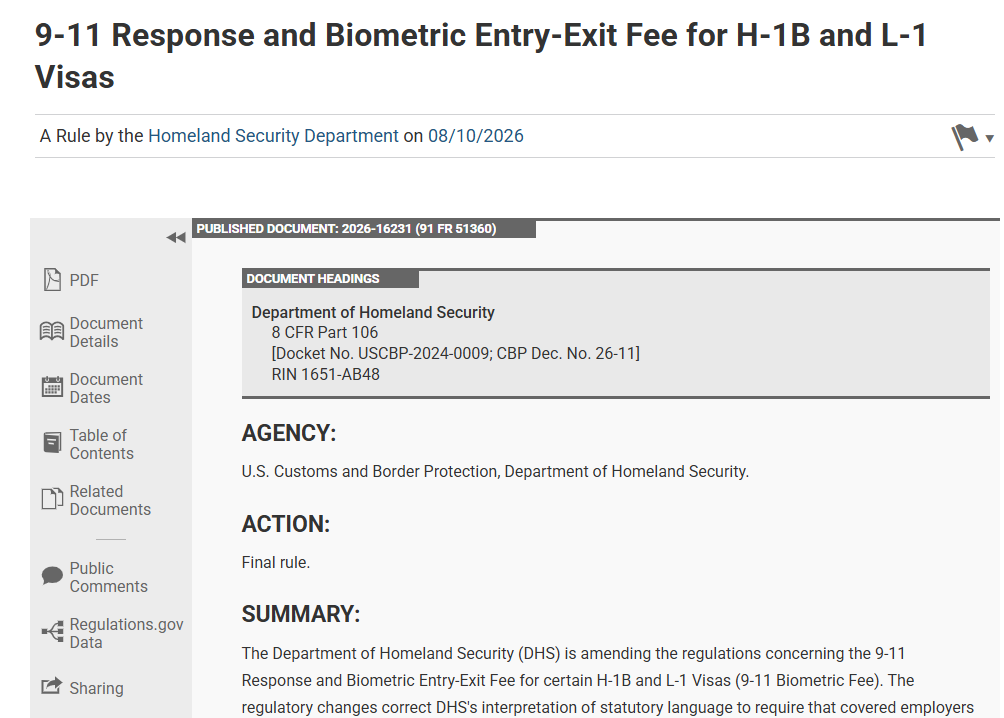
On August 10, 2026 local time, the U.S. Department of Homeland Security (DHS) officially published a final rule in the Federal Register, expanding the scope of the "9-11 Response and Biometric Entry-Exit Fee".
The new rule will officially take effect on September 9, 2026.
At that time, qualifying U.S. employers will be required to pay this additional fee even if they are merely applying for an H-1B or L-1 status extension for the same employee:
H-1B: $4,000
L-1: $4,500
This means that a fee adjustment proposed back in 2024 has now completed the proposal phase and is officially implemented.

From New Petitions to Extensions: Fee Scope Further Expanded
This fee is not newly established.
In 2015, the U.S. Congress established the "9-11 Response and Biometric Entry-Exit Fee," primarily to support the construction of the U.S. biometric entry-exit system. Under previous implementation practice, qualifying employers paid this fee mainly when applying for an employee's initial H-1B/L-1 status or petitions involving a change of employer.
However, when the same employer applied for a simple status extension for the same employee, this surcharge was usually not required in the past. This is precisely the key change introduced by the new rule.
DHS explicitly stated that once the new rule takes effect, as long as an employer falls within the covered scope, all petitions involving H-1B or L-1 status extensions will be included in the fee scope, regardless of whether there is a change of employer.
In other words, even if an H-1B employee does not change jobs and their position remains unchanged, simply having the original employer apply for a status extension may trigger an additional fee of $4,000. The same applies to L-1.
From now on, foreign employees will incur significant additional costs throughout their entire lifecycle—from initial employment visa petitions and job transfers to long-term status extensions in the U.S.
Which Companies Must Pay? Meeting Two Thresholds Simultaneously
It should be noted that this new rule does not apply to all U.S. businesses employing H-1B or L-1 workers.
According to the final rule, only employers meeting both of the following conditions fall within the scope of this surcharge:
First, employing 50 or more employees in the United States;
Second, H-1B, L-1A, and L-1B status employees combined account for more than 50% of the company's total workforce in the United States.
Employers meeting the above conditions must pay $4,000 when submitting relevant petitions for H-1B employees and $4,500 for L-1 employees.
If submitting only an amended petition without simultaneously requesting an extension of the employee's current H-1B or L-1 status, this fee is not required.
What Does This Mean for H-1B and L-1 Holders?
Legally speaking, this fee is levied on employer petitioners, not directly on individual H-1B or L-1 employees.
However, in the long run, for qualifying employers, every extension adds thousands of dollars in extra costs, further increasing cost considerations when hiring, renewing, and retaining foreign talent long-term.
For affected employees, whether their status can be maintained depends not only on personal circumstances, but is also closely tied to employer workforce arrangements, renewal intentions, and policy changes.
For those relying on temporary work status to remain in the U.S. over the long term, status uncertainty objectively remains.
Increasing Variables in Temporary Status Make Long-Term Immigration Planning More Crucial
H-1B and L-1 are essentially non-immigrant work statuses. For those working in the U.S. temporarily, they remain important pathways; however, if the ultimate goal is clear—to live and develop long-term in the U.S.—the focus of status planning can no longer rely solely on repeated renewals.
Especially for those whose children plan to study in the U.S., who wish to work long-term in the U.S., or whose entire family has defined a U.S. development trajectory, planning temporary work status separately from long-term permanent status as early as possible will minimize exposure to employer changes, renewal costs, and policy adjustments.
For example, EB-5 investment immigration is inherently an immigration category aimed at obtaining U.S. permanent residency, currently starting at an investment of $800,000, where one person applies and the whole family receives green cards.
According to the latest U.S. Department of State Visa Bulletin, rural reserved visa category projects under the new EB-5 law currently remain in a no-retrogression status. Applicants residing legally in the U.S. can concurrently file I-526E and I-485 adjustment of status applications when there is no backlog.
From the H-1B lottery and employer ties to now requiring certain companies to bear thousands of dollars in extra costs even for extending the same employee, the U.S. temporary work status system is constantly facing new variables.
For families with clear long-term goals in the U.S., establishing a more stable and sustainable long-term status pathway early on is far more important than repeatedly reacting to the next policy change.
It is worth noting that now is an important window for planning EB-5. Starting January 1, 2027, the minimum EB-5 investment amount is expected to rise from the current $800,000 to $900,000–$950,000 or higher, meaning the current investment threshold countdown is underway.
WorldWay features two major EB-5 projects with approved I-956F petitions: 「Deer Valley·Snowridge Mansions」 and 「Marriott·Royal Lake Bay Resort」, a fifth collaboration between WorldWay and Peachtree Group, helping investor families seize the current policy window and advance U.S. residency planning more efficiently.
From now until August 31, 2026, applicants applying for EB-5 immigration can also enjoy limited-time exclusive offers from WorldWay. Families interested in planning U.S. residency can take advantage of this dual policy and promotional window to lock in quota spots and launch their applications in a timely manner.


For details, please inquire in Mainland China: 400-138-2929, Hong Kong Customer Service Center: (852)2802 8798