





On August 6, local time, U.S. President Donald Trump signed two executive orders, one aimed at further restricting birthright citizenship policies, and the other focusing on cracking down on commercialized “birth tourism.”
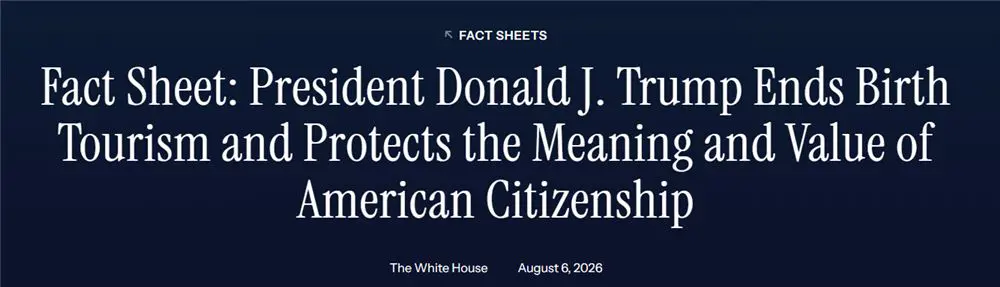
This marks another push by the White House to tighten relevant policies following the U.S. Supreme Court's previous rejection of Trump's broader plan to restrict birthright citizenship, drawing widespread external attention.
I. Further Restricting the Scope of Application for Birthright Citizenship
According to the new executive order, if neither parent is a U.S. citizen and certain specific conditions are met, the federal government will no longer issue or recognize proof of U.S. citizenship for the relevant individuals born in the United States.
The circumstances involved mainly include: one parent is determined to be a “hostile alien,” including members of designated foreign terrorist organizations or Specially Designated Global Terrorists; one parent is an employee of a foreign government, including diplomats, embassy or consulate staff, individuals employed by a foreign government in an official capacity, and employees of international organizations with immunity. Additionally, children born in the United States and U.S. territories through commercial transactions or surrogacy arrangements are also excluded from the scope of birthright citizenship recognized by federal agencies. Furthermore, if a child is born in a U.S. territory or territorial sea where federal law does not grant citizenship to persons born in that area, birthright citizenship likewise does not apply.
The U.S. Department of State, Department of Justice, Department of Homeland Security, and Social Security Administration are responsible for implementing the executive order, and all federal executive departments must issue accompanying implementation guidelines within 30 days.
On June 30 this year, the U.S. Supreme Court rejected Trump's previous executive order that more broadly restricted birthright citizenship for children of non-citizens. Therefore, how this new executive order will be implemented in the future and whether it will face judicial challenges again remains worthy of attention.
WorldWay will also continue to track relevant policy changes and share the latest updates with everyone as soon as possible.

II. “Giving Birth in the U.S.” Becomes a Key Target of Crackdown
Trump stated that the birthright citizenship system has long been abused and that “birth tourism” has developed into a business. He claimed that “hundreds of thousands of people” each year may obtain U.S. citizenship for their children through such methods.
This new executive order also lists commercialized “giving birth in the U.S.” as a key target of the crackdown,
According to the executive order, the U.S. government will step up crackdowns on foreigners entering the U.S. on non-immigrant visas with the primary purpose of giving birth in the U.S. The U.S. Department of State and the Department of Homeland Security may take measures such as visa refusal, visa revocation, entry refusal, deportation, and even permanent entry bans in accordance with relevant regulations. Not only that, individuals and agencies that organize, assist, or provide relevant “giving birth in the U.S.” services for foreigners may also face investigation and law enforcement actions.
This means that in the future, the U.S. is likely to conduct stricter reviews of visa applicants' purpose of travel to the U.S., reasons for entry, and related commercial arrangements.
III. Immigration Policies Continue to Evolve
Advance Planning Becomes More Crucial
From birthright citizenship to stricter supervision of “giving birth in the U.S.,” it can be seen that U.S. scrutiny of status acquisition methods is being further strengthened.
As birthright citizenship and “giving birth in the U.S.” policies continue to tighten, the previous mindset of some families relying on a child's birth to resolve future status issues is facing growing policy and legal uncertainties. For families with long-term plans to go to the U.S., the importance of planning a stable and compliant U.S. status in advance from a holistic family perspective is rising further.
Among existing U.S. immigration pathways, EB-5 Investment Immigration offers eligible families an option to apply for a U.S. Green Card. One person applies, and the whole family receives Green Cards, without relying on school admissions, lottery results, or specific employer sponsorships. Currently, rural EB-5 projects offer the advantages of no visa backlog and priority processing. The “concurrent filing” policy allows applicants who are legally present in the U.S. with no visa backlog to concurrently file Form I-526E and I-485, while applying for work authorization and advance parole travel documents.
For those whose children plan to study or work in the U.S. in the future, or for families with long-term needs to live in the U.S., securing immigration status in advance also means having more choices in future education, employment, and living arrangements.
Currently, the minimum EB-5 investment amount remains $800,000, and starting January 1, 2027, the investment threshold will be adjusted, with the minimum investment amount expected to rise to $900,000–$950,000 or even higher. For families with clear U.S. status planning needs, now is an important window worthy of grasping.
Currently, WorldWay holds two high-quality EB-5 projects: 「Deer Valley · Snow Ridge Residences」 and 「Marriott · Royal Lake Bay Resort」, providing more options for investing families with different needs.
To help investing families better grasp the current window, WorldWay is launching a major promotional offer: from now until August 31, clients applying for EB-5 immigration can enjoy a limited-time exclusive discount to advance their U.S. status planning at a better cost.
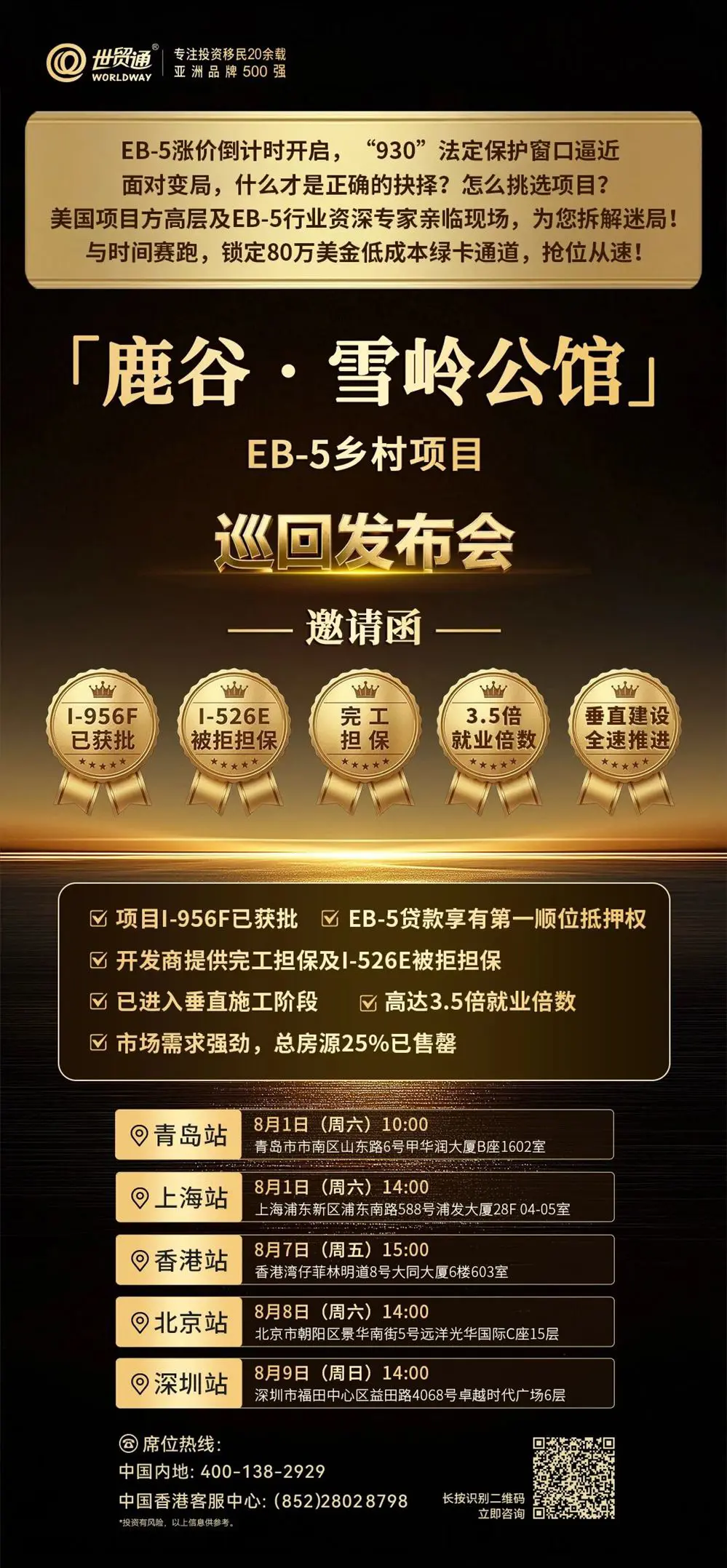

Inquiries - Mainland China: 400-138-2929, Hong Kong, China Customer Service Center: (852)2802 8798