New layoffs reported in the U.S. tech industry.
According to a Reuters report on July 22, local time, Amazon is laying off staff in some teams within its Artificial General Intelligence (AGI) organization. Amazon has not yet disclosed the specific number of employees affected by this round of layoffs, but has confirmed that this personnel adjustment is related to the company's refocusing on key AI projects.
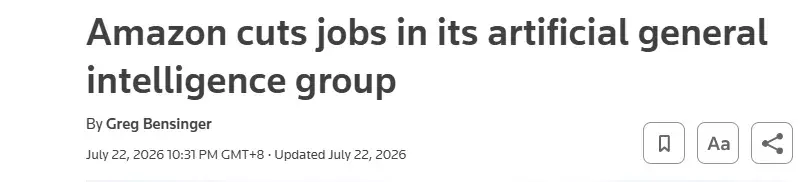
This AGI department layoff is also part of Amazon's ongoing organizational streamlining. In January 2026, Amazon announced the elimination of approximately 16,000 corporate roles; combined with the reduction plan of about 14,000 roles initiated in October 2025, Amazon plans to cut approximately 30,000 corporate positions within a few months, equivalent to nearly 10% of its corporate workforce.
From general business units to highly anticipated AI teams, internal personnel adjustments at major tech firms are continuously expanding. Even entering a popular track or a core department no longer guarantees long-term job stability.

For foreign employees, layoffs affect more than just their jobs
For U.S. citizens and green card holders, layoffs primarily mean an interruption in income and disruption to career planning.
However, for foreign employees who rely on statuses such as OPT or H-1B to work in the U.S., losing a job may simultaneously trigger an immigration status crisis.
F-1 students are subject to unemployment day limits during their OPT; H-1B holders typically have a limited grace period after their employment relationship terminates, requiring them to find a new employer, change status, file a new application, or arrange for departure as soon as possible.
In other words, the same layoff notice has completely different consequences for people with different statuses.
Green card holders can adjust their status, look for their next job, or even take a temporary break; while employees who rely on an employer to maintain their status may enter a countdown for their legal stay from the very day they become unemployed.
Especially for international students who have just graduated or just started their jobs, their professional foundation and network resources have not yet been fully established. Once suddenly laid off, they often have to face the pressures of job hunting, visas, and residency simultaneously.

Big tech platforms cannot replace long-term status planning
In the past, international students and highly educated professionals viewed joining big tech companies as an important step toward staying in the U.S.
However, reality is proving that entering a big tech company and securing a high-paying job can only solve short-term employment issues and cannot fundamentally eliminate status risks.
When an individual's legal right to work and residency status are highly dependent on a single employer, a company reorganization, a project cancellation, or a change in management can directly affect their long-term arrangements in the U.S.
Therefore, for families planning to stay in the U.S. long-term, status planning should not wait until the OPT is about to expire, the H-1B has failed to be selected multiple times, or a layoff has already occurred.
The truly secure approach is to evaluate status pathways that do not rely entirely on a single employer while one's career development is relatively stable, thereby retaining more initiative for the future.

Proactively lay out independent status pathways to reduce employer dependence
Against the backdrop of increasing uncertainty regarding OPT, H-1B, and employer sponsorship, EB-5 is becoming an important choice for more families to plan their U.S. status in advance.
Unlike the traditional path of "study first, work later, then enter the lottery," EB-5 helps applicants gradually reduce their reliance on lotteries, single employers, and specific positions through compliant investment and job creation.
For students planning to go to the U.S. or currently studying in the U.S., planning for EB-5 in advance can reserve more space for future education, employment, and long-term stay in the U.S.; for professionals working on H-1B, it can also reduce the status risks brought about by layoffs, job changes, and company reorganizations.
Under the new EB-5 law, advantages such as reserved visa categories, the "concurrent filing" mechanism, and priority processing for rural projects have further enhanced the appeal of this status pathway.
It is worth noting that the protection period for the "grandfather clause" under the new EB-5 law will expire on September 30, 2026. Meanwhile, starting January 1, 2027, the investment threshold will increase from $800,000 to approximately $900,000-$950,000.
For families with long-term plans to stay in the U.S., evaluating and preparing as early as possible is more conducive to seizing the current policy window.

Only with stable status can you have true career choice
Layoffs cannot be completely avoided, and corporate strategies can change at any time.
However, when an individual has a relatively independent status pathway, they have the opportunity to calmly look for their next job, change industries, start a business, or rearrange family plans when facing job adjustments, without having to fall into a status crisis immediately due to the loss of employer support.
The layoffs in Amazon's AGI team serve as another reminder to all international students and professionals in the U.S.:
A popular industry does not equal a stable position, and a big tech platform does not equal long-term status security.
Your job determines your current development, while your status determines how many choices you have in the future.
The more frequent the layoffs and the faster the employment environment changes, the more you need to examine your status structure in advance to leave more room for adjustment in your career and family planning.
WorldWay holds two high-quality EB-5 projects, "Deer Valley · Ridge Mansion" and "Marriott · Royal Lake Resort," to help investors quickly realize their U.S. status planning.