





Are you well-qualified, only to be turned away due to a new regulation? This regret regarding a U.S. Green Card may become a reality in the future.
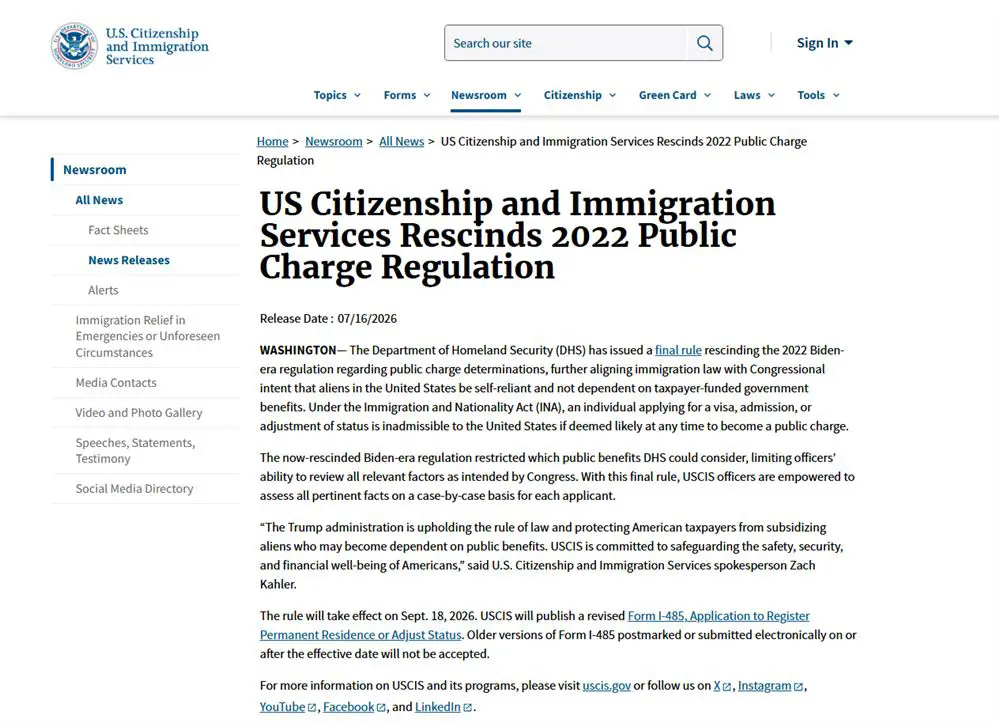
On July 16, 2026, the U.S. Citizenship and Immigration Services (USCIS) issued a major announcement: The Department of Homeland Security has finalized the rule to rescind the 2022 "public charge" regulation. This rule is expected to take effect on September 18, 2026.
This means:When applying for a Green Card in the future, USCIS will have greater discretionary authority in "public charge" reviews, no longer limited to the few benefit programs previously explicitly listed. For every family planning for U.S. status, this serves as both a "policy alarm" and a critical moment to re-examine their immigration path.
I. Three Key Changes to the New Public Charge Rule
1. Review Framework: From "Limited List" back to "Totality of Circumstances"
Under the 2022 rule, USCIS primarily focused on cash income assistance and long-term institutional care funded by the government, while most non-cash benefits (such as SNAP, Medicaid, and housing assistance) were generally not included in the assessment.
Once the new rule takes effect, these benefit records may become a factor in the overall assessment, though receiving benefits alone will not automatically lead to a denial of the application.
2. Scope of Review: More Comprehensive and Case-Specific
The new rule removes the limitations on factors to be considered under the 2022 rule, allowing immigration officers to once again consider the totality of circumstances:
• Age, health status, and family size
• Assets, resources, and overall financial status
• Educational background and professional skills
• Receipt of means-tested benefits
• Whether the I-864 Affidavit of Support is sufficient, etc.
The review will place greater emphasis on the applicant's overall economic capacity and future self-sufficiency.
3. Timeline: Synchronized Update of I-485 Version
The new rule takes effect on September 18, 2026, and USCIS will simultaneously implement the new version of Form I-485.
• Old versions of Form I-485 received before the effective date will still be adjudicated under the 2022 rule;
• Applications submitted on or after the effective date must use the new version of the form, otherwise they will be rejected or not accepted.
In short: the rules have changed, the forms have changed, and the review logic has become "stricter."
II. What Does This Mean for Ordinary Immigration Applicants?
The public charge provision applies to the vast majority of applicants for visas, admission, or adjustment of status, including family-based and employment-based categories for I-485 adjustment of status within the U.S.
The following types of families should pay special attention in the future:
• Those with complex financial situations: unstable income, primary reliance on family support, or complex savings and asset structures;
• Those with a record of benefits: having received or currently receiving means-tested benefits such as Medicaid, SNAP, or housing subsidies;
• Those with weak documentation: lack of a complete chain of evidence for income, assets, and family situation, making them prone to Requests for Evidence (RFE) or even heightened scrutiny.
Against the backdrop of increased USCIS discretionary authority, both "explanation costs" and "uncertainty" are on the rise.
III. EB-5: A "Definitive Choice" in a Tightening Environment
EB-5 investment immigration applicants are also subject to the public charge provision, and I-485 applications are not automatically exempted simply because they belong to an investment category. However, from the perspective of actual review logic, EB-5 families naturally possess several advantages:
1. Stronger Assets and Financial Capacity
EB-5 applicants must prove the lawful source of investment funds of $800,000 or more and possess corresponding asset and income capabilities, which is highly consistent with the "proof of economic self-sufficiency" required in public charge reviews.
2. Clear Educational and Professional Backgrounds
Most EB-5 applicants have stable careers, business backgrounds, or high academic qualifications, making it easier to prove that they will not rely on public benefits in the United States.
3. Project and Job Creation Endorsement
The EB-5 program itself requires the creation of at least 10 full-time jobs. This "investment + employment" model naturally weakens any skepticism regarding the "potential to become a public charge in the future."
Therefore, for families with the financial means, EB-5 in the current policy environment is not only a path to a Green Card but also an identity strategy to hedge against the uncertainty of reviews.
IV. Overlapping Dual Windows
9·30 Grandfather Clause & 2027 Investment Threshold Increase
The new public charge rule is just one of the "tightening signals." EB-5 itself is also in a policy dividend window, with two key time points approaching:
• September 30, 2026: Deadline for the Grandfather Clause
According to the EB-5 Reform and Integrity Act, investors who file their I-526E applications before September 30, 2026, will be protected by the "grandfather clause"—even if the Regional Center authorization changes in the future, USCIS must continue to adjudicate the filed applications. Submitting after this date will result in the loss of this layer of legal protection.
• January 1, 2027: Expected Increase in Investment Amount
The minimum EB-5 investment amount is automatically adjusted for inflation every five years. It is expected that starting January 1, 2027, the investment threshold for TEA projects will be raised from $800,000 to approximately $900,000–$950,000. In other words, the current $800,000 window may have less than half a year remaining.

For families with the conditions to choose EB-5, now is not the time to "wait and see," but rather to complete the assessment, select a project, and file the I-526E application as soon as possible to truly lock in their status and policy dividends.
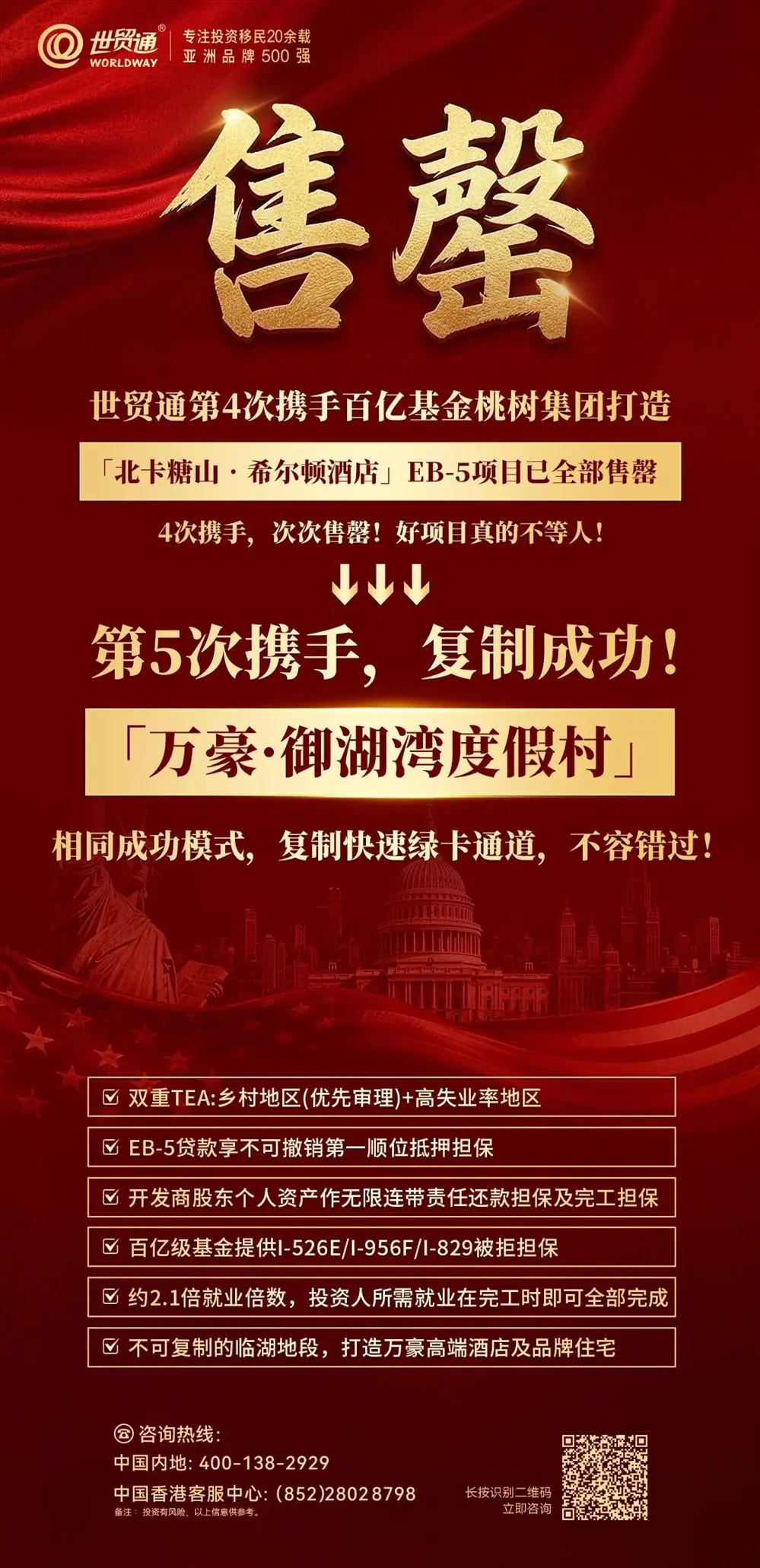
Currently, WorldWay, in its 5th collaboration with the multi-billion dollar PeachTree Group, has created the "Marriott·Royal Lake Bay Resort" EB-5 project, a masterpiece of successful experience inheritance, which can provide more stable choices for applicant families.

For detailed inquiries in Mainland China: 400-138-2929, Hong Kong Customer Service Center: (852)2802 8798