





On July 17, 2026, the U.S. Department of Homeland Security (DHS) officially released a final rule that has sent shockwaves through the global international student community, as published in the Federal Register: The "Duration of Status" (D/S) system for international students, which has been in use for nearly half a century, has been officially terminated. The new rule is expected to take effect on September 15, 2026.
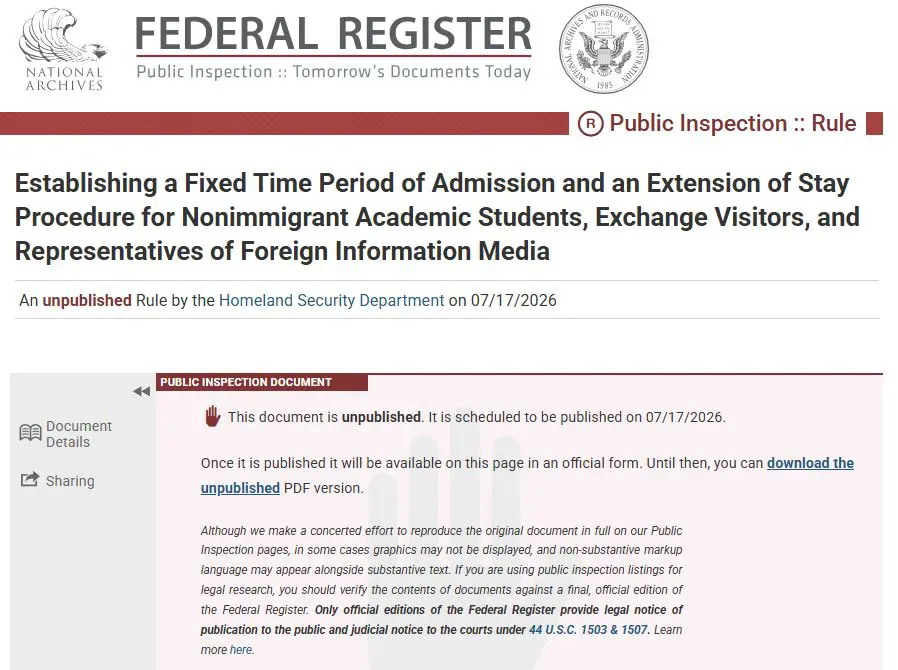
This means that after September 15, 2026, all foreign nationals holding F student visas, J exchange visitor visas, and I media visas will have a fixed, explicit time limit set for their legal stay in the United States for the first time. Once the authorized period of stay expires without departure or the completion of extension procedures, it will constitute unlawful presence, resulting in a record of entry restrictions. Chinese nationals are facing some of the most stringent restrictions under this reform.
Impact of the D/S System Termination: Saying Goodbye to "Status as Long as You Are Enrolled"
Since the implementation of D/S for F visas in 1978 and its adoption for J and I visas in 1985, the I-94 forms for holders of these three visa categories have only been marked with "D/S," with no fixed departure date.
In the past, the "D/S" marked on the I-94 of F-1 students meant that "as long as you are studying, you can remain legally." You could complete a bachelor's degree, move on to a master's, change majors, switch schools, or extend your studies—all without needing to apply for an extension with the immigration authorities.
Now, all of this has come to an end.
Key changes in the new rule include:
• Fixed period of stay up to 4 years: The I-94 expiration date will be based on the program end date on the I-20 or DS-2019, not to exceed four years. Doctoral programs requiring five to seven years? You must proactively submit an I-539 extension application to USCIS before the expiration date.
• Grace period cut from 60 days to 30 days: The buffer time after graduation is directly halved.
• Graduate students may not change educational objectives or transfer schools at will.
• Finished one master's degree and want to pursue a second? This path is essentially blocked.
• English language training programs are limited to 24 months.
• Extensions require separate application and fees to USCIS: This adds administrative burdens, extra costs, and long wait times.
"Special Treatment" for Chinese Nationals: I Visas Limited to 90 Days
The new rule includes a provision specifically targeting Chinese citizens. Generally, foreign I-category journalist visa holders can stay for up to 240 days, while Chinese applicants are limited to only 90 days. DHS implemented this differential restriction citing the "principle of reciprocity."
Although the population affected by I visas is limited, the policy signal sent by this provision is alarming: in the current climate, Chinese nationals are facing an increasing number of targeted restrictions within the U.S. immigration system.
Who will be affected?
Every Chinese international student family!
If you are an international student currently studying in the U.S.: The new rule includes transitional provisions—you do not need to apply for a new I-94 expiration date immediately. However, you must still apply for an extension before the program end date on your I-20 or four years from the effective date (whichever comes first).
If you are a prospective student planning to study in the U.S.: New entrants will be directly assigned a fixed I-94 expiration date. Doctoral students with programs exceeding four years must plan for extensions in advance.
If you want to pursue a master's degree after completing your bachelor's: The transition at each stage must be completed within the fixed-term framework and must be an "upgrade" to a higher educational level.
Even if you apply for OPT and STEM OPT: Although the program itself has not been cancelled, in some cases you may need to apply for a status extension while on OPT, significantly increasing the complexity of the process.

Why is DHS doing this?
DHS stated clearly: In 2024, there were over 1.8 million student visa entry records, an increase of over 11% from the previous year. The surge in visitor numbers "posed challenges to DHS's ability to monitor and manage these non-immigrant individuals within its borders."
Furthermore, under the D/S system, it is difficult for the government to track those who overstay—because there is no clear "expiration date" to refer to.
WorldWay Urgent Reminder:
Now is the time to act
This reform is not a simple administrative procedure adjustment—it fundamentally changes the way Chinese families have planned their U.S. educational paths for decades.
In the past, the mindset of "get admitted, go, and figure it out later" was feasible under the D/S system. But under the fixed-term system, every transition between educational stages—bachelor's to master's, changing majors, extending studies, internship and employment—must be calculated with precise timing. Any delay or error in any link could lead to loss of status, unlawful presence, or even a 3-year or 10-year entry ban.
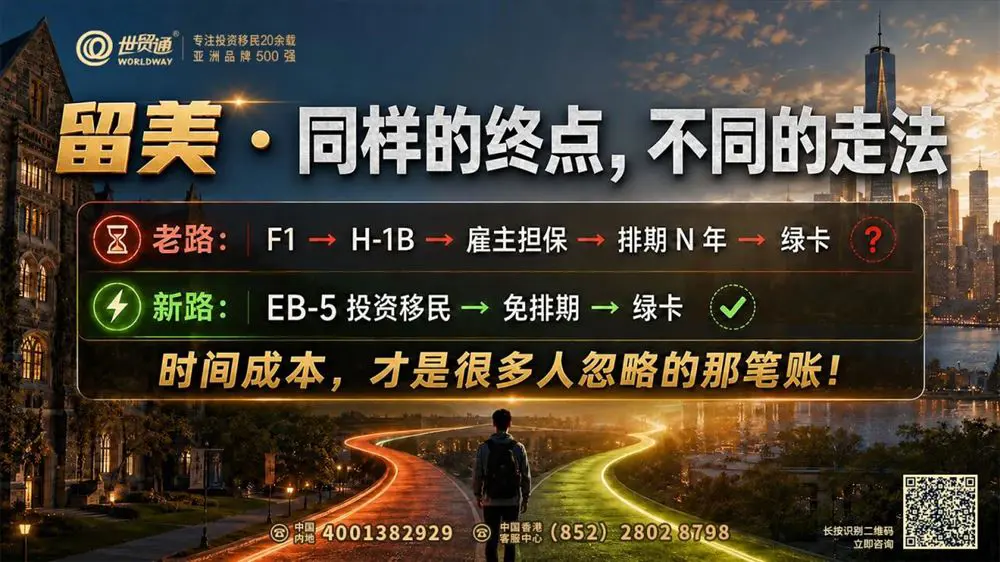
Facing this "status storm," more and more international student families are turning their attention to EB-5 investment immigration—a certain path that does not rely on schools, employers, or H-1B lotteries.
• No-backlog dividend: The reserved visa channel is currently still in a "no-backlog" golden window, which is a countdown dividend left for Chinese applicants after the legislative reform!
• Concurrent filing advantage: International students in the U.S. with legal entry status can simultaneously file I-526E and I-485 to quickly obtain legal status, completely breaking free from the various shackles of F-1 status.
• One investment, green card for the whole family: Allow for synchronized planning of children's education and family status.
In addition, it should be noted that the "grandfather clause" in the new EB-5 law will reach a critical time point on September 30, 2026. On January 1, 2027, the minimum investment amount will increase from $800,000 to $900,000-$937,500 or even higher.
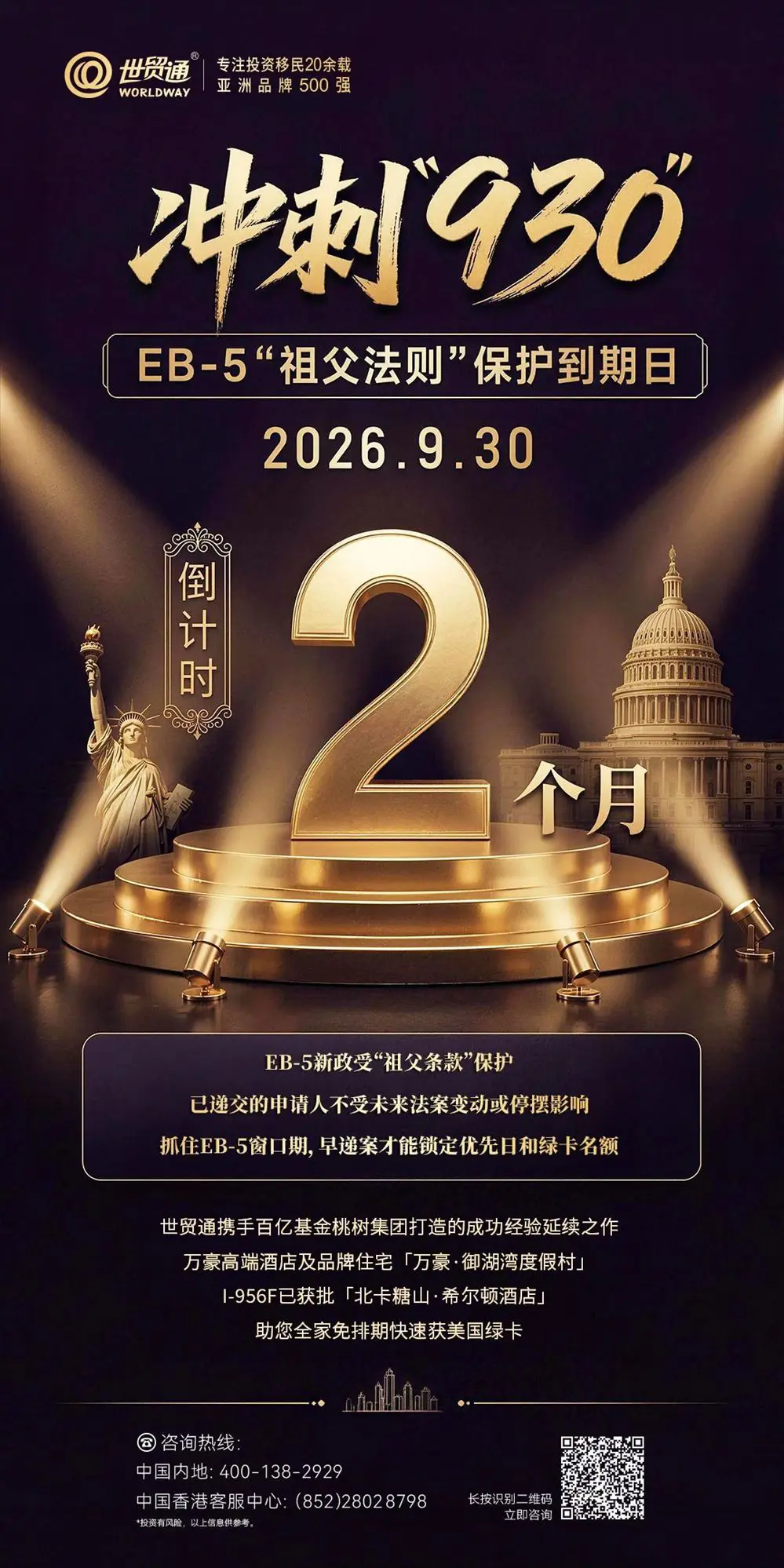
The new rule is expected to take effect on September 15, and the EB-5 grandfather clause expires on September 30—the overlap of these two critical time points creates an unprecedentedly urgent window. For international students currently studying in the U.S., families planning their U.S. paths, and parents hoping to secure U.S. status for their children, the question is no longer "should we do it," but "can we still make it in time."
Do not wait until the status "countdown" ends to start worrying. Contact WorldWay immediately to obtain an exclusive assessment plan for the new EB-5 policy and lock in the protection window of the "grandfather clause" before September 30!
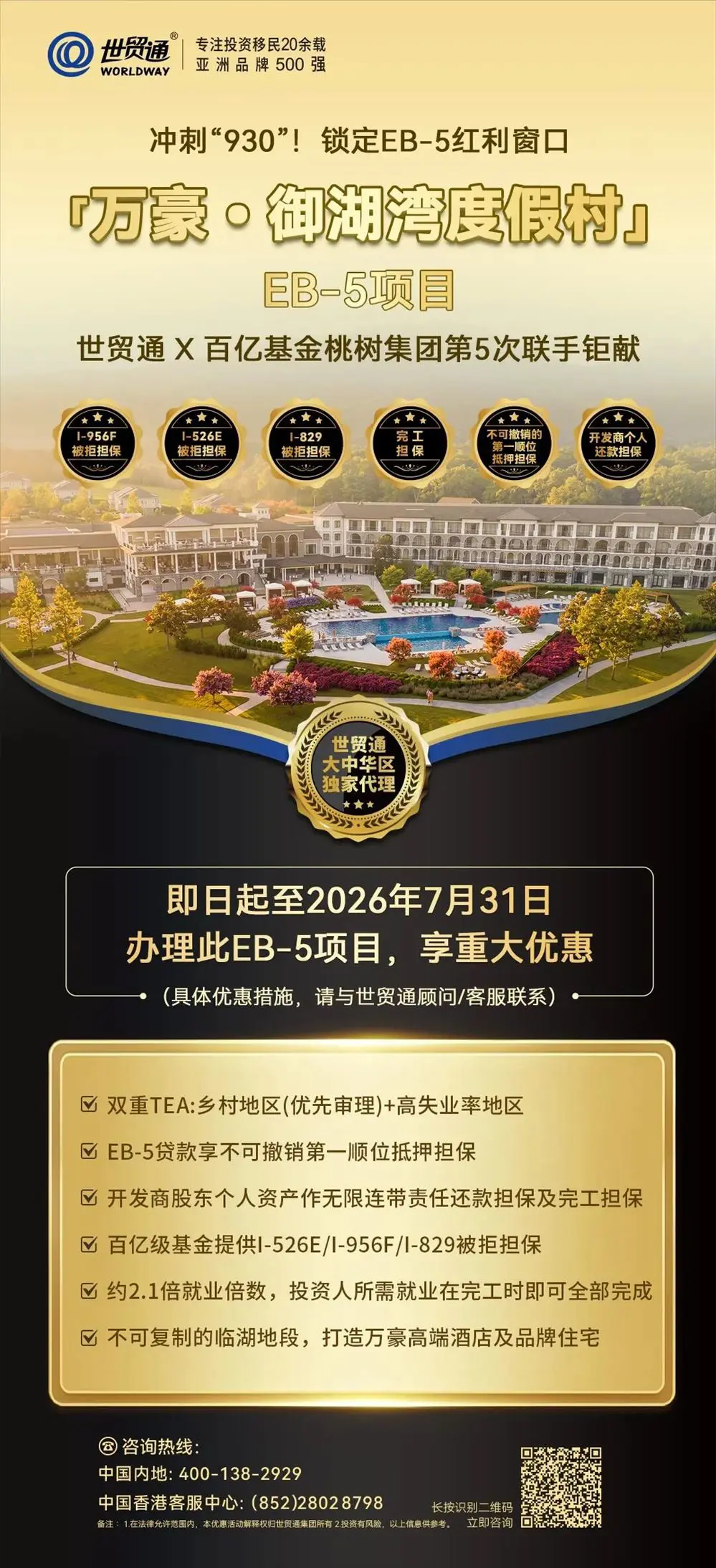
Currently, WorldWay is partnering for the 5th time with the multi-billion dollar PeachTree Group to offer the successful legacy project "Marriott · Imperial Lake Resort" EB-5 project, which can provide more stable options for applicant families.
For inquiries in Mainland China: 400-138-2929, Hong Kong Customer Service Center: (852)2802 8798