





Recently, the U.S. Department of Labor Office of Inspector General announced the formal launch of a large-scale investigation into H-1B work visa and PERM labor certification fraud and labor trafficking, acting in coordination with federal law enforcement and the "Anti-Fraud Task Force" led by Vice President Vance.
Previously, the U.S. Department of Labor had signaled significant reforms to the PERM labor certification system for the first time in over 20 years (for details, click to read WorldWay's previous report: Sudden Change for H-1B Holders in the U.S.! Major PERM Rule Overhaul Proposed). Now, with investigations and reforms proceeding in succession, U.S. oversight of employer-sponsored immigration channels is tightening further.
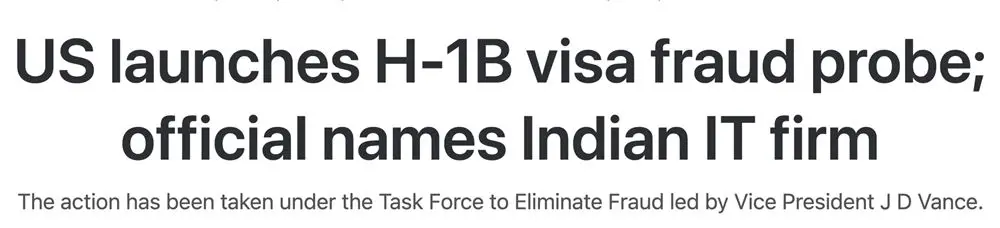

H-1B and PERM Fraud Investigation Formally Launched
According to public information from the U.S. Department of Labor Office of Inspector General, certain companies and labor intermediaries are suspected of applying for H-1B visas or PERM labor certifications through fraudulent positions, falsified materials, and non-genuine employment relationships.
Some foreign employees may also face issues such as wage theft, demands to return a portion of their salary, long-term "bench status without pay," or discrepancies between actual job duties and the declared positions.
The U.S. Department of Labor Inspector General stated in a media interview that investigators have already issued dozens of subpoenas to comprehensively map out case leads and trace relevant chains of non-compliance. The well-known IT outsourcing firm Cognizant has also been publicly mentioned due to relevant whistleblower leads, becoming one of the companies under scrutiny in this investigation.
The U.S. established the H-1B and PERM systems originally to address shortages of domestic high-skilled talent and attract excellent global labor, not to allow unscrupulous enterprises to exploit system loopholes to suppress wages and seek profit.
This round of investigations sends a clear policy signal: U.S. oversight of H-1B and PERM will tighten further in the future, and companies will face higher compliance requirements regarding job authenticity, salary standards, and actual employment practices.
Judging by the scale of this action, the U.S. government is adopting a stricter enforcement stance against fraudulent employment, low-wage hiring, and labor exploitation within the H-1B and PERM systems.
Not Just Outsourcing Firms; International Students May Also Be Affected
Many believe that this investigation is primarily targeting Indian outsourcing companies and has little to do with Chinese international students. However, in reality, from OPT and H-1B to PERM, every link in the traditional path to staying in the U.S. is closely tied to employer compliance.
Students in the OPT stage need to maintain genuine, compliant employment related to their major; after entering the H-1B stage, they must not only face the lottery but also ensure that their position, salary, work location, and actual job duties are consistent with the application materials; upon entering the PERM stage, the employer must also complete recruitment testing and prove that no qualified U.S. worker is willing or able to fill the position.
As the investigation escalates, authorities may pay closer attention in the future to: whether the position genuinely exists; whether the employee is actually performing the declared work;
whether the salary meets the prescribed standards; whether the employer has a genuine need for labor; and whether the application materials are consistent with the actual work situation.
Once a company conducts layoffs, stops sponsorship, or is investigated due to employment issues, the employee's work status and immigration process may be affected.
From OPT to Green Card, Risks of Dependence on a Single Employer Are Rising
For a long time, many Chinese international students have assumed the standard path to staying in the U.S. is: working on OPT after graduation, participating in the H-1B lottery, and once selected, having the employer handle the PERM and employment-based green card application.
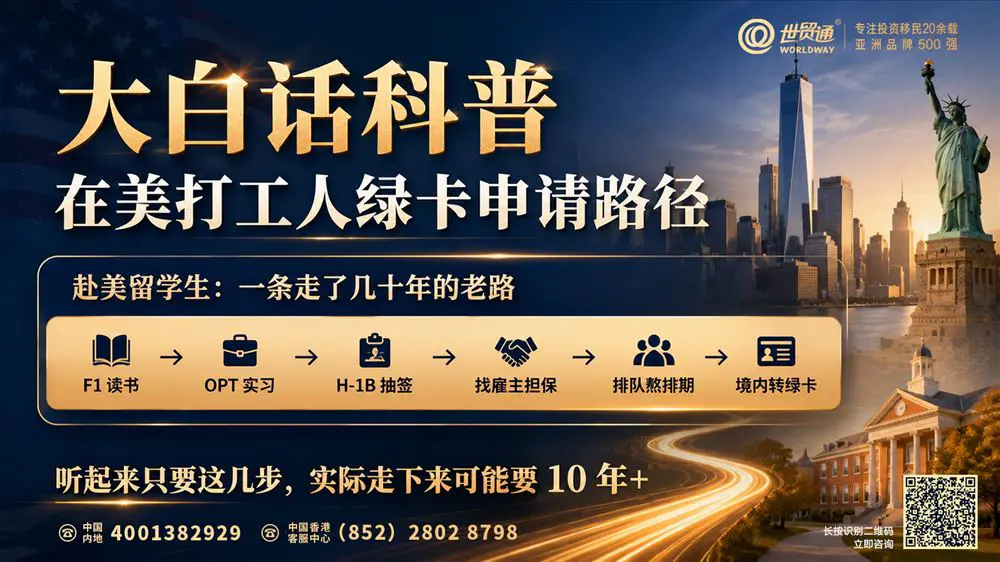
The path appears clear, but in reality, every step is full of variables.
Applicants must not only consider whether they can win the H-1B lottery, but also whether the employer is stable, whether the company will conduct layoffs, whether the position can be retained long-term, and whether the company is willing to continuously bear the costs of the green card application. Especially against the backdrop of ongoing personnel restructuring in the technology, finance, consulting, and internet industries, even if a company is performing well, it may cut positions due to AI transformation, cost control, and business reorganization.
For U.S. domestic employees, layoffs mean looking for a new job; but for foreign employees relying on OPT or H-1B status, layoffs also affect their legal residency and subsequent green card application.
The biggest problem with the traditional employer-sponsored route is that no matter how strong an applicant's personal capabilities are, they cannot fully control corporate operations, layoff plans, or sponsorship policies.
New Law EB-5 Offers an Identity Option Not Tied to an Employer
Against the backdrop of rising uncertainty for H-1B and PERM, the new law EB-5 is receiving increasing attention from international student families.
EB-5 has no rigid requirements for education, language, major, or work experience, and does not require participating in the H-1B lottery or obtaining a PERM labor certification. Currently, the Rural EB-5 project has the advantages of no visa backlog and priority processing. The "concurrent filing" policy allows applicants who have no visa backlog and possess legal status in the U.S. to file Form I-526E and Form I-485 simultaneously, and apply for work authorization and advance parole.

After obtaining work authorization, applicants can choose their employer and position based on their own plans, no longer needing to be tied to a single company for a long time to maintain H-1B status. Even if they encounter layoffs or change jobs in the future, they will not directly interrupt their EB-5 application due to the loss of sponsorship from a specific employer.
Critical Window Approaching, Identity Planning Should Be Done Sooner Rather Than Later
It is worth noting that the "grandfather clause" in the new EB-5 law will reach a critical time point on September 30, 2026. On January 1, 2027, the minimum investment amount will increase from $800,000 to $900,000-$937,500 or even higher.
For families with long-term needs to stay in the U.S., the prudent approach is to evaluate identity paths that do not rely on a single employer in advance while current status is stable and the policy window still exists, in order to retain more proactive choices for the future.

Currently, WorldWay, in its 5th collaboration with the multi-billion fund PeachTree Group, has created the legacy of success: the "Marriott Lakeview Resort" EB-5 project, which can provide more robust options for applicant families.

For inquiries in Mainland China: 400-138-2929, Hong Kong, China Customer Service Center: (852)2802 8798