





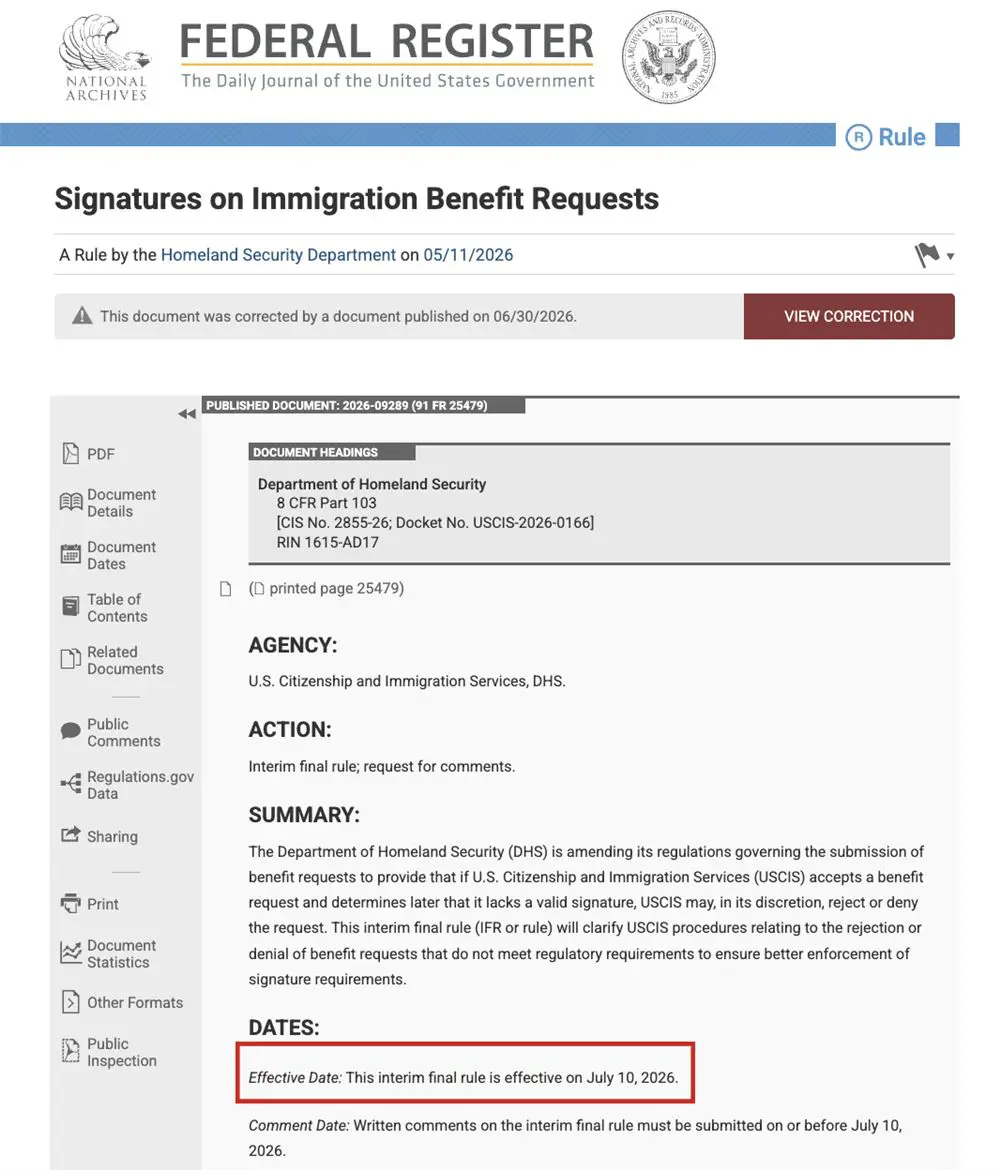
Previously, the new signature regulation issued by the U.S. Department of Homeland Security (DHS) (for details, click to read the previous report by WorldWay: Quick Look! Two Major Changes to U.S. Immigration Applications), took effect on July 10, 2026, local time.
In other words, for applications submitted on or after July 10, 2026, if U.S. Citizenship and Immigration Services (USCIS) discovers an invalid signature after accepting the case, it may choose to reject the application or issue a denial decision directly, depending on the specific circumstances. Once a case is denied, it is generally considered to have completed processing, and the application fee may not be refunded.

Do not rely on Requests for Evidence (RFE) to sign after the fact
In the past, many applicants believed that even if an application had missing, incorrect, or non-compliant signatures, USCIS would first issue an RFE, and the applicant could simply re-sign later.
However, the new regulation explicitly states that there is no mechanism for post-submission signing. If a valid signature is missing at the time of submission, it generally cannot be corrected by re-signing.
Naturalization applications such as N-600 and N-600K are limited exceptions. If the only issue with the application is an invalid signature, USCIS can only reject the application and cannot deny it solely on that basis.
These 5 types of signature operations carry high risks
According to information released by the U.S. Department of Homeland Security, the number of invalid signatures discovered by USCIS has increased significantly in recent years. The following types of operations require particular attention:
• Copying and pasting signature images onto different forms
• Using typed names, signature stamps, or software-generated signatures
• Having an unauthorized third party sign on one's behalf
• Multiple forms containing identical signature layers
• The final submitted version being inconsistent with the signed version
Official data shows that cases denied due to signature issues have risen from approximately 300 in fiscal year 2021 to nearly 3,000 in fiscal year 2025. Non-compliant signatures are no longer an isolated phenomenon.
The U.S. Department of Homeland Security stated that the new regulation was introduced primarily to strengthen compliance with signature requirements, maintain the integrity of the immigration benefit adjudication process, and prevent abuse of the immigration application system and procedures.
This adjustment affects most immigration benefit applications that require the submission of paper materials. Any form that requires a signature from the applicant or an authorized signatory must be signed individually in accordance with the corresponding requirements; signatures cannot be simply copied or reused from previous submissions.
For those preparing to submit applications, you should check the signatory, signature location, date of signing, and the final form version item by item before submission. For cases that have already been submitted but are still pending, you should review your retained copies to confirm whether there are issues such as copied signatures, missing signatures, incorrect signatures, unauthorized signatures, or abnormal dates.
Adjudication standards are tightening; professionalism and compliance are more important than ever
The entry into force of this new signature regulation once again sends a clear signal: U.S. immigration adjudication is further strengthening procedural compliance, the authenticity of materials, and applicant responsibility.
Faced with continuous changes in U.S. immigration policy and adjudication standards, professional teams must not only help applicants seize policy windows but also strictly control every form, every piece of material, and every signature detail to reduce the risk of procedural errors affecting the outcome of the case.
For families preparing to plan for U.S. status through EB-5 investment immigration, the more the environment trends toward stricter adjudication and higher detail requirements, the more necessary it is to plan in advance, operate in a standardized manner, and choose a professional institution with long-term experience and comprehensive service capabilities.
As a professional institution long-rooted in the U.S. EB-5 field, WorldWay possesses extensive project experience and numerous successful cases, capable of providing applicants with full-process services ranging from preliminary status planning, project screening, and material preparation to application submission and subsequent status maintenance.

Key EB-5 policy window is approaching
While strictly controlling application materials and signature details, applicants should also pay attention to the current EB-5 policy window. The "grandfather clause" in the new EB-5 law will reach a critical time node on September 30, 2026; starting from January 1, 2027, the minimum investment amount will also be raised from the current $800,000 to $900,000 to $937,500, or even higher.
For families who already have U.S. status planning needs, the current policy window is gradually tightening. Only by understanding the policy early, preparing materials well, and advancing the application in a standardized manner with the assistance of a professional team can one better grasp the current EB-5 policy opportunities.


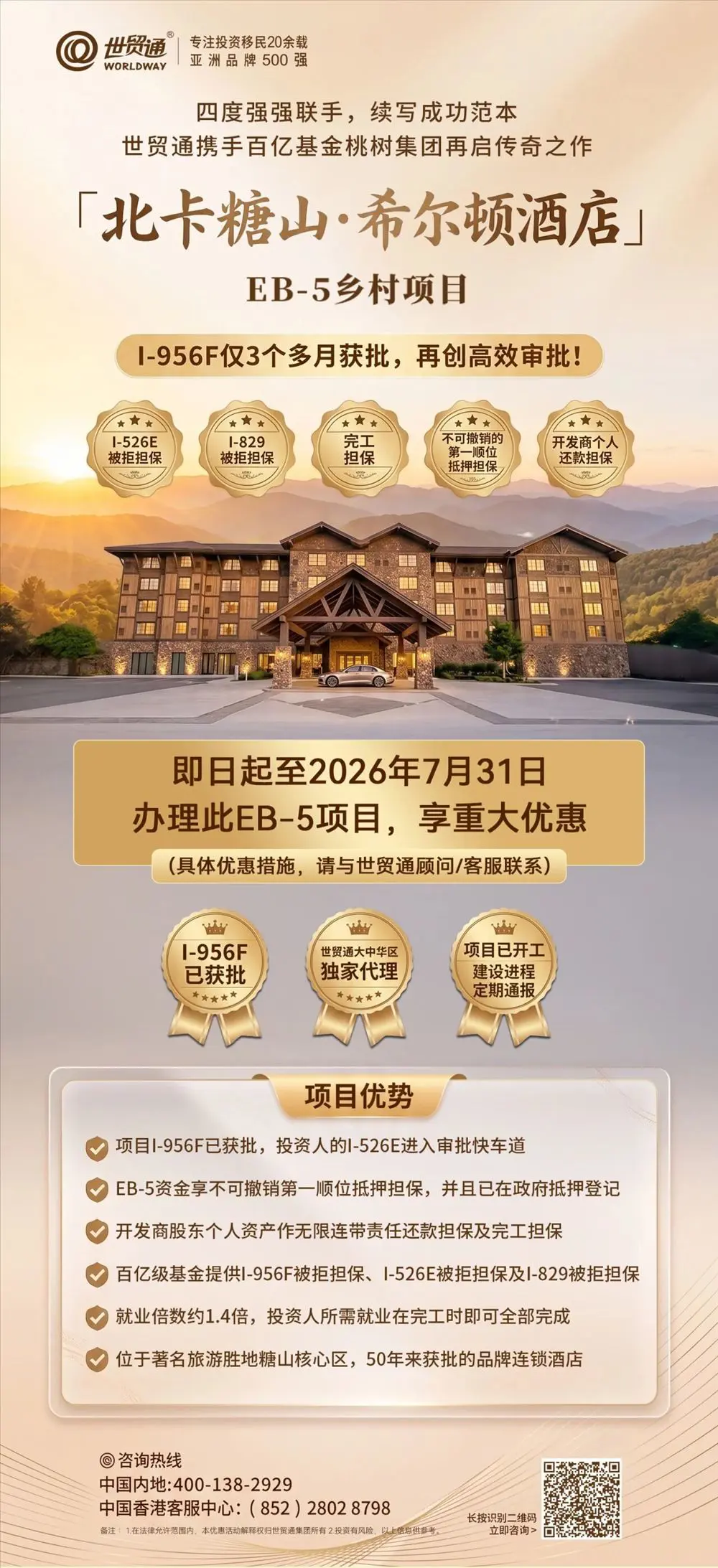
For inquiries in Mainland China: 400-138-2929, Hong Kong, China Customer Service Center: (852)2802 8798