





Recently, U.S. H-1B data has sparked attention.
According to reports, as of the first nine months of fiscal year 2026, U.S. Citizenship and Immigration Services (USCIS) has approved 273,026 H-1B "continuing employment" applications, which is very close to the high of 291,542 in the previous fiscal year. On the surface, this seems to contradict the Trump administration's policy direction of continuously tightening H-1B: while emphasizing the protection of local employment and raising the threshold for hiring, the volume of H-1B approvals is still rising.
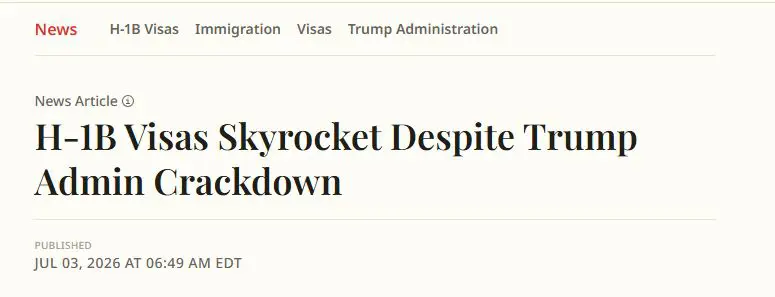
However, this set of figures does not mean that international students have more opportunities to stay in the U.S.
What really needs to be seen clearly is: the rise in H-1B approvals reflects more that those who have already entered the U.S. employment system are still renewing, transferring positions, and changing employers; for international students who have not yet obtained an H-1B, the entrance has not widened, but is actually becoming narrower.

What is surging is not new quotas, but existing stock mobility
The "continuing employment" applications discussed here are not the new quotas in the annual H-1B lottery.
They mainly include H-1B renewals, extensions, employer transfers, and position adjustments. In other words, most of these applications correspond to H-1B holders who are already working in the U.S., rather than international students transitioning from OPT to H-1B for the first time.
Therefore, the rise in H-1B continuing employment approvals cannot be simply understood as "the U.S. has relaxed H-1B" or "it is easier for international students to stay." It shows that U.S. companies still need some mature foreign talent, but most of this talent is already within the system.
What is truly difficult is for international students who are still standing at the entrance.
They are still facing limited annual H-1B quotas, fierce lottery competition, and the uncertainty of whether employers are willing to sponsor them.
The U.S. does not reject talent, but is becoming increasingly selective
In the past, many families understood studying in the U.S. with the default path: study first, work through OPT after graduation, then participate in the H-1B lottery, stay in the U.S. after being selected, and then wait for employer support for a green card.
But now, the uncertainty of this path is rising.

The U.S. is not in no need of foreign talent; fields such as technology, finance, engineering, medicine, and AI still rely on high-skilled labor. What has really changed is that the U.S. screening criteria for foreign talent are being raised: not only must they have degrees and employers, but it also depends on whether the position is sufficiently high-paying, whether the skills are sufficiently scarce, and whether the company is willing to bear higher employment costs.
The H-1B wage-weighted rule is a reflection of this change. The new rule favors high-paying, high-skilled positions; the higher the wage level, the greater the probability of being selected.
This is not friendly to newly graduated international students. Most fresh graduates are still at the starting stage of their careers, and even if they graduate from U.S. universities, they may not necessarily get high-paying positions. Especially in an environment where corporate hiring is more cautious, layoffs are frequent, and AI substitution is accelerating, entry-level positions are decreasing, and young international students have weaker bargaining power.
For international students from mainland China, this path has never been easy. Data shows that among H-1B approvals in fiscal year 2025, beneficiaries born in India accounted for nearly 70%, and beneficiaries born in mainland China accounted for about 10%. At the same time, the number of H-1B registrations is long-term far higher than the available quotas, and even after "one person, one lottery," the overall winning rate remains limited. Coupled with the wage-weighting trend, fresh graduates are at a greater disadvantage in future competition due to their relatively lower starting salaries.
Being selected for H-1B does not mean true stability
Even if you successfully win the H-1B lottery, the problem of staying in the U.S. is not completely solved.
H-1B is essentially still an employer-sponsored non-immigrant work visa, with status and work deeply bound. Changing jobs requires a new employer to take over the application; once laid off, there is usually only a 60-day grace period to find the next employer, change status, or leave the country.
In the past, when many families made U.S. plans, they focused on school selection, majors, rankings, and employment rates. But in today's policy environment, focusing only on these is no longer enough. Schools and majors solve the problem of education and employment direction, while status solves the problem of whether children can stay in the U.S. for long-term development.
This is why more and more families are starting to prioritize status planning.

EB-5, becoming an important alternative for families staying in the U.S.
Against this background, EB-5 investment immigration is being paid attention to by more families staying in the U.S.
EB-5 is not a simple substitute for H-1B, but provides another way of thinking: do not bet the child's future entirely on the lottery and employers, but strive for U.S. permanent resident status in advance through family-level status planning.
Under the new EB-5 law, for eligible applicants who are already in the U.S., they can also combine the "concurrent filing" mechanism to advance status adjustment while submitting immigration applications, and apply for work permits and travel documents. In this way, applicants also have the opportunity to obtain more flexible work and entry/exit arrangements while waiting for green card approval, reducing dependence on a single employer.

For international students, after their status is stable, they no longer need companies to bear the H-1B lottery and sponsorship costs when job hunting; when changing jobs, they do not have to be forced to lower their selection standards due to status issues; their future choices in industries, cities, and career directions will also be freer.
September 30 window, worth paying attention to in advance
It should be reminded that the "grandfather clause" in the new EB-5 law will reach a key time node on September 30, 2026. The minimum investment amount may also be raised from $800,000 to $900,000-$937,500 or even higher on January 1, 2027.

Studying abroad can start with grades, but staying in the U.S. cannot be completed by luck alone.
When lottery, salary, employer, layoffs, and policy changes all become variables, families need to prepare an active path for their children in advance.
What children are trapped by is often not ability, but status.
And the earlier status planning starts, the less likely future choices will be passively handed over.
Currently, WorldWay holds two high-quality EB-5 projects, "Marriott · Imperial Lake Bay Resort" and "North Carolina Sugar Mountain · Hilton Hotel", which can provide more stable choices for applicant families.


For detailed inquiries in mainland China: 400-138-2929, Hong Kong, China Customer Service Center: (852)2802 8798