





Recently, the Office of Foreign Labor Certification (OFLC) under the U.S. Department of Labor released foreign labor application data for the second quarter of fiscal year 2026.
The data shows that PERM labor certification applications, which represent demand for employment-based immigration, and LCA applications, which reflect corporate willingness to hire H-1B employees, have both experienced varying degrees of slowdown.
This data indicates that it is not that the United States does not need foreign talent, but rather that companies are becoming more cautious in hiring foreign employees, supporting work visas, and processing green cards.

PERM Remains at Low Levels
Employers Are More Cautious in Supporting Green Cards
PERM is an important step in many traditional EB-2 and EB-3 employment-based immigration applications.
Simply put, if a U.S. employer wants to sponsor a foreign employee for a green card, they usually need to go through the PERM labor certification process to prove that hiring a foreign worker will not adversely affect the U.S. labor market.
Therefore, the volume of PERM applications can, to a certain extent, reflect the willingness of companies to process long-term status for foreign employees.
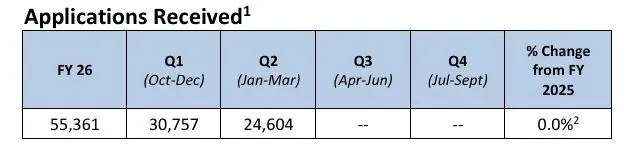
According to the data, the cumulative number of PERM applications for the first two quarters of fiscal year 2026 was 55,361, with 24,604 in the second quarter and 30,757 in the first quarter. The cumulative application volume for the first two quarters is almost flat compared to the same period last year.
Looking at the long-term trend, PERM application volume grew rapidly from 2021 to 2023, but began to decline starting in fiscal year 2024, and continued to fall in fiscal year 2025. By the first two quarters of fiscal year 2026, it remained at a low level overall.
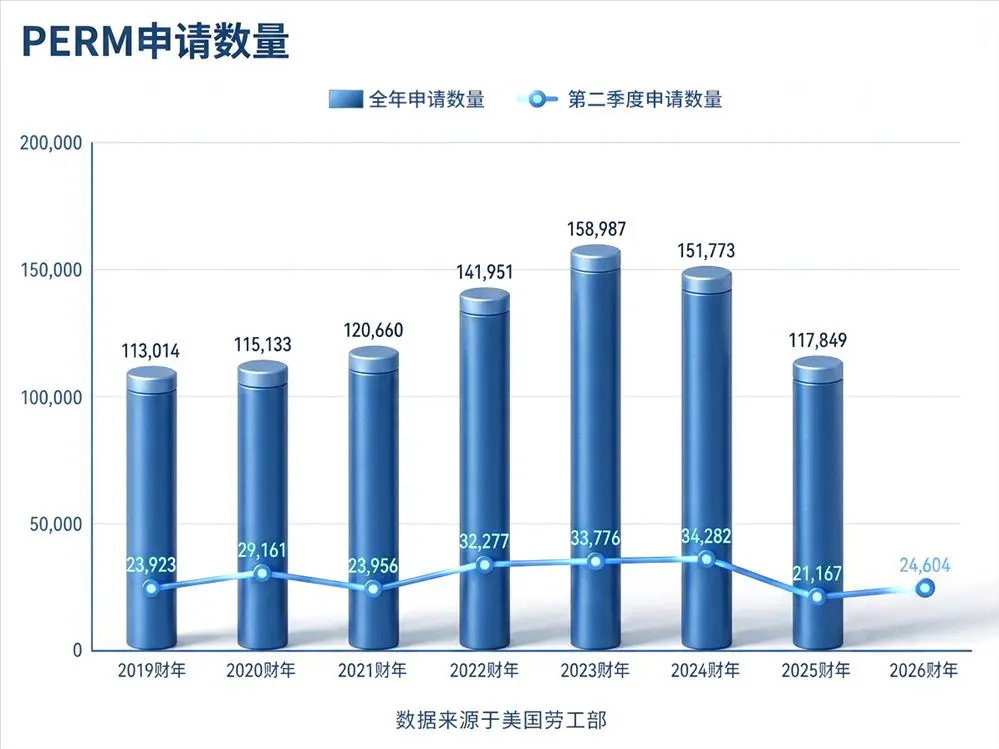
This indicates that the willingness of employers to advance green card applications for foreign employees is no longer as active as it was in previous years.
LCA Applications Decline
H-1B Hiring Demand is Cooling Down
In addition to PERM, LCA is also an important data point for observing the demand for foreign talent among U.S. companies.
LCA is a document that companies must submit before applying for work status for H-1B employees. Whether a company is willing to hire foreign employees is often reflected in the number of LCA applications.
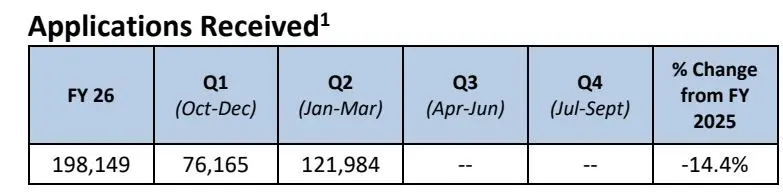
According to the data, the cumulative number of LCA applications for the first two quarters of fiscal year 2026 was 198,149, with 121,984 in the second quarter and 76,165 in the first quarter, a decrease of 14.4% compared to the same period of the previous fiscal year. This shows that the corporate demand for hiring H-1B employees is cooling down.
The Difficulty of Relying on Employer-Supported Status for International Students is Rising
In the past, the rapid expansion of the U.S. technology industry, which relied heavily on international talent for software engineers, data scientists, and IT positions, drove the growth of H-1B and employment-based immigration applications.
However, in the last two years, the technology industry has entered a period of adjustment. Increased layoffs, slower hiring, corporate cost-cutting, and the increased efficiency of certain roles due to AI technology have led companies to be more rigorous in their assessment of new positions and support for foreign employee status.
This does not mean that the United States has lost its appeal to global talent, but rather that foreign talent seeking to obtain H-1B and subsequent green card support through employers is facing a higher threshold.
In the past, the planning logic for many international student families was: study in the U.S., work via OPT after graduation, participate in the H-1B lottery, and then strive for employer-supported green card application. But now, the uncertainty of this path is increasing. If one relies entirely on this path, children will need to face multiple uncertainties in the future, such as the lottery, layoffs, employer willingness to provide support, visa backlogs, and policy changes.
This also means that competition for staying in the U.S. is no longer just about academic and employment competition; status factors are becoming increasingly important.

Status Planning is Becoming Part of Educational Planning
The United States remains an important center for global higher education and innovative industries, with high-quality universities, research resources, and employment platforms still possessing strong appeal.
However, from the low levels of PERM to the decline in LCA applications, and the persistent competition for H-1B, these changes are a reminder to families of international students: status planning is shifting from a "post-graduation issue" to an "issue that needs to be considered before studying abroad."
For families with U.S. education and long-term development goals, the earlier they understand the status path and the earlier they plan, the more choices and greater initiative they will have in the future.
Currently, EB-5 investment immigration has become an important option for high-net-worth families to plan for U.S. status in advance. Compared to the traditional path that relies on employer sponsorship, EB-5 does not require an employer to provide H-1B or green card support. Applicants can plan for U.S. permanent resident status for their families in advance through qualifying investments.
Especially under the new EB-5 law, rural EB-5 projects are exempt from visa backlogs and have the advantage of priority processing; the "concurrent filing" policy allows applicants who are in the U.S. with legal status and no visa backlog to file I-526E and I-485 simultaneously, quickly obtaining a Combo card, achieving legal residence and employment eligibility, thereby reducing the sole reliance on H-1B lotteries, employer sponsorship, and the PERM process.

But policy dividends will not last forever. As reserved quotas continue to be consumed, the risk of invisible backlogs is emerging; at the same time, the grandfather clause will expire on September 30, and the minimum investment amount will be raised from $800,000 to $900,000-$937,500 or higher on January 1, 2027. For families with clear plans to stay in the U.S., the earlier they evaluate, the more opportunities they have to seize the current window.

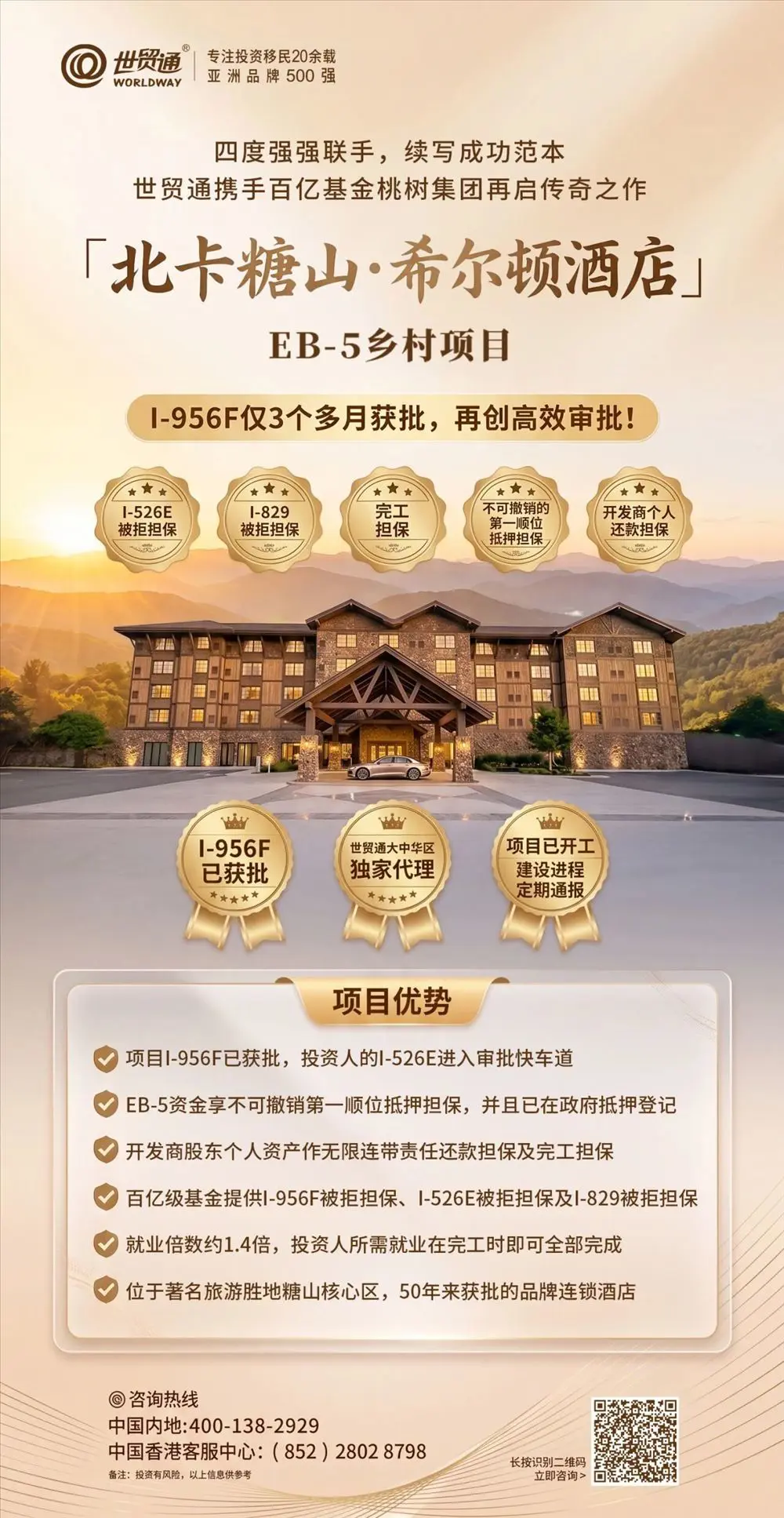
Currently, WorldWay holds two high-quality EB-5 projects, "Marriott Resort at Lake Oconee" and "Hilton Hotel at Sugar Mountain, North Carolina," which can provide more stable choices for applicant families.

For inquiries in mainland China: 400-138-2929, Hong Kong, China Customer Service Center: (852)2802 8798