





Major news has emerged regarding U.S. immigration policy.
The U.S. Department of Labor has recently officially scheduled the "most significant reform of the PERM permanent labor certification system in 20 years." This means that since the implementation of the PERM system in 2004, the underlying rules for U.S. employment-based immigrant green cards may be facing a systemic adjustment.

What is PERM?
PERM is a permanent labor certification program managed by the U.S. Department of Labor, designed to ensure that the entry of foreign employees into the United States does not adversely affect the job opportunities, wages, and working conditions of U.S. workers.
PERM labor certification is the first step for H-1B visa holders to apply for a green card. It is filed by the employer on behalf of the employee. Once approved, the company can proceed to file the I-140 employment-based immigrant petition, allowing the applicant to submit the I-485 adjustment of status application to USCIS, and subsequently receive a green card. H-1B holders can work in the U.S. for a maximum of six years; if they have not adjusted their status or are laid off and unemployed one year before the expiration, they must leave the United States. Therefore, the PERM application directly determines whether international students can obtain U.S. permanent residency.
What changes will the PERM reform bring?
The official final details have not yet been released, but the direction of the reform is relatively clear. This reform takes a "modernized PERM system" as its entry point, which will essentially further strengthen recruitment requirements, enhance employer compliance reviews, and expand protections for U.S. workers affected by layoffs. In the future, when employers sponsor foreign employees for green cards, there will be a greater emphasis on authentic recruitment, priority for local workers, documentation retention, and compliance responsibilities.
Labor market testing will be reshaped: The core of PERM is to prove that there are no suitable candidates in the U.S. domestic labor market. One of the key points of this reform is to update this set of labor market testing standards. In the future, employers may need to prove in a more comprehensive way that aligns with the current recruitment environment that the position is indeed open to U.S. domestic workers and that the recruitment process is authentic and effective.
Recruitment authenticity reviews will be stricter: The current PERM rules have long followed the 2004 framework, but corporate recruitment methods have long since shifted entirely to online platforms and digital screening. The new regulations will require employers to recruit through more modern digital channels and establish more rigorous candidate evaluation and record-keeping systems.
Protection for U.S. domestic workers will be further increased: This reform will strengthen protections for U.S. workers affected by layoffs. In other words, if a company has recently experienced layoffs and intends to sponsor a foreign employee for a green card, it may face stricter scrutiny in the future. The Department of Labor will pay closer attention to whether the company truly has no U.S. domestic workers capable of performing the job.
Documentation and record-keeping requirements will be stricter: In the future, it may not be enough for employers to simply complete the recruitment process; they will also need to maintain more complete recruitment records. This includes job postings, candidate screening, interview feedback, and specific reasons for rejecting U.S. candidates, all of which may become the basis for review. Insufficient documentation may trigger audits, requests for evidence, or even affect the outcome of the PERM.
Employer sponsorship costs may rise simultaneously: In addition to the PERM reform, the Department of Labor (DOL) proposes to significantly increase the four prevailing wage level percentiles for employment-based immigration (EB-2/EB-3) and H-1B visas. For example, the entry-level Level 1 wage standard is proposed to be raised from the 17th percentile to the 34th percentile. If this rule is implemented, the cost for employers to sponsor foreign employees will rise significantly, and it will also be more difficult for recent international graduates to obtain H-1B or green card support in the future.
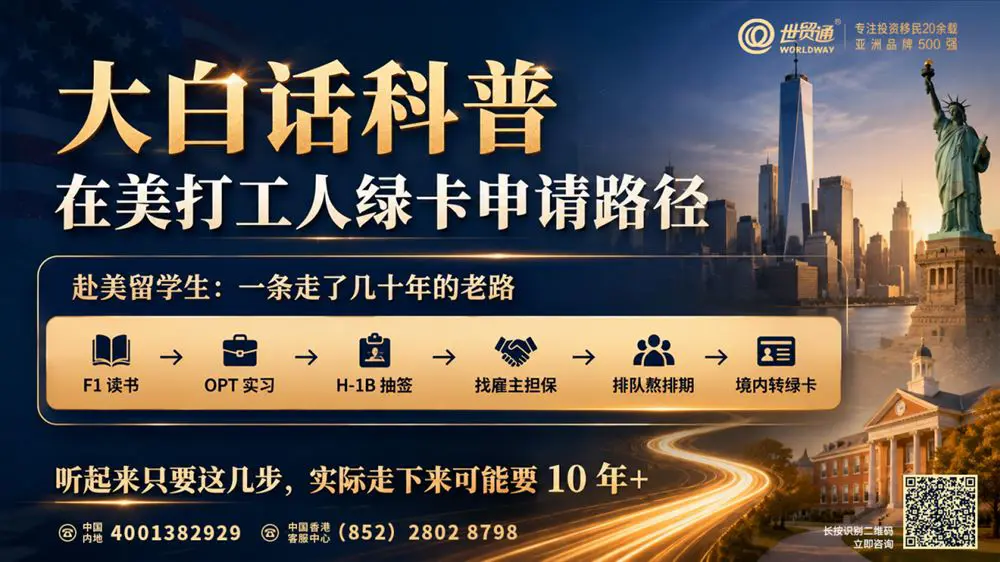
The traditional H-1B to green card route
is becoming unstable
The PERM reform ostensibly adjusts employer recruitment and labor certification rules, but the ultimate impact is on every foreign employee who relies on employer-sponsored green cards.
In the past, many families assumed that after their children went to the U.S. for studies, they could work in the U.S. using OPT, then enter the H-1B lottery, and subsequently apply for a green card through the company via PERM. But now, the uncertainty along this path is constantly increasing.
H-1B itself carries the risk of a lottery; after the wage threshold is raised, corporate sponsorship costs will increase; after the PERM reform, recruitment testing and document review will be stricter; once a company has layoffs, job changes, or restructuring, the green card process may also be interrupted.
More importantly, this route is highly dependent on the employer. Whether a child can stay in the U.S. depends not only on their academic qualifications and abilities, but also on whether the company is willing to sponsor them, whether the position is stable, and whether the enterprise has the capability for compliance.

EB-5 provides more initiative
for international student families
Against the backdrop of tightening employer-sponsored paths, EB-5 is becoming a choice that more and more international student families are paying attention to.
Unlike H-1B and PERM, EB-5 does not rely on employer sponsorship, does not require a lottery, and does not restrict the applicant's academic, language, major, or industry background. Its core is to apply for U.S. permanent resident status through compliant investment and job creation.
For international students studying in the U.S., H-1B holders already working, and families hoping to plan U.S. status for their children in advance, the value of EB-5 lies in the fact that it provides an independent immigration path that is not tied to an employer.
Especially under the new EB-5 law, rural EB-5 projects are exempt from visa backlogs and have the advantage of priority processing; the "concurrent filing" policy allows applicants who have no visa backlog and have legal status in the U.S. to file I-526E and I-485 simultaneously, quickly obtaining a Combo card, achieving legal residency and employment eligibility, thereby reducing the single reliance on the H-1B lottery, employer sponsorship, and the PERM process.

The more intensive the policy changes, the more you need to plan in advance
This PERM reform is not a single policy change, but an important signal that U.S. employment-based immigration reviews are continuously tightening. From the increase in the H-1B wage threshold to the adjustment of PERM labor certification rules, and then to the strengthening of employer compliance requirements, foreign talent obtaining a U.S. green card through employer sponsorship may face higher thresholds and more uncertainties in the future.
When the uncertainty of traditional paths rises, evaluating independent status paths that are not tied to an employer, such as EB-5, has become an important choice for international student families to reduce risks and increase their initiative.
It should be noted that the "grandfather clause" in the new EB-5 law will reach a critical time node on September 30, 2026. On January 1, 2027, the minimum investment amount will be raised from $800,000 to $900,000-$937,500 or even higher.

Currently, WorldWay holds two high-quality EB-5 projects: "Marriott Resort at Lake Oconee" and "Hilton Hotel at Sugar Mountain, North Carolina", which can provide more stable choices for applicant families.


For detailed inquiries in Mainland China: 400-138-2929, Hong Kong, China Customer Service Center: (852)2802 8798