





For many high-net-worth families, planning for U.S. status has always had children's education as one of its core objectives.
The advantages of U.S. education stem from a mature and diverse educational ecosystem: from the public school system in the basic education stage to renowned university resources in the higher education stage, and further to research, internship, employment, and long-term development opportunities, the United States has long maintained its global leading appeal.
For families who hope their children will receive an international education, enter prestigious universities, and remain in the United States for development in the future, the value of a U.S. Green Card has therefore become even more practical.
I. A U.S. Green Card is first and foremost a stabilizer for children's educational paths
The United States implements a community-based public education system. For families residing locally, children can enter the corresponding school district based on their residential address to receive public education from elementary through secondary school.
The U.S. public school system has broad coverage and rich course options. In addition to basic subjects, many schools also provide AP courses, STEM courses, arts, sports, club activities, and college counseling. For families holding a U.S. Green Card, children are no longer just staying for a short term as "international students," but are able to integrate into the local education system more stably as long-term residents.
This means that children can adapt to the English environment, classroom discussion methods, extracurricular activity systems, and U.S. college application logic earlier. Compared to entering the U.S. as an international student in the later stages of high school, having status in advance and receiving a local education is often more conducive to long-term academic planning.
II. Entering the university stage, the status advantage is even more obvious
The United States possesses the most competitive higher education system in the world. From the Ivy League to the University of California system, the University of Michigan, the University of Texas, and other prestigious public universities, as well as numerous top-tier schools in science, engineering, business, medicine, law, and the arts, U.S. universities provide students with an extremely rich range of choices.
However, for international students, U.S. university applications often face more intense global competition. Especially in popular majors, prestigious institutions, and scholarship resources, international students not only face admission competition but also need to consider visa status, tuition costs, and the connection of future employment status.
A U.S. Green Card can help children shift from "international student competition" to "local student planning." When applying for universities, Green Card status helps children participate in the academic path with more stable status; after meeting conditions such as state residency, they may also apply for in-state tuition eligibility, significantly reducing education costs. In addition, some scholarships and financial aid resources are more inclined to be open to U.S. citizens and Green Card holders. Having Green Card status also means that children have the opportunity to obtain more educational financial support during their university years.
III. Beyond education, there is broader space for employment and development
Many families plan for U.S. status not just for their children to "study," but so that they can stay and develop after graduation.
For international students, from F-1 student visas to OPT, then to H-1B lottery, and finally to employer-sponsored Green Cards, there is uncertainty at every step. Even if they enter a prestigious university and find a job, their long-term development may be affected by status restrictions.
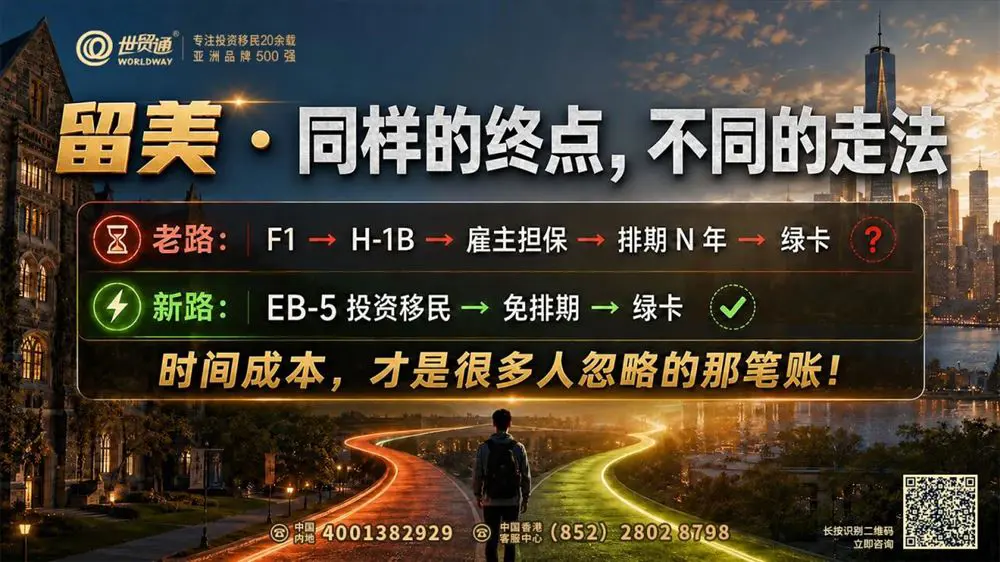
Green Card status is different. After becoming a U.S. permanent resident, children have greater initiative in future employment choices, career transitions, long-term residency, and status stability. U.S. Citizenship and Immigration Services also clarifies that a Green Card is proof of status for permanent residents to live and work in the United States.
For students planning to enter fields such as artificial intelligence, biotechnology, finance, engineering, scientific research, and medicine, status stability is particularly important. It not only affects whether they can successfully intern and find employment, but also affects whether they can accumulate professional experience, expand their network, and enter higher-level development platforms in the United States in the long term.
IV. The value of a Green Card belongs not only to the children, but to the entire family
The value brought by a U.S. Green Card is not limited to education.
For a family, it means more flexible entry and exit arrangements, more stable residency planning, more convenient asset allocation, and a longer-term global layout for the family. For entrepreneurs and high-net-worth families, U.S. status can also help the family more calmly connect with the U.S. market, educational resources, medical resources, financial systems, and business opportunities.
It is precisely for this reason that a U.S. Green Card is not just a bonus for children's academic advancement, but a strategic configuration for a family facing the future.
V. EB-5: An important path for the whole family to obtain a U.S. Green Card
Among various U.S. immigration paths, EB-5 investment immigration has always been an important choice for high-net-worth families. For families who hope their children will study in the U.S., develop in the U.S. in the future, or configure U.S. status for the whole family, EB-5 is not only a Green Card path, but also a long-term plan for the next generation.
Under the new EB-5 law, rural projects are currently still in a visa-free status and have the advantage of priority processing; applicants in the U.S. can also use "concurrent filing" to simultaneously submit I-526E and I-485, obtaining convenience for legal residence, work, and travel in the U.S. in advance.
However, the policy window will not last forever. As reserved quotas continue to be consumed, the risk of invisible backlogs is emerging; at the same time, the grandfather clause will expire on September 30, and the minimum investment amount may also be raised from $800,000 to $900,000-$937,500 or even higher on January 1, 2027. The sooner you act, the more likely you are to lock in the current policy dividends.
Currently, WorldWay holds two high-quality EB-5 projects: "Marriott · Royal Lake Bay Resort" and "North Carolina Sugar Mountain · Hilton Hotel", which can provide more stable choices for applicant families. With the window open, it is worth evaluating and acting as soon as possible.


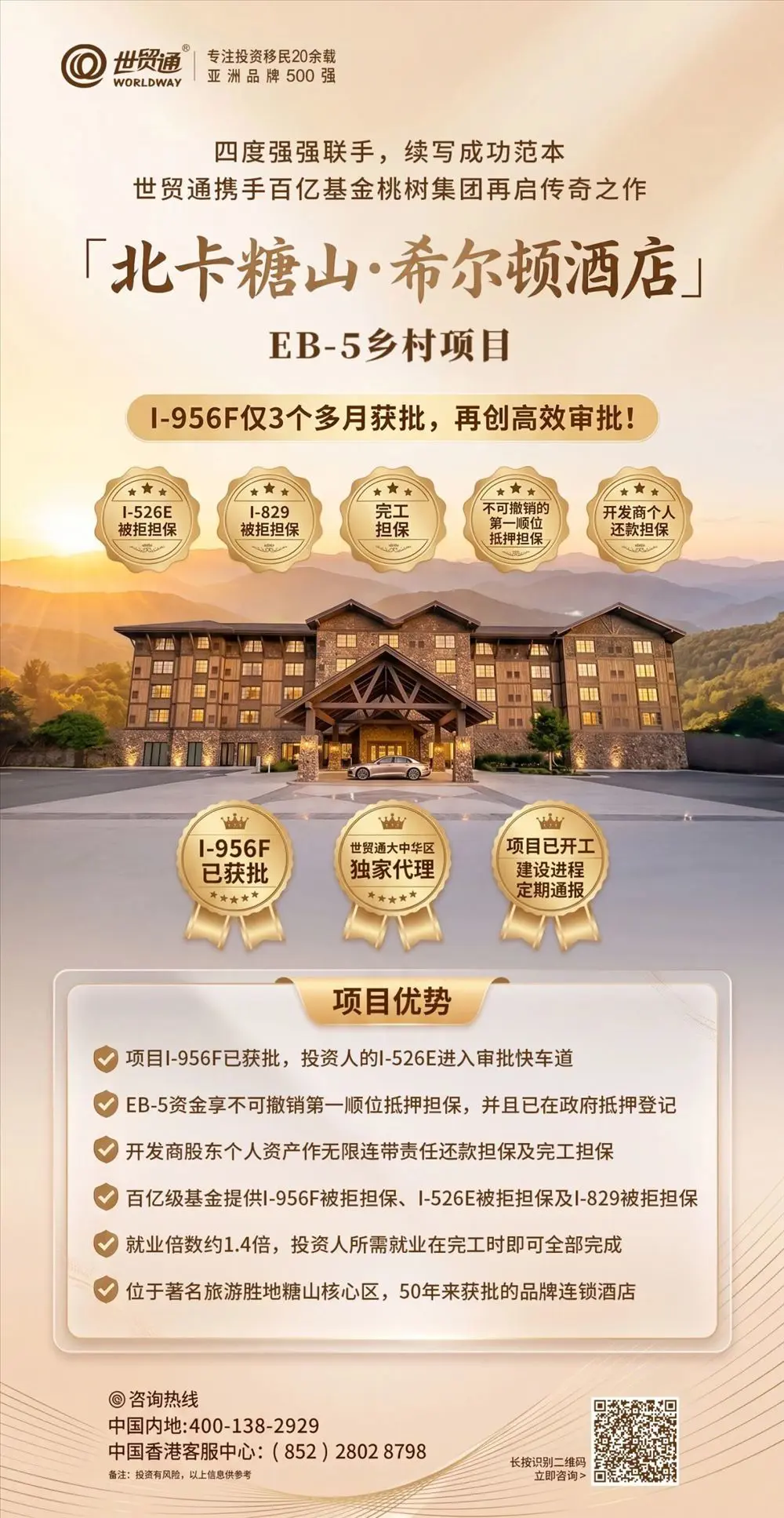
For inquiries in Mainland China: 400-138-2929, Hong Kong, China Customer Service Center: (852)2802 8798