





For over two decades, many international students have followed a relatively fixed route for their U.S. status planning:
Study in the U.S., accumulate work experience through OPT after graduation, then apply for an H-1B work visa, and subsequently have the employer initiate a green card application.
While this path is not easy, it has at least been relatively clear, making it the default long-term plan for many international students and their families.
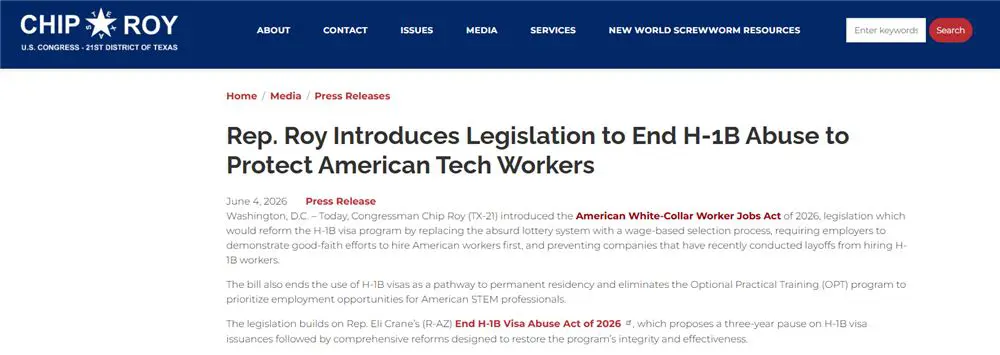
However, a U.S. Representative recently introduced the "2026 American White-Collar Worker Employment Act," once again bringing new uncertainty to this traditional path.
According to public information, this proposal seeks to make significant adjustments to the OPT and H-1B systems, including canceling OPT, shortening the duration of H-1B visas, changing H-1B allocation rules, and further strengthening requirements for companies to prioritize hiring local U.S. employees.

I. What key aspects does this proposal involve?
Based on the public content, this is not a simple minor adjustment, but rather one that directly targets the paths international students rely on most for status transition.
1. Cancellation of OPT: Legal status after graduation faces interruption
OPT has always been a key transitional mechanism for international students to remain in the U.S. for work after graduation. Under the current system, graduates in general majors can usually obtain a 12-month OPT work permit, and STEM graduates can apply for an additional 24-month extension, for a total of up to 36 months. For international students, this period is an important window for finding jobs, accumulating experience, and transitioning to an H-1B.
If OPT is canceled, it means that international students would lose their legal status to work in the U.S. on the day of their graduation.
2. Shortening of H-1B duration: The window for green card waiting narrows
Under the current system, an H-1B is usually approved for 3 years initially, with one possible extension, for a maximum of 6 years. The new proposal suggests shortening the H-1B validity period to 2 years and limiting extensions. This means that the window of time many people previously relied on while waiting for employer-sponsored green cards will be significantly compressed.
3. H-1B salary priority: Entry-level positions become "also-rans"
The proposal suggests issuing H-1B quotas based on salary levels rather than using a random lottery system.
On the surface, this is intended to prioritize quotas for high-salary, high-skill positions; however, for recent graduates, it presents a new challenge. Because starting salaries are generally lower than those of applicants with years of experience, some entry-level positions, small and medium-sized enterprise roles, and research positions will be at a disadvantage in salary ranking, further increasing the difficulty of obtaining an H-1B.
4. Cancellation of "dual intent": H-1B may become a purely temporary visa
The reason the H-1B has long been viewed as an important transitional status for employment-based immigration is that it allows applicants to work legally in the U.S. while simultaneously advancing their green card application.
If this special arrangement is canceled in the future, the H-1B will be redefined as a more purely temporary work visa, and its function as a bridge from "study to green card" will be weakened.
5. Higher employer threshold: Status support becomes harder to obtain
In addition to imposing restrictions on the applicants themselves, the proposal also seeks to further raise the threshold for companies to apply for H-1B visas.
Before applying for an H-1B, companies would need to prove that they have prioritized hiring U.S. employees, have not replaced U.S. employees through layoffs, and do not use H-1B visas to suppress wages.
This means that companies may face higher compliance costs when hiring foreign employees in the future. Large enterprises or high-salary positions may still have the capacity to handle complex processes, but small and medium-sized enterprises, startups, and entry-level positions may become more cautious.
Ultimately, those affected will still be international students who are at the beginning of their careers and most dependent on employer support.
II. More important than the proposal itself is the policy signal
It should be noted that this content is currently a congressional proposal and does not mean it has officially taken effect. However, the policy signal it releases is worth the attention of all families planning to study in the U.S. and develop long-term careers there.
In recent years, discussions surrounding OPT, H-1B, employer sponsorship, salary thresholds, and local employment protection have become increasingly frequent.
In other words, the real issue is not "whether this proposal will take effect," but that the traditional single path of "study—OPT—H-1B—green card" is becoming increasingly dependent on external variables.
For international students and their families, this is the policy signal that requires more attention.
III. Proactive status planning is becoming a realistic necessity
In the past, many families were accustomed to considering status issues only after studying abroad: first applying to schools, then finding internships and jobs, and only seeking solutions when encountering H-1B lottery, employer sponsorship, or status expiration issues. But today, every link in the traditional "study—OPT—H-1B—green card" path may be affected by policy changes.
In this context, EB-5 is becoming an important choice for more families to lay out their U.S. status in advance. Unlike F-1, OPT, and H-1B, EB-5 does not rely on employers or lotteries, but rather on compliant investment and job creation to apply for permanent resident status.
Especially after the implementation of the new EB-5 law, eligible applicants can use the "concurrent filing" mechanism to simultaneously submit an I-526E immigration petition and an I-485 adjustment of status application, and apply for an Employment Authorization Document (EAD) and Advance Parole, thereby obtaining the convenience of legal stay, work, and travel before the green card is approved.
At the same time, rural EB-5 projects also enjoy the advantages of no visa backlog and priority processing. As reserved visa quotas are gradually consumed, the critical date of September 30, 2026, approaches, and future investment amounts may increase, the time left for applicants to plan calmly is shortening. (Click to read: What variables will the EB-5 green card face after 2026.9.30?)
WorldWay holds high-quality EB-5 projects such as "Marriott · Imperial Lake Resort" and "North Carolina Sugar Mountain · Hilton Hotel," helping investors quickly realize their U.S. status planning.



Great news! To help investors sprint for the EB-5 "930" golden window, WorldWay has launched a limited-time promotional event. Customers who process U.S. immigration projects during June 2026 can enjoy exclusive WorldWay discounts. For details, please contact your exclusive WorldWay consultant or customer service.