





For families considering U.S. residency, 2026 is no longer a year to wait and see.
The core question truly facing investors is: can you still manage to file your application before the critical window closes?
Currently, the U.S. EB-5 investment immigration program is entering a complex policy cycle. Changes in visa policies, uncertainties in status adjustment, and the upcoming September 30, 2026, deadline for the "grandfather clause" are collectively prompting more and more families to re-evaluate their U.S. residency planning.
Especially against the backdrop of increasing uncertainty in traditional paths to staying in the U.S., EB-5 is becoming a key residency planning route for an increasing number of families.

Why are more and more families focusing on EB-5?
In the past, many families viewed studying abroad, employment, H-1B lotteries, and employer-sponsored green cards as the conventional paths to staying in the U.S.
This path once seemed clear: enter the U.S. through studies, extend your status through job opportunities, and finally wait for the green card result. But reality is changing. Many families are gradually facing several practical issues while waiting:
The transition of status after studies is full of uncertainty;
Work visas are highly dependent on employers and positions;
The waiting period is getting longer and longer;
The pace of policy changes is accelerating.
When traditional paths become increasingly dependent on external variables, EB-5 is becoming an important choice for more families to lay out their U.S. residency plans in advance. Especially after the implementation of the new EB-5 law, the lack of visa retrogression for reserved visa categories, the "concurrent filing" mechanism, and the priority processing advantage for rural projects have further increased the attention on EB-5 in residency planning.
For families who want their children to receive a U.S. education, want the family to obtain long-term residency options, and want to reduce reliance on a single visa path, EB-5 has become an important route that requires early assessment and advance planning.
More importantly, under the current framework of the new EB-5 law, the timeline itself is becoming a significant variable affecting the outcome of residency planning.
A truly important date: September 30, 2026
Many investors tend to confuse the various timelines of EB-5.
A common saying in the market is:
"Isn't the EB-5 Regional Center program not expiring until 2027? Why is there such a rush now?"
This is precisely the point most easily misunderstood at present.
September 30, 2027, is generally regarded as an important milestone for the current authorization period of the Regional Center program.
But for investors, the more critical date is September 30, 2026.
According to the "grandfather clause" in the new law, if an investor files an immigration application before September 30, 2026, even if the Regional Center program authorization, policy rules, or legal environment change in the future, the already filed application will still be processed according to the current rules.
Simply put:
2027 is the timeline at the program authorization level;
2026 is the critical window for investors to lock in their legal protection eligibility.
This means that for families who have not yet completed project selection, source of funds explanation, document preparation, and filing arrangements, time is already very tight.
More importantly, September 30, 2026, is not the date to "start preparing," but should be the date to "complete the filing."
In other words, the actual preparation time left for investors is much shorter than it appears on the calendar.

Why can't you wait until the last moment?
Many people think that as long as they choose a project, sign the documents, and complete the investment, the EB-5 application can be filed quickly.
But anyone who has actually gone through the process knows that besides the project, the source of funds explanation also affects the filing speed. EB-5 applications have strict requirements for the source of funds. Investors need to prove that the source of funds is legal, the path is clear, the documents are complete, and the logic is sound.
The closer it gets to the deadline, the more problems may arise in the market:
Quotas for high-quality projects are consumed rapidly;
The processing capacity of legal teams becomes strained;
Concentrated filings by applicants lead to delays in the process.
Therefore, truly mature planning is not to wait until September to act, but to be as accurate as possible and file as early as possible.
2027 may also see an adjustment in investment thresholds
In addition to the September 30, 2026, grandfather clause deadline, there is another important variable in 2027: the adjustment of the investment amount.
According to the mechanism of the new law, the EB-5 investment threshold will be adjusted periodically based on inflation. Starting from January 1, 2027, the investment threshold may rise from the current $800,000 to $900,000-$937,500 or even higher.
This means that for families considering EB-5, the cost of hesitation may not only be the uncertainty of time, but also the increase in the financial threshold.
The window is narrowing; the earlier you act, the more initiative you have
From the perspective of residency planning, a very clear time window is forming:
On one side is the September 30, 2026, grandfather clause protection deadline;
On the other side is the expectation of an investment amount adjustment in 2027;
Superimposed on this is the continuous consumption of reserved visa quotas.
For investors, this is not a simple difference between "a little earlier" or "a little later," but whether they can complete their layout while the rules are still clear, the thresholds are still controllable, and the channels are still relatively well-defined.
For families with clear needs for U.S. residency, now is not the time to wait and see the policy, but the time for prudent assessment, rapid preparation, and timely action.
The window will not stay open forever.
The earlier you prepare, the more initiative you have.
WorldWay holds high-quality EB-5 projects, "Marriott Lakeview Resort" and "North Carolina Sugar Mountain Hilton Hotel," to help investors quickly realize their U.S. residency planning.


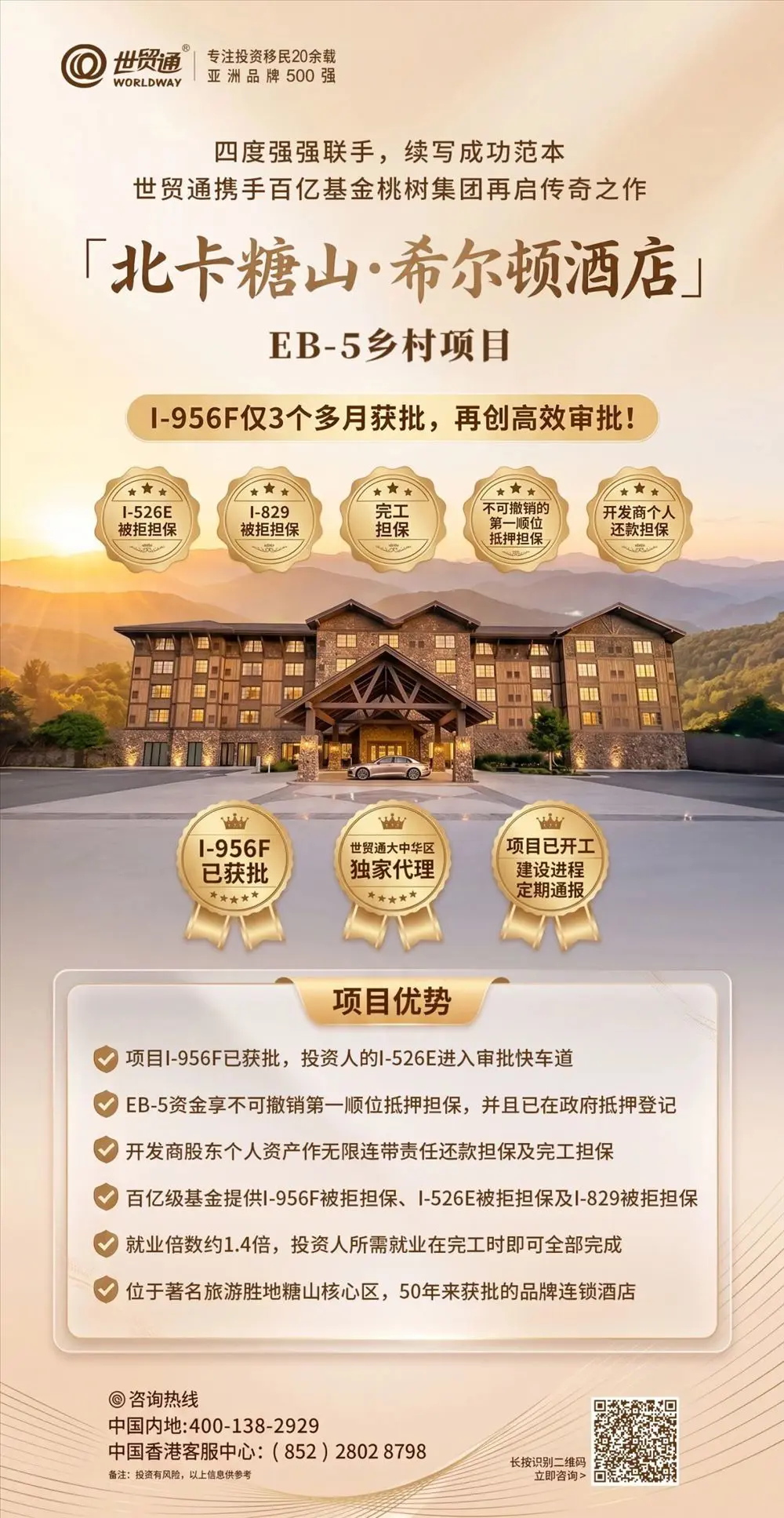
Great news! To help investors sprint for the EB-5 "930" golden window, WorldWay is launching a limited-time promotion. Clients who process U.S. immigration projects during June 2026 can enjoy exclusive WorldWay discounts. For details, please contact your exclusive WorldWay consultant or customer service.
For inquiries in Mainland China: 400-138-2929, Hong Kong, China Customer Service Center: (852)2802 8798