





For families planning to study in the United States, the U.S. student status policy is undergoing a significant change.
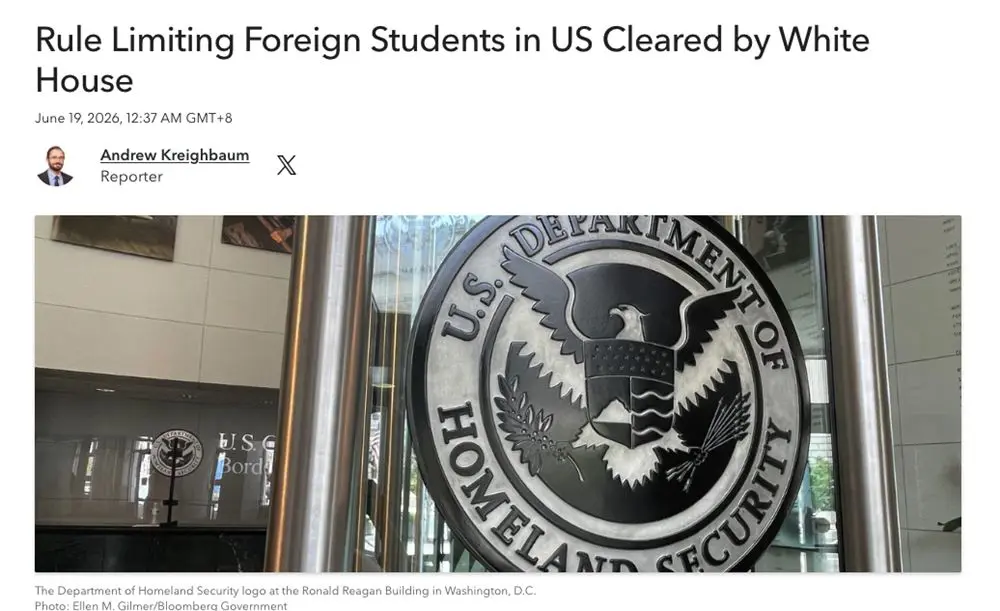
According to public information, the major reform proposal by the U.S. Department of Homeland Security (DHS) regarding F-1 student visas and J-1 exchange visitor visas received final approval from the White House Office of Management and Budget (OMB) on June 17, 2026.
This means that this highly anticipated reform has entered the final stage before official implementation. Next, it only awaits formal publication in the Federal Register, and the new regulations are expected to take effect approximately 60 days after publication.

I. What are the core changes brought by the new regulations?
1. Abolition of D/S indefinite status in favor of a fixed period
Under current policy: When entering the U.S. with F-1 or J-1 status, the duration of stay on the I-94 record is shown as "D/S". This means that as long as students or scholars maintain legal status and complete their studies, research, or exchange programs as required, they can remain legally in the U.S. without needing to apply for an extension from the immigration authorities.
Under the new regulations: F-1 and J-1 status will be managed under a fixed-term system. The I-94 duration of stay for all international students will no longer show "D/S" but will instead set a specific expiration date. This date will align with the duration of the academic program or a four-year period, whichever is shorter.
2. Extension procedures will become more administrative
Under current policy: Most extensions are handled by the school's international student office (DSO/ARO) without the need to file a separate application with the immigration authorities.
Under the new regulations: If a student experiences a delay in their study program, delayed graduation, or continues their studies, they will need to file an application for an extension of stay with the U.S. immigration authorities and submit proof of enrollment, proof of funds, identity documents, application fees, and potentially undergo biometric data collection.
3. Shortened grace period after graduation
Under current policy: F-1 students have a 60-day grace period after graduation. During this time, students can prepare to depart, transfer schools, apply for new programs, or change status (e.g., OPT, H-1B, etc.).
Under the new regulations: This period will be shortened to 30 days. This means that post-graduation status conversion and job search arrangements will become more time-constrained.
4. Stricter restrictions on transferring schools and changing majors
In principle, undergraduate students may not transfer schools or change majors within the first year of enrollment; for graduate students, cross-school transfers or changes in research programs will generally be prohibited throughout their entire period of study.
5. Restrictions on repeating studies at the same or lower academic level
The room for extending F-1 status by repeatedly pursuing degrees at the same or lower levels may be compressed. For example, pursuing another master's degree after completing one, or moving from a higher academic level to a lower one, may no longer be easily viewed as a normal path to maintaining student status as it was in the past.
6. Limitations on the duration of language courses
In the future, for students in ESL programs at language schools in the U.S., the cumulative duration of language training under F-1 status, including vacations and breaks, will be capped at 24 months. Exceeding this limit will require departure or a transfer to another program.
II. What are the impacts on international students?
U.S. international student status management is shifting from the relatively flexible model of the past to a new stage that places greater emphasis on deadlines, approvals, and compliance oversight.
First, status management will be stricter, and extension procedures will be more complex.
Second, common situations such as delayed graduation, transferring schools, changing majors, or continuing studies may all entail higher compliance requirements.
Third, the planning window after graduation may be shortened, and students will need to arrange OPT applications, job searches, further studies, or status conversions earlier.
For families planning to study in the U.S., it is no longer enough to focus only on school admissions; they must also consider academic cycles, professional paths, graduation timelines, and status transitions in advance.
The previously common path of "study abroad, then OPT, then H-1B, then apply for a Green Card" may face more uncertainty in the future.
III. The way forward: Proactive status planning
Once the new regulations officially take effect, the scheduling for studies, internships, employment, and status conversions for international students in the U.S. will face higher requirements. For families planning to study in the U.S. or those already studying there, planning status paths in advance will help reduce uncertainty in subsequent transitions.
Especially for families who have clearly decided they want to develop their long-term future in the U.S., status planning should not be passively considered only after graduation, but should be extended from a "study abroad path" to a "long-term residency path" as early as possible.
IV. Seizing the window: Locking in the new EB-5 law
In the current policy environment, the new EB-5 law remains one of the status planning methods worth paying attention to. Rural EB-5 projects are currently still in a no-backlog status and enjoy priority processing. For applicants currently in the U.S., while filing the I-526E immigrant petition, they can also file an I-485 application to adjust status, quickly obtaining a Combo card (EAD + Advance Parole), enjoying Green Card benefits in advance, and achieving legal employment and free travel.

It should be noted that the EB-5 grandfather clause will expire on September 30, 2026. On January 1, 2027, the minimum investment amount may increase from the current $800,000 to $900,000-$937,500 or even higher. For families intending to plan their U.S. status through EB-5, please be sure to seize the policy dividends, submit applications as early as possible, and lock in your priority date as soon as possible.
WorldWay holds high-quality EB-5 projects such as "Marriott Lakeview Resort" and "Hilton Hotel at Sugar Mountain, North Carolina" to help investors quickly realize their U.S. status planning.


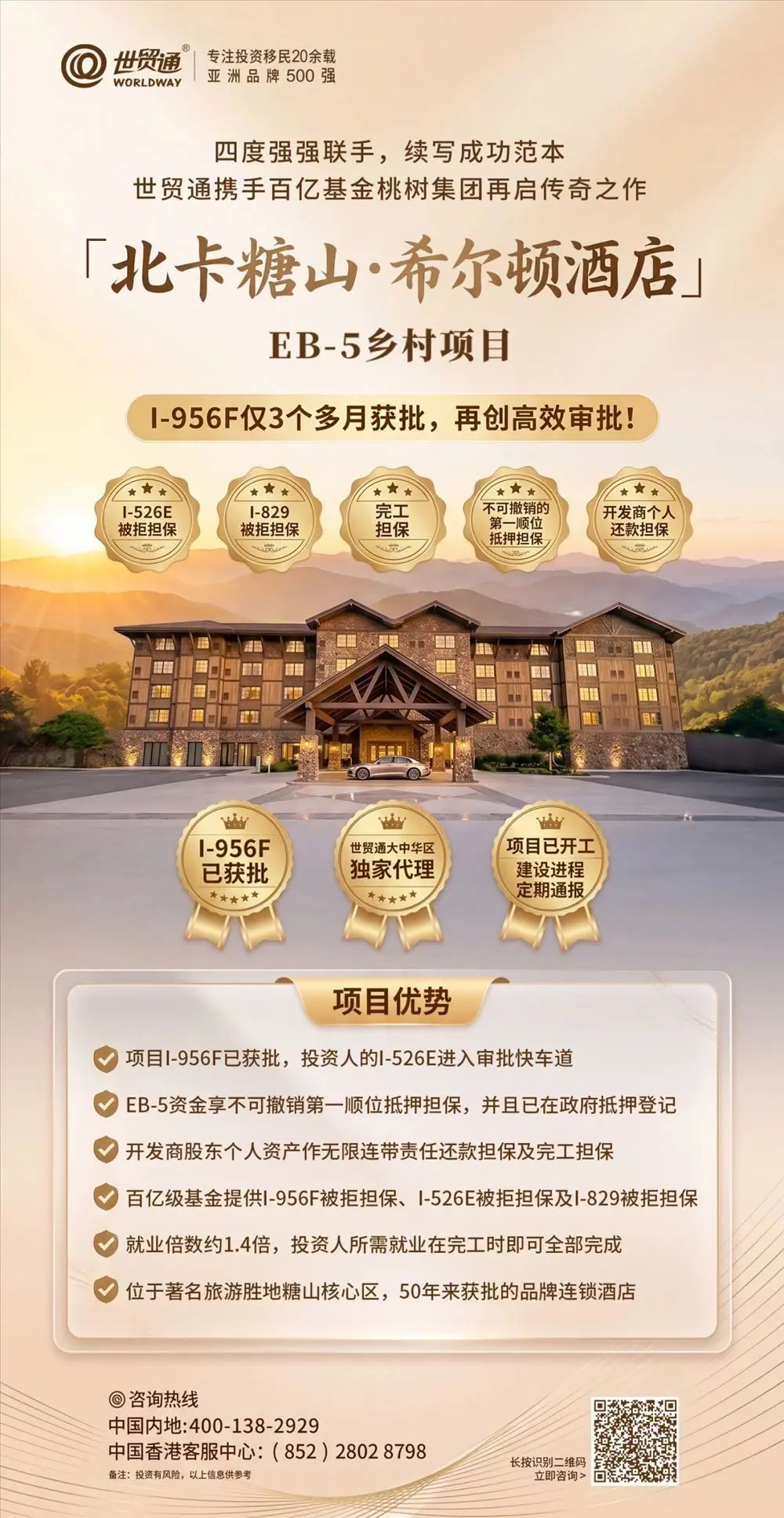
Great news! To help investors sprint for the EB-5 "930" golden window, WorldWay is launching a limited-time promotional event. Clients who process U.S. immigration projects during June 2026 can enjoy exclusive WorldWay discounts. For details, please contact your exclusive WorldWay consultant or customer service.
For inquiries in Mainland China: 400-138-2929, Hong Kong, China Customer Service Center: (852)2802 8798