





On May 22, a policy memorandum issued by the U.S. Citizenship and Immigration Services (USCIS) caused significant shockwaves within the immigration community. This memorandum was widely interpreted as "Adjustment of Status (AOS) applicants may be required to depart the country to wait for their Green Cards." (For details, please click to view previous reports by WorldWay: 1.Tightening: Is the U.S. Immigration "In-Country Green Card Adjustment Era" Ending? 2.Internal USCIS Memorandum Exposed: Redefining I-485 In-Country Green Card Adjustment?)
However, just one week later on May 29, as reported by The New York Times, the U.S. Department of Homeland Security (DHS) provided a latest clarification: stating that the memorandum did not make significant changes to current applications, and not all AOS applicants are required to depart the country.
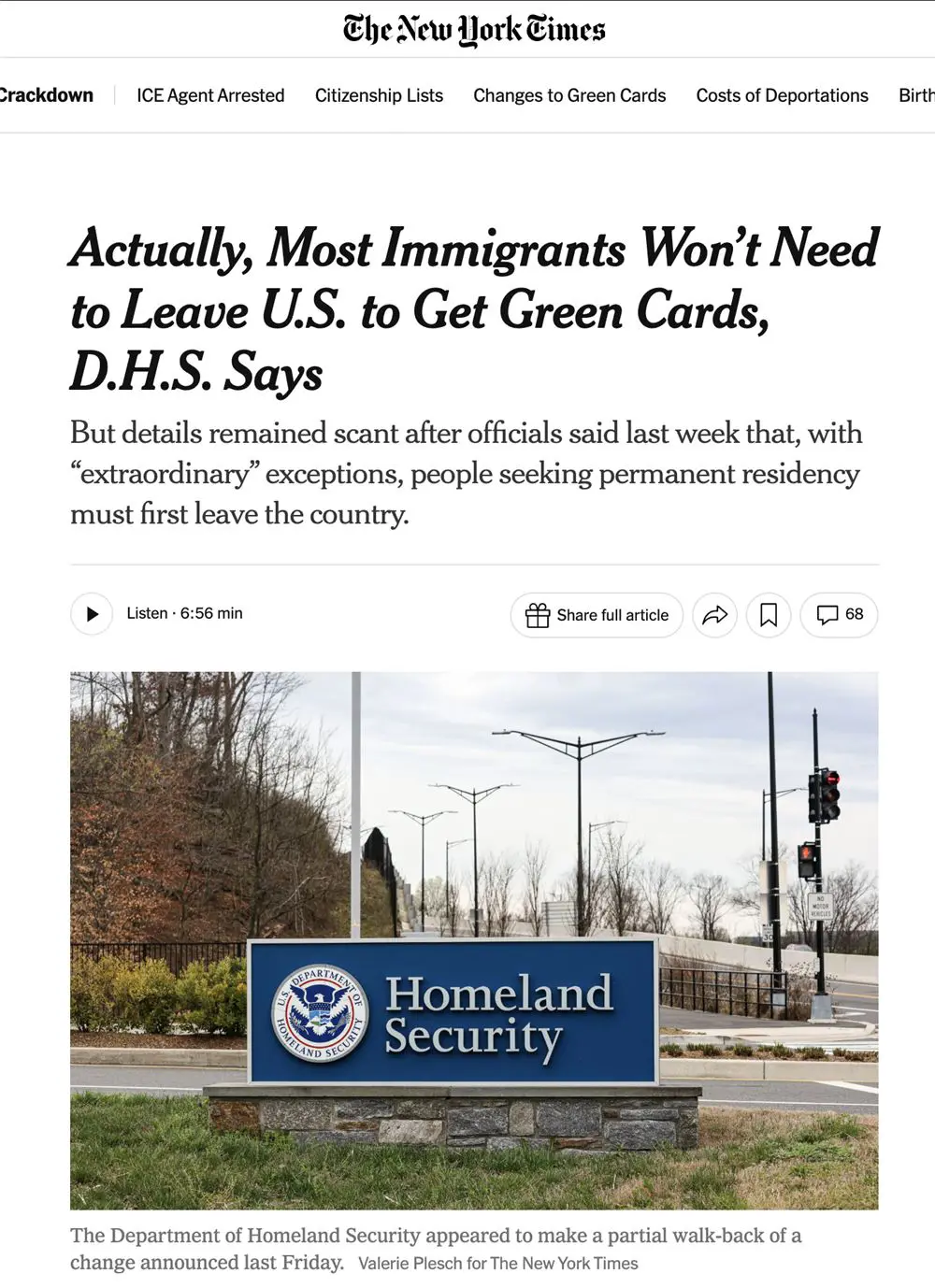

DHS Emphasizes: Not a Comprehensive Policy Change
DHS Clarification: This is not a major policy shift. Immigration officers have always possessed the discretionary authority to determine whether certain applicants should process through consular procedures rather than adjusting status within the United States.
DHS emphasized that the latest memorandum is merely a "reminder" to officers of this existing authority, rather than a new regulation imposing mandatory departure for all.
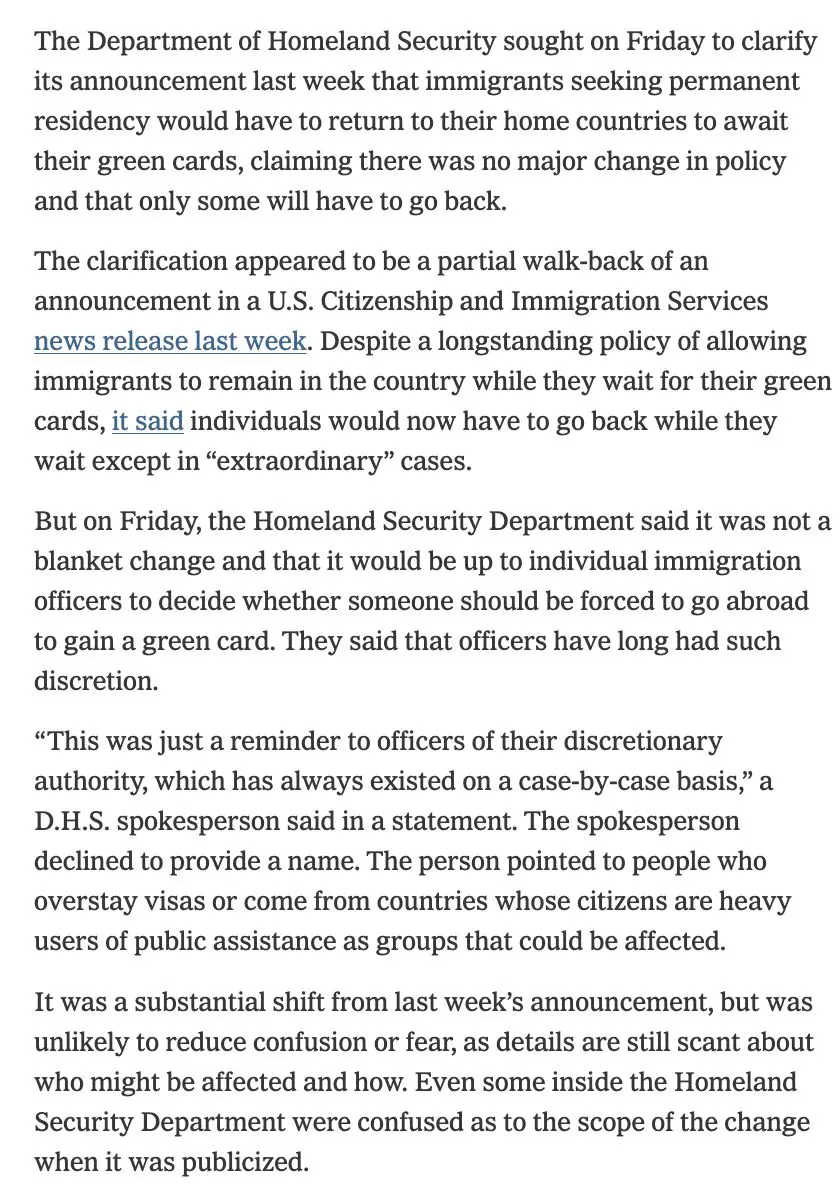
Risks Remain, Who Might Be Affected?
Although DHS has clearly stated that most applicants will not be required to leave the United States, it still explicitly identified groups that may be subject to focused review, including:
• Individuals with expired visas
• Applicants from countries with high rates of public benefit dependency
• Other cases deemed unsuitable for in-country adjustment of status
However, the authorities have not yet announced: clear review criteria, conditions for waiver applications, or how "National Interest Exceptions" will be determined. There remains significant uncertainty regarding how this will be implemented in the future.
Immigration Officers Have Begun Action
New Relevant Questions Added to Interviews
It is reported that recently, during AOS interviews, USCIS officers have begun directly asking: Why was an I-485 adjustment of status filed instead of returning to the home country for consular processing? Are there reasons why you cannot return to your home country for processing, etc.
This indicates that USCIS may indeed have begun case-by-case reviews, rather than simply keeping the policy on paper.
Divergence in Affected Groups
Family Immigration and Overstayers Face Greater Impact
Reports suggest that in this policy adjustment, employment-based immigration is not the primary target; family-based immigration may become a more significantly affected group, including spouses of U.S. citizens, adult children, and other family immigration applicants.
Most of these applicants lack stable, compliant non-immigrant status backups such as H-1B or L-1. Once required to depart and switch to consular processing, their life, work, and residence status in the U.S. will be directly interrupted.
EB-5 Investors: No Need for Panic at This Stage
Currently, the true intent of this memorandum is to raise the threshold for in-country adjustment of status and strengthen the discretionary power of USCIS. For EB-5 investment immigration, based on the latest clarification from DHS: there is currently no unified policy requiring "mandatory departure to wait for a Green Card," and the in-country I-485 adjustment of status procedure remains legally available and functional.
The core direction of current policy is: USCIS officers are authorized to more actively exercise case-by-case discretionary power. For a very small number of cases with special issues, there remains a possibility of being required to switch to overseas consular approval. However, the authorities have not yet released clear applicable scenarios, determination criteria, or waiver rules.
For EB-5 investors and families with long-term U.S. residency plans, they should view policy changes rationally. There is no need to conclude that the AOS channel has been cancelled, nor is there any need for excessive panic. Applicants who have already filed I-485 should avoid panic-driven actions and try to maintain their existing legal status during the adjustment of status processing period. Applicants who have not yet filed I-485 can make case-by-case judgments based on factors such as personal status history, entry records, whether there has been any overstay, and family and work arrangements.
WorldWay Group will continue to monitor the latest changes in U.S. immigration policy and provide clients with the latest analysis, risk warnings, and response suggestions in a timely manner.


For inquiries in Mainland China: 400-138-2929, Hong Kong Customer Service Center: (852)2802 8798