





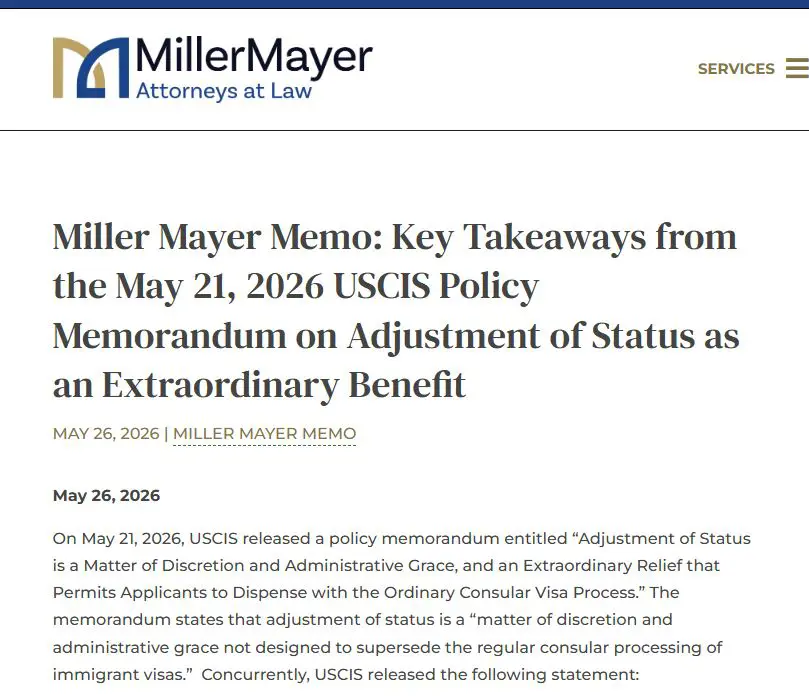
Recently, the renowned U.S. immigration law firm Miller Mayer released a memorandum interpreting an internal policy memorandum issued by U.S. Citizenship and Immigration Services (USCIS) on May 21, 2026.
The core message of this memorandum is very clear: Adjustment of Status (AOS, i.e., the I-485 process for obtaining a Green Card while in the U.S.) is not a right inherently enjoyed by applicants, but rather an administrative benefit based on the discretionary judgment of immigration officers, and it should not be used to replace the standard overseas consular immigrant visa process.

1. Adjustment of Status is a "Discretionary Benefit"
According to Miller Mayer's interpretation, the policy memorandum issued by USCIS on May 21, 2026, explicitly states that Adjustment of Status is a "matter of discretion and administrative grace" and is not intended to replace the standard consular process for immigrant visas.
USCIS also stated in its announcement that it is returning to the original intent of the law to ensure that foreign nationals use the U.S. immigration system correctly. Except in special circumstances, foreign nationals temporarily residing in the U.S. who wish to obtain a Green Card should return to their home country to apply through the consular process.
Miller Mayer further explained that Adjustment of Status is the process by which a non-immigrant applies for permanent residence or a Green Card while in the United States. Based on the information released in this memorandum and announcement, most non-citizens should apply for U.S. permanent residence from outside the country, and Adjustment of Status should only be granted to applicants who can demonstrate the existence of "special circumstances."
2. What factors might be prioritized in future I-485 adjudications?
According to the memorandum, immigration officers will adopt a "totality of the circumstances" approach in the future, weighing both positive and negative factors of the applicant.
Negative factors that may be subject to heightened scrutiny include:
• Whether the applicant has ever violated U.S. immigration laws;
• Whether the applicant has ever violated the conditions of their non-immigrant status or entry permit;
• Whether there is any fraud, misrepresentation, or if false information has been provided to USCIS or other government agencies;
• Whether the applicant met the legal, regulatory, and policy requirements at the time of their initial entry into the U.S. or when obtaining their entry permit;
• Whether the applicant's actions were inconsistent with the purpose of their non-immigrant status;
• Whether the applicant failed to depart in a timely manner as required by their original status;
• Whether there is an intent for long-term residence that is inconsistent with their temporary entry status;
• Whether the applicant failed to maintain valid non-immigrant status throughout the adjudication of the Adjustment of Status application.
3. Does this mean I-485 can no longer be done?
Not at all.
Miller Mayer specifically reminds applicants currently awaiting adjudication of their Adjustment of Status that it is not currently recommended to withdraw an I-485 application. At the same time, this policy should not be interpreted as a comprehensive barrier to Adjustment of Status. In particular, for applicants who hold dual-intent statuses such as H-1B or L-1, and who have employment, family ties, investments, assets, or other positive factors in the U.S., Adjustment of Status may still remain a viable option.
However, Miller Mayer also pointed out that there are still several uncertainties regarding this policy: the memorandum was issued without prior notice, has no clear effective date, and does not specify whether it applies to I-485 applications that have already been filed and are currently under review. Furthermore, it remains to be seen whether this policy will face legal challenges in the future.
Therefore, it is not appropriate to make overly absolute judgments about this policy at this stage. It does signal a trend toward stricter scrutiny, but the specific scale of implementation, whether it affects pending cases, and whether it will change in the future remain to be monitored.
4. What preparations can applicants consider?
Miller Mayer suggests that those who are currently processing or planning to file an Adjustment of Status application should: comprehensively collect and organize materials that can substantiate their favorable conditions, specifically including:
• Proof of family members in the U.S., work-related materials (affidavits from relatives, employment contracts, employer recommendation letters, etc.)
• Proof of community service and volunteer activities
• Proof of real estate ownership within the U.S.
• Documentation related to U.S. investments
Please keep all the above supporting documents in a safe place.
Applicants who have already had an immigrant petition (I-130, I-140, I-526, I-526E) approved and originally chose to adjust status within the U.S.: you may consider filing Form I-824 to switch to the overseas consular processing channel as a backup plan. This is especially recommended for those who entered the U.S. on B or F visas, or those who entered under parole status.
WorldWay Tip: Do not panic, but prioritize individual compliance assessment
WorldWay believes that this USCIS policy memorandum does not equate to the cancellation of I-485, nor does it mean that the channel for domestic Adjustment of Status has been closed. Its more significant signal is that whether an applicant is suitable for adjusting status within the U.S. in the future will depend more on individual case circumstances and compliance records.
For applicants at different stages, WorldWay suggests focusing on the following points:
First, for applicants who have already filed I-485, it is not recommended to withdraw the application rashly.
For applicants currently awaiting adjudication of their Adjustment of Status, the more prudent approach is to continue monitoring whether USCIS releases more specific implementation details or policy updates, and to evaluate whether the individual case requires supplementary materials or adjustments to subsequent strategies in consultation with legal counsel.
Second, try to maintain your original legal status during the Adjustment of Status adjudication period.
Even if an I-485 has been filed, it is not recommended to easily allow student status, work visa status, or other legal non-immigrant statuses to lapse if conditions permit. Maintaining a stable and valid legal status arrangement until the Green Card is finally approved helps reduce uncertainty.
Third, applicants who have not yet filed I-485 should first undergo an individual case assessment by an attorney.
Before filing, applicants should have a professional immigration attorney assess their current visa type, entry records, status maintenance, whether there is any overstay or unauthorized work, and whether filing an I-485 might raise questions regarding the purpose of entry.
Overall, this policy signal is not a total negation of the domestic Adjustment of Status path, but rather a reminder to applicants that future U.S. Green Card applications will place greater emphasis on the reasonableness of the status path, the compliance of the application record, and the completeness of individual case materials.
Currently, the specific implementation scale of this policy, whether it applies to pending cases, and whether there will be further explanations or adjustments remain to be continuously observed. WorldWay Group will continue to monitor the situation, follow up on the latest developments, and provide clients with professional analysis, risk warnings, and response suggestions in a timely manner.


For inquiries in Mainland China: 400-138-2929, Hong Kong Customer Service Center: (852)2802 8798