





As global high-net-worth families increasingly focus on residency planning, asset allocation, tax arrangements, and wealth succession, Turkey is exerting a strong appeal to global capital and high-net-worth individuals with a new round of tax incentive policies.
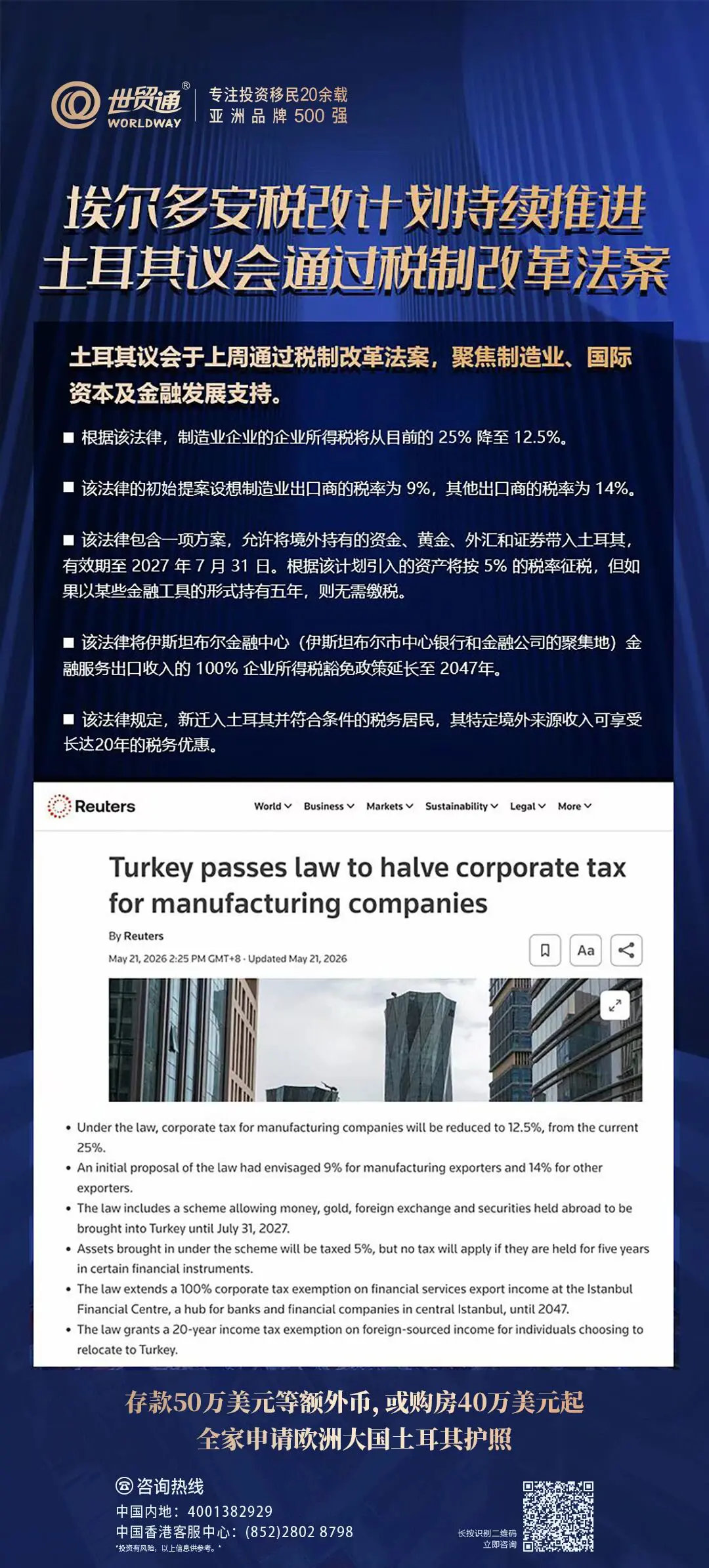
Recently, the Grand National Assembly of Turkey passed a tax reform bill, introducing a package of tax and investment incentives. According to public information from the Turkish Parliament, the key points of the bill include: Eligible new tax residents can enjoy an exemption from income tax on foreign-sourced income for up to 20 years; inheritance and gift tax for eligible individuals can be reduced to 1%; and it is accompanied by various incentive policies such as asset repatriation, corporate income tax, and the Istanbul Financial Center.
With the implementation of these tax policies, the comprehensive value of the Turkish Citizenship by Investment program has been further upgraded, becoming an important choice that integrates residency planning, tax planning, and wealth succession.
From Personal Income to Corporate Operations
Policy Benefits Fully Unleashed
This tax reform is not only aimed at individuals but also covers multiple levels such as corporate operations, asset repatriation, and financial development, sending a clear signal of Turkey's commitment to attracting global capital and high-net-worth individuals.
At the individual level, eligible new tax residents can enjoy a tax exemption on foreign-sourced income for up to 20 years, covering foreign dividends, interest, rent, and capital gains. For individuals with overseas assets, foreign investment income, or income from multinational businesses, Turkey's tax appeal has significantly increased.
Regarding asset allocation, Turkey has simultaneously launched preferential policies for asset repatriation. Individuals and companies can declare and transfer overseas funds, gold, foreign exchange, and securities within a specified period; the longer the assets are retained, the lower the applicable tax rate, with a 0% tax rate available after a five-year retention period, providing a new window for compliant capital repatriation and global asset reallocation.
In terms of wealth succession, eligible individuals can also enjoy a 1% inheritance and gift tax incentive, which is conducive to long-term family wealth planning for high-net-worth families.
At the corporate level, Turkey has further reduced the corporate tax burden. The corporate income tax rate for manufacturing enterprises will be reduced from 25% to 12.5%; the tax rate for manufacturing exporters can be reduced to 9%, and the rate for other exporters is 14%. Meanwhile, the 100% corporate income tax exemption policy for financial service export income related to the Istanbul Financial Center has been extended to 2047, further promoting Turkey's efforts to build a financial and trade hub connecting European, Asian, and Middle Eastern markets.
Turkey Immigration:
More Than Just Residency, It Is Comprehensive Allocation
With the passage of this tax reform, Turkey's comprehensive appeal has been further enhanced. For global investors and high-net-worth families, the value of Turkey is no longer limited to obtaining an international residency status, but extends to multiple dimensions such as tax planning, asset allocation, corporate operations, and wealth succession, making it a comprehensive planning destination worthy of key attention.
First, residency configuration. Obtaining Turkish residency through investment adds an international residency option for the family.
Second, tax planning. Eligible new residents can enjoy a 20-year tax exemption on foreign-sourced income, which helps business owners and high-net-worth families re-evaluate their global tax residency layout.
Third, wealth succession. The 1% inheritance and gift tax arrangement provides new policy incentives for family wealth succession.
Fourth, corporate operations. Preferential policies such as the Istanbul Financial Center, entrepot trade, and financial service exports provide new landing points for multinational businesses.
Fifth, life and asset allocation. Turkey spans Europe and Asia, and Istanbul possesses the attributes of an international metropolis, a commercial center, and a destination for living; at the same time, as a member of the G20 and OECD, Turkey's GDP in 2025 was approximately USD 1.6 trillion, making it the 17th largest economy in the world.
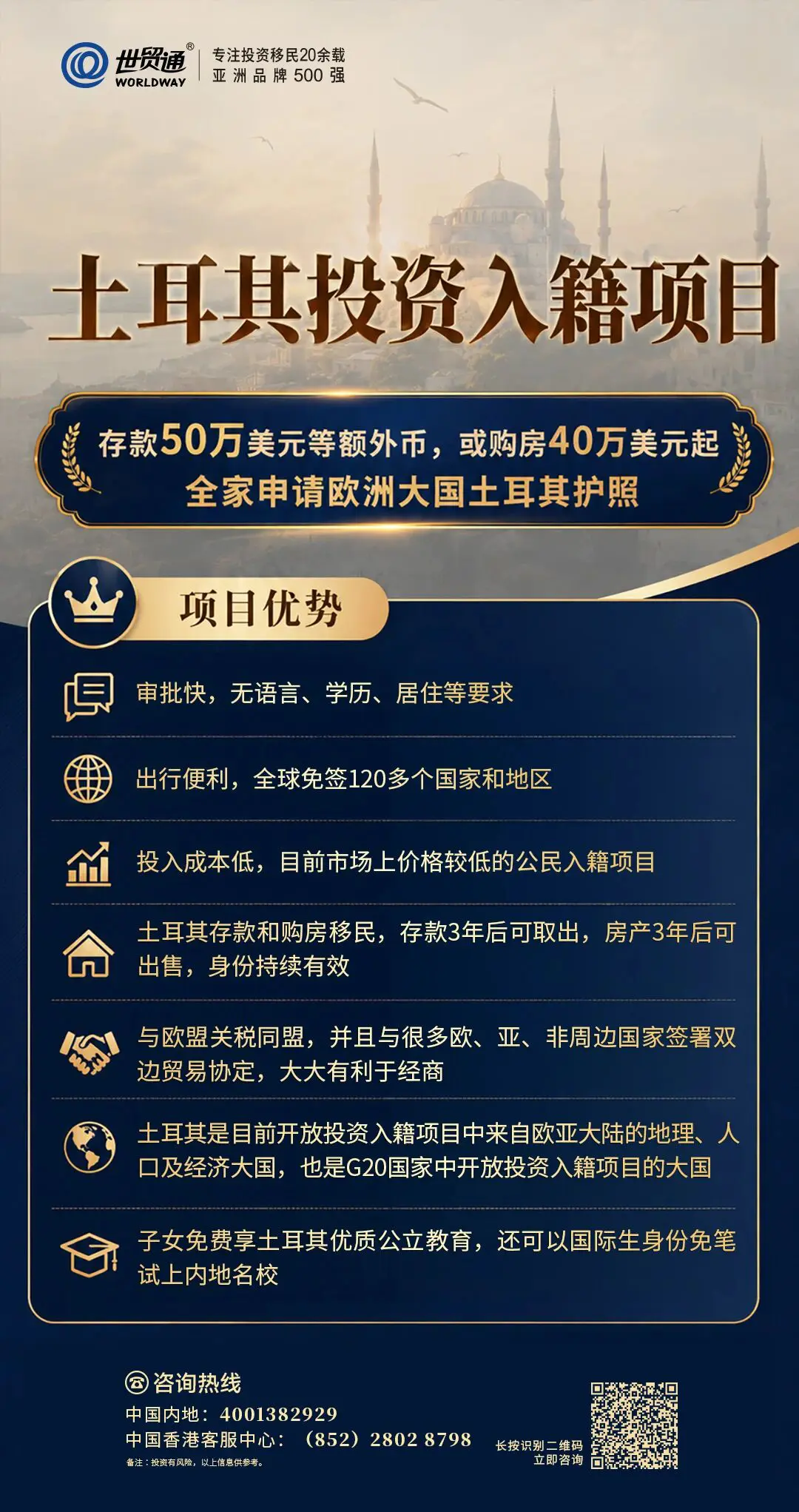
For investors who are considering a second residency, overseas asset allocation, and long-term family planning, Turkey is entering a new window of attention. Applicants can apply for a Turkish passport for the whole family by depositing USD 500,000 or more in foreign currency, or by purchasing property starting from USD 400,000.
For inquiries in Mainland China: 400-138-2929, Hong Kong, China Customer Service Center: (852)2802 8798