





More important than the press release is this internal policy memorandum.
WorldWay Group Research Center: Following the previous article published by WorldWay: "USCIS Major Tightening: Is the 'In-Country Green Card Adjustment Era' for U.S. Immigration Coming to an End?" (click the link for details), an internal Policy Memorandum from the U.S. Citizenship and Immigration Services (USCIS) has further shaken the U.S. immigration industry.
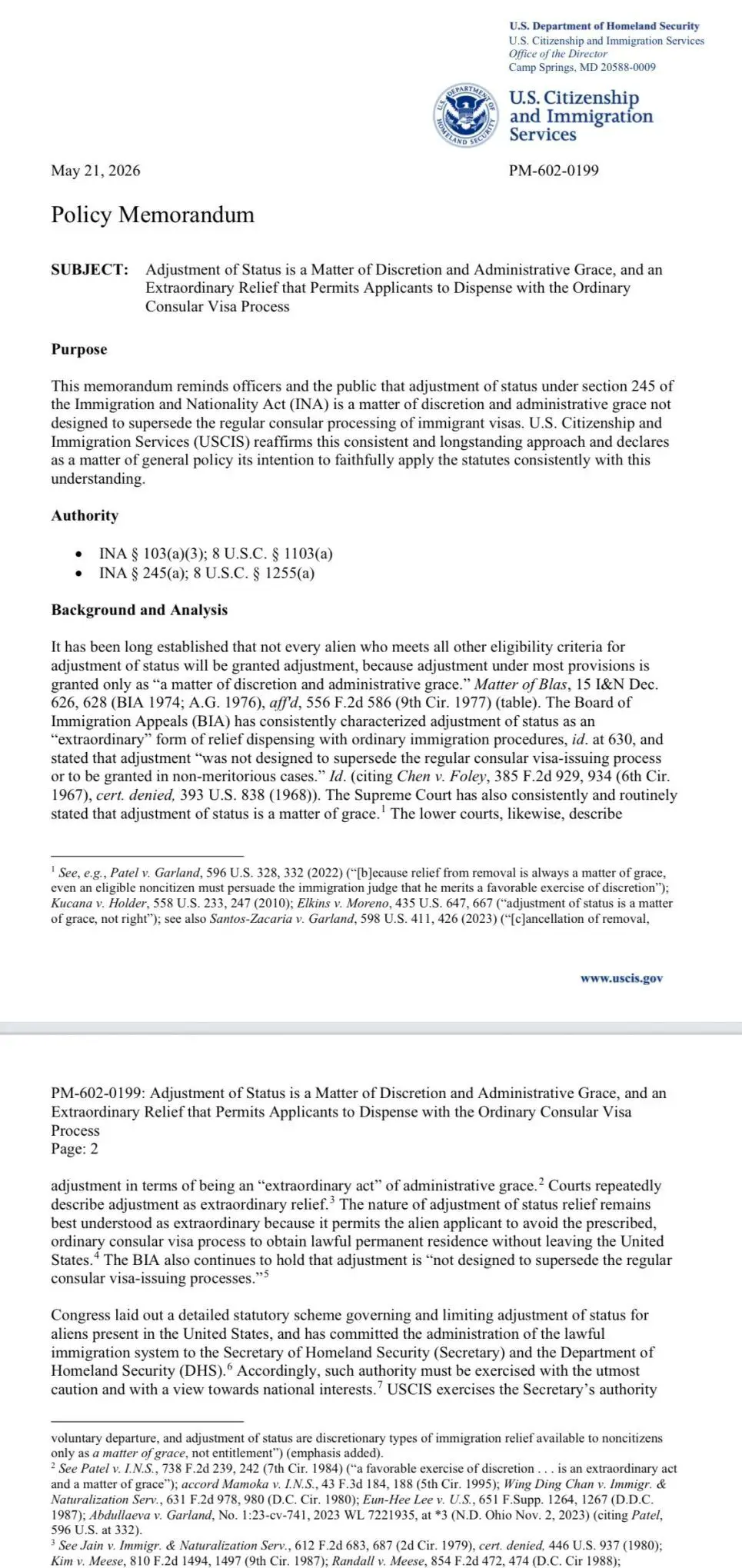
Because compared to a press release, this memorandum is the true "internal adjudication logic" written for immigration officers.
And the signals it releases are clearer and more far-reaching than any press release.

I. What is truly terrifying about this memorandum?
Many people think: USCIS is just "tightening the review process."
But in reality, the core of this memorandum is that USCIS is redefining what is meant by "AOS (Adjustment of Status)." That is: what is meant by "in-country green card adjustment."
USCIS has explicitly stated for the first time: AOS is not a "right." Instead, it is: "Administrative Grace."
The memorandum states at the outset: "Adjustment of Status is a Matter of Discretion and Administrative Grace."
At the same time, the memorandum repeatedly cites historical precedents from the U.S. Supreme Court, federal courts, and the Board of Immigration Appeals (BIA), emphasizing that even if an applicant meets the eligibility requirements, it does not mean they are guaranteed approval.
Because: AOS is essentially a form of "extraordinary relief."
This means that the belief held by many in the past—that "as long as you meet the requirements, you can adjust to a green card within the United States"—is being fundamentally overturned by USCIS from a systemic logic perspective.
USCIS is now emphasizing that in-country green card adjustment is not a standard path, but an exceptional one.
II. USCIS is re-elevating
"Consular Processing." This is one of the most significant strategic changes in this memorandum.
The memorandum repeatedly emphasizes that the normal U.S. immigration path should be:
* Applying for an immigrant visa overseas
* Attending an interview at a U.S. consulate
* Entering the United States as a permanent resident
Rather than: entering the U.S. with a temporary status and then adjusting to a green card while in the country. USCIS even explicitly writes that AOS "should not replace the normal overseas consular immigrant visa process."
III. The truly dangerous new change is here
There is an extremely critical sentence in the memorandum: USCIS believes that if an applicant could have immigrated through the normal consular process but chose to attempt to bypass it, this itself may become a negative factor.
What does this mean? It means that in the future, immigration officers may ask: "Why didn't you return to your home country for consular processing?" And this could become part of the I-485 discretionary review.
IV. A "buffer logic" to pay special attention to
The U.S. legal community generally believes that "Economic Benefit" and "National Interest" may become important exemption logics for USCIS in future AOS adjudications.
Therefore:
* H-1B
* L-1
* O1
* EB-1A
* NIW
* EB-5
Because they inherently possess:
* Employment contributions
* Investment contributions
* Talent attributes
* National interest attributes
In the short term, they may not be the primary targets of USCIS restrictions. However, this does not mean automatic approval. Individual case reviews will still be required in the future.
V. What does this mean for EB-5?
Although the memorandum does not explicitly name EB-5, in reality, the path of entering with a short-term status such as B1/B2 and then performing "Concurrent Filing (I-526E + I-485)" is very likely to become one of the areas of focus for USCIS.
Because: in the past few years, the operational path for some EB-5 clients has been:
* Entering the U.S. on B1/B2
* Staying for 90 days
* Concurrent Filing (I-526E + I-485)
* Obtaining a Combo card
* Staying in the U.S. long-term
But now, USCIS is re-emphasizing: Temporary means temporary.
Therefore, this policy has no impact on EB-5 applicants following the consular processing route; whether it impacts EB-5 applicants using "Concurrent Filing" depends primarily on their current status.
In short, the compliance of EB-5 "Concurrent Filing" is not the issue; the core depends on the status the applicant held when entering the United States.
VI. The danger is not "prohibition," but "expanded discretion"
Many people mistakenly believe that the U.S. has already banned I-485. In fact, it has not. INA 245(a) has not been cancelled, and I-485 still exists.
But the real danger is: USCIS is expanding the discretionary space for immigration officers.
This means that in the future, even if an applicant is: technically eligible, they may not necessarily receive: favorable exercise of discretion.
VII. What will immigration officers focus on in the future?
The memorandum has provided the direction; USCIS will focus on reviewing the following in the future:
* Purpose of entry
* Non-immigrant intent
* Whether status conditions were violated
* Whether there were actions inconsistent with the purpose of entry
* Whether there was overstaying
* Whether there was unauthorized employment
* Whether there was fraud or misrepresentation
* Whether there was an attempt to bypass normal consular procedures
* Whether it aligns with the "best interests of the United States"
Even "failure to depart as expected" could become a negative factor.
But there is one important exception; the memorandum also acknowledges that the "Dual Intent" category still exists. For example: H-1B; L-1.
USCIS explicitly states: Maintaining dual intent status is not contradictory to applying for AOS.
However, USCIS also emphasizes: Even with dual intent status, it does not automatically guarantee favorable discretion.
VIII. Who is truly hit the hardest?
WorldWay believes: The impact of this memorandum is primarily on the B1/B2 path.
In particular, the risk of "concurrent filing after entering on a tourist visa" has clearly increased for the future.
While F-1, H-1B, and L-1 may also be affected, relatively speaking, long-term legal status is usually easier to explain than short-term visitor status like B1/B2.
Among them, H-1B and L-1 belong to the "Dual Intent" status explicitly recognized by law, which is relatively more advantageous; while F-1 does not belong to the "Dual Intent" category, in practice, it is usually easier to maintain the consistency of status logic than B1/B2.
However, F-1 applicants must pay special attention: If they have already stopped their studies, their student status has expired, they are relying long-term on I-485 Pending status, EAD work permits, or AP travel documents, or their behavior in the U.S. has clearly deviated from the original purpose of "student status," the risk in future AOS discretionary reviews will increase significantly.
IX. Why is the U.S. doing this suddenly now?
Judging from the content of the memorandum, the U.S. is re-strengthening: "Temporary means temporary."
The underlying logic includes:
1. Re-strengthening immigration boundaries
The U.S. is re-emphasizing: Temporary entry ≠ Permanent immigration.
2. Reducing status abuse
USCIS explicitly mentioned the desire to reduce:
* Illegal overstaying
* Status violations
* Bypassing normal immigration procedures
3. Reducing pressure on USCIS
The memorandum clearly releases a tendency to "push more immigrant visa cases back to overseas consulates."
In other words: In the future, the importance of Consular Processing may significantly rise again.
X. What does this mean for high-net-worth Chinese families?
Future U.S. status planning will become increasingly complex.
In the past, many clients focused on: "How to enter the U.S. the fastest."
In the future, what may be more important is: "How to be more stable, long-term, and compliant."
XI. WorldWay's assessment
WorldWay believes: The U.S. immigration industry is entering an era of "high scrutiny, high discretion, and high compliance."
The truly important capability in the future will no longer just be: project sales capability.
Instead, it will be: path design capability, risk control capability, and long-term planning capability.
XII. Is "Concurrent Filing" currently completely impossible to do?
According to new communications between WorldWay and several large U.S. immigration law firms: Currently, I-485 has not been cancelled, and concurrent filing has not been officially prohibited.
But the adjudication standards and future execution direction are clearly tightening. In particular, the uncertainty of the B1/B2 path has clearly increased.
Therefore, whether it is suitable for "concurrent filing" in the future must be analyzed on a case-by-case basis.
XIII. WorldWay's special reminder
It should be specifically noted that: The memorandum released by USCIS this time did not abolish the I-485 (Adjustment of Status) system, nor did it officially announce that all "Concurrent Filing" is unfeasible.
Currently, the U.S. Immigration and Nationality Act (INA) Section 245 remains effective, and the I-485 in-country status adjustment application still exists at the legal level.
However, this memorandum significantly increases the intensity of discretionary review by USCIS in AOS (in-country status adjustment) adjudications.
In particular, USCIS is re-emphasizing: "Temporary means temporary."
And it is re-strengthening: The importance of Consular Processing as a normal immigration path.
Therefore: Future new "concurrent filing" applications may theoretically still have room for operation, but the uncertainty of adjudication has clearly increased.
Especially: Cases where green card applications are submitted after entering with a temporary visitor status such as B1/B2 will need to be more cautious in the future.
And while "Dual Intent" statuses such as H-1B and L-1 are relatively safer, it does not mean automatic approval.
WorldWay Group will continue to maintain close communication with major U.S. immigration law firms and relevant professional institutions, continue to monitor subsequent USCIS implementation details, judicial challenges, and actual adjudication trends, and provide clients with new analysis and risk warnings in a timely manner.
XIV. WorldWay's advice
Facing current changes, WorldWay advises applicants:
1. Do not blindly rely on "tourist visa concurrent filing"
Future risks are already significantly different from the past.
2. Re-emphasize "Consular Processing"
In the past, many people thought consular processing was slow and troublesome, but in the future, consular processing might actually be more stable.
3. Plan long-term global status in advance
Future global status planning is no longer just about "getting a status," but about long-term global family layout.
Conclusion:
✔ I-485 not abolished
✔ Concurrent filing not officially prohibited
✔ USCIS is strengthening discretionary review
✔ B1/B2 risk rising
✔ F-1 risk unclear, requires caution
✔ H/L relatively more stable due to dual intent
✔ EB-5 may receive a buffer due to economic benefit
✔ Everything depends on how USCIS executes
The U.S. immigration system is undergoing profound changes.
And what is truly important is no longer just: "Can it be done?"
Instead, it is: "How to complete a global status layout more stably, safely, and long-term."
The U.S. immigration industry is entering: a new era.


For inquiries in mainland China: 400-138-2929, Hong Kong, China customer service center: (852)2802 8798