





When many families discuss studying abroad, they first think of schools, majors, admissions, and employment, all of which are certainly important. However, modern study-abroad planning must also consider whether a child can have a more stable and broader space for development after completing their studies.
Recently, the data platform Voronoi analyzed the educational backgrounds of 3,184 billionaires worldwide based on the "Forbes 2026 World's Billionaires List" and public educational records. Data shows that 45.38% of billionaires come from the world's top 100 universities. Among these 100 universities, the head effect is even more pronounced: the top 10 universities contributed approximately 35.99% of these billionaire alumni. Harvard is particularly prominent, with 134 billionaire alumni, corresponding to a wealth scale of approximately $1.235 trillion, accounting for about 9.09% of the total wealth of all billionaires.
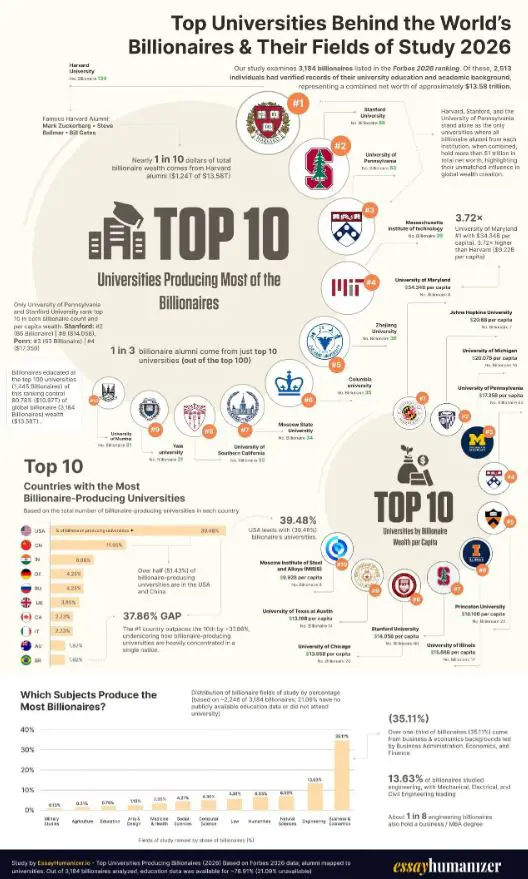
This set of data does not suggest that "attending a prestigious school guarantees success," but rather reminds us that high-quality educational platforms are often connected to richer industrial opportunities, talent networks, and long-term development environments.
High-quality education is the starting point for long-term development
Good education is first reflected in systematic academic training and capability cultivation. The curriculum system, faculty, research resources, and academic environment of excellent universities will have a long-term impact on a student's knowledge structure, professional capabilities, and judgment.
Study-abroad planning should look beyond school rankings to the industrial environment and development opportunities behind the school. For example, many well-known universities in the United States are closely linked to fields such as technology, finance, life sciences, engineering, consulting, and venture capital, making it easier for students to access research projects, internship opportunities, entrepreneurial resources, and alumni networks during their studies.
Data from Voronoi also shows that among the most common fields of study for billionaires, business and economics account for the highest proportion at 35.11%; engineering ranks second at 13.63%; and majors such as computer science, law, and natural sciences also account for a certain proportion.
Especially against the backdrop of AI, technological innovation, and global industrial changes, the competition students face in the future will be more comprehensive. Professional ability remains the foundation, but career development often also requires industry understanding, practical experience, communication skills, and cross-cultural adaptability.
Therefore, studying abroad is not an isolated educational action, but a continuous path: from school selection and professional direction to internship opportunities, the job market, and finally visa arrangements and long-term status planning. The earlier these factors are considered together, the more proactive a family's future choices will be.
Status is an unavoidable variable for studying in the United States
For many Chinese families, the United States remains an important destination for studying abroad.
The United States possesses numerous world-leading universities, a mature scientific research system, an active innovation environment, developed capital markets, and a wealth of high-end employment opportunities. For students wishing to enter fields such as AI, technology, finance, engineering, life sciences, and business management, the United States remains highly attractive.
However, studying in the United States should not just be about "whether one can get admitted," but also whether the child can successfully transition to internships, employment, and long-term development after graduation.
The development path for many international students in the United States usually involves F-1 student status, OPT internships, H-1B work visas, and then seeking long-term status. This path itself is not without opportunities, and many excellent students can still achieve great development through their own abilities. However, it also means that a child's future development will be influenced by factors such as visa expiration, employer support, quota mechanisms, and policy changes.
In other words, development after studying in the United States is not just an educational issue, but also involves career planning and status arrangements. For families planning for their children to study, intern, work, or even start businesses in the United States for the long term, status planning also needs to be incorporated into the overall consideration earlier.
EB-5, an important choice for long-term U.S. status planning
Among the paths for U.S. status planning, EB-5 investment immigration is a method favored by many high-net-worth families, especially rural projects under the new law.
For families planning for their children to study, intern, work, or even start businesses in the United States for the long term, the value of EB-5 is not just about obtaining a status, but about adding stability and initiative to the child's future development path in advance.
• No Visa Backlog & Priority Processing: Under the new EB-5 law, rural reserved projects have more sufficient quotas, are currently without a backlog, and enjoy priority processing. The earlier you submit, the earlier you enter the approval queue.
• Concurrent Filing (I-526E + I-485): For applicants currently in the United States, they can file an I-485 adjustment of status application while submitting their I-526E immigration petition.
• Employment Authorization and Advance Parole: Quickly obtain a Combo Card (EAD + Advance Parole) to enjoy green card benefits in advance, enabling legal employment and free travel in and out of the country.
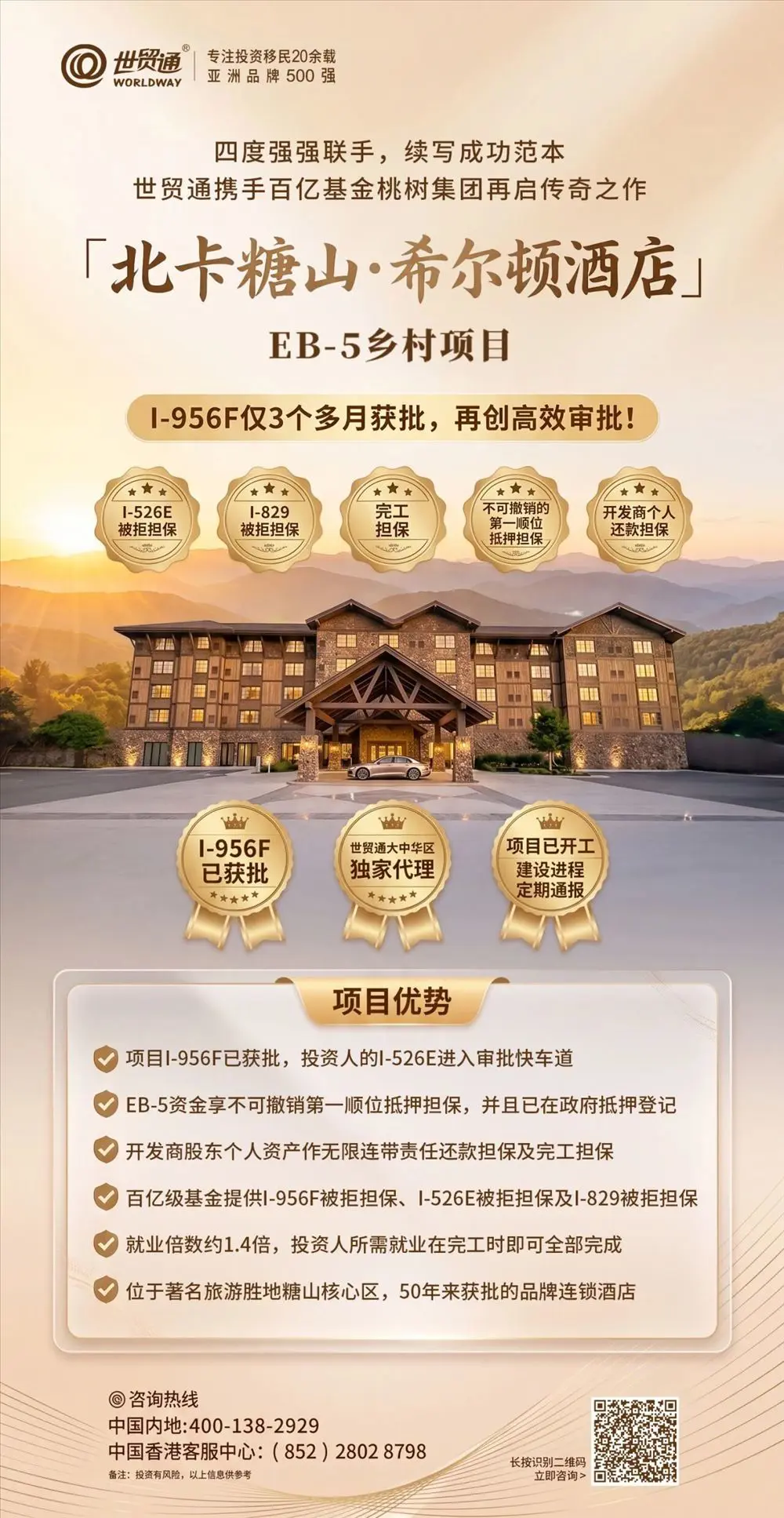
Studying abroad is an important educational choice and a long-term family plan. Education determines what kind of platform a child can enter; status influences whether the child can continue to develop on that platform. WorldWay holds high-quality rural EB-5 projects with official I-956F approval——"Sugar Mountain Hilton Hotel", helping investors quickly realize their U.S. status planning and embark on a new life in the United States.

For inquiries in mainland China: 400-138-2929, Hong Kong, China Customer Service Center: (852)2802 8798