





Against the backdrop of waves of layoffs, tightening visa policies, and the continuously rising uncertainty of the H-1B lottery, many international students and H-1B holders in the U.S. are facing unprecedented anxiety regarding their immigration status.
In the past, the primary concern was "whether one could win the H-1B lottery"; however, the issue is becoming increasingly complex: even if selected, is the sponsoring company truly compliant? Does the position actually exist? Can the office location withstand scrutiny? These details, which were easily overlooked in the past, are now becoming new risk factors affecting the security of one's immigration status.

Nearly 30 Companies Under Investigation
H-1B Compliance Risks Brought to the Forefront
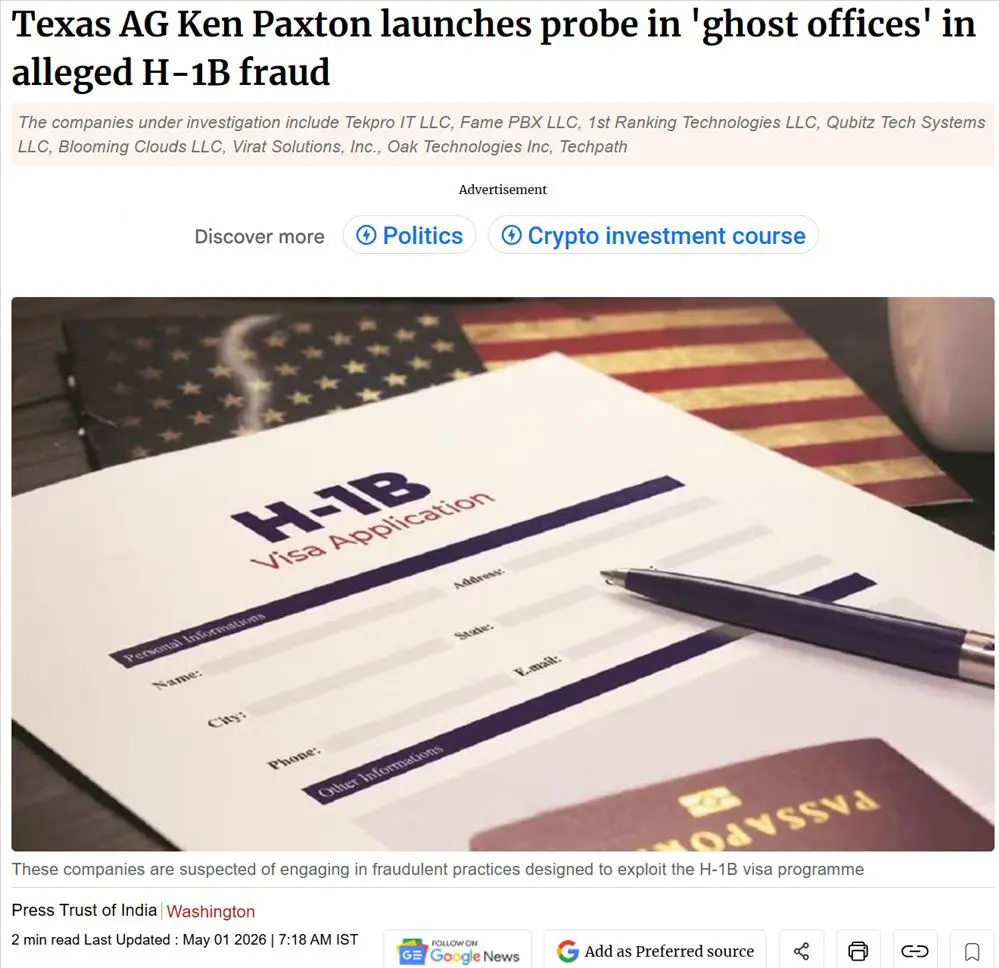
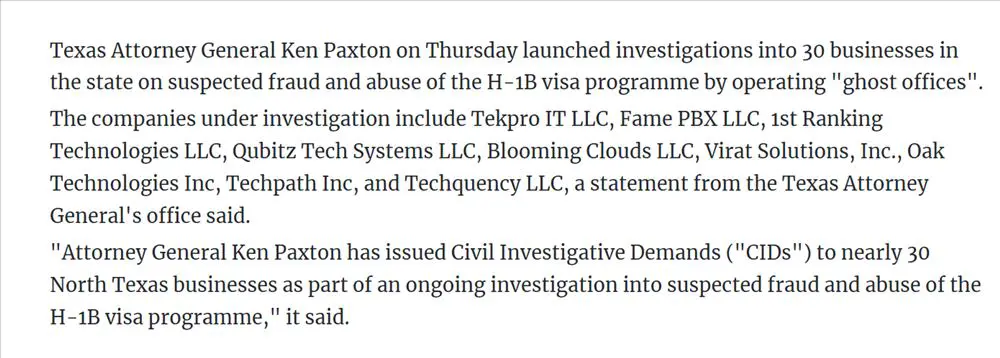
Recently, Texas Attorney General Ken Paxton announced that civil investigative demands have been issued to nearly 30 companies in North Texas, investigating whether they are suspected of abusing the H-1B visa program through methods such as "ghost offices." Currently, some of the named companies have been made public, sparking high concern among international students and H-1B applicant groups.
What is a "ghost office"?
Under federal law, an H-1B position must have a real working environment and specific professional duties. A so-called "ghost office" typically refers to a situation where a company declares a seemingly compliant office address, but the address does not have actual business operations, or it is merely a vacant space, a virtual office, a residential address, or a shared address that lacks the conditions for actual employment and real work.
If a company uses a fake address to package an "actual workplace," or utilizes shell companies or staffing agency models to create a "façade of compliance," not only may the company itself face investigation, but the immigration status security of the relevant applicants may also be indirectly affected.
State Government Intervention
H-1B Regulatory Logic is Changing
The H-1B program originally belonged to the federal immigration system, primarily handled by U.S. Citizenship and Immigration Services (USCIS), with the U.S. Department of Labor responsible for LCA and related labor compliance requirements. However, the unique aspect of this incident is that the Texas state government is directly intervening in the compliance review of H-1B-related companies using state-level investigative authority.
This indicates that H-1B regulation is shifting from being primarily federal-led to further extending into multiple levels, including the authenticity of business operations, employment relationships, wage compliance, and local law enforcement, with the overall review environment clearly tightening.
What does this mean for
international students and H-1B applicants?
This Texas investigation serves as a wake-up call for international students who are currently job hunting, participating in the H-1B lottery, waiting for their H-1B to take effect, or preparing for visa renewal. In the past, many believed that as long as a company was willing to provide H-1B sponsorship, it was an opportunity. But in the future, applicants need to pay closer attention to the following issues:
• Whether the company is truly operating, rather than being a shell company or an agency that profits solely from visa services.
• Whether the office address is real and matches the LCA, wage standards, and actual work location.
• Whether the job duties are clear and truly meet the requirements for a professional position.
• Whether the salary is reasonable and meets the wage requirements for the corresponding region and position.
• Whether the company has the capacity for sustained employment and whether there are large-scale layoffs, operational irregularities, or compliance disputes.
Once a sponsoring company is investigated, the applicant's status, visa renewal, entry, change of status, and even future green card path may all be affected. Combined with a series of previous signals of policy tightening, such as rising H-1B-related fees, expanded social media scrutiny, and the shift of lottery rules toward wage weighting, the feasibility and stability of the traditional "study → OPT → H-1B → green card" path are being further weakened.
Planning for staying in the U.S. requires early status planning
In the past, many viewed "winning the H-1B lottery" as the end goal for staying in the U.S.; today, more and more people are beginning to realize that it may just be a new starting point full of uncertainty. This is why an increasing number of families are beginning to re-evaluate their strategies for staying in the U.S. and are turning their attention to paths that can provide "status certainty."
Against this backdrop, the "concurrent filing" policy brought about by the new EB-5 investment immigration law has become a significant advantage in the current window period. Eligible applicants in the U.S. can file Form I-526E and Form I-485 simultaneously and quickly obtain a Combo card, thereby securing legal residence, work authorization, and travel convenience as early as possible.
It is worth noting that the protection period for the "grandfathering provision" of the new EB-5 policy will expire on September 30, 2026. By filing an application before this date, even if policies change in the future, the applicant can still continue to be processed under the current legal rules. WorldWay holds high-quality rural EB-5 projects with officially approved I-956F petitions—the "North Carolina Sugar Mountain Hilton Hotel," helping investors quickly realize their U.S. status planning.


For inquiries in Mainland China: 400-138-2929, Hong Kong Customer Service Center: (852)2802 8798