





Recently, there have been two noteworthy changes in U.S. immigration. One concerns signatures on application forms, and the other concerns reporting addresses after moving within the United States. For applicants, these seemingly minor details can pose real risks if not handled properly.

1. New Rule on Invalid Signatures:
From "Correctable" to "Direct Denial"
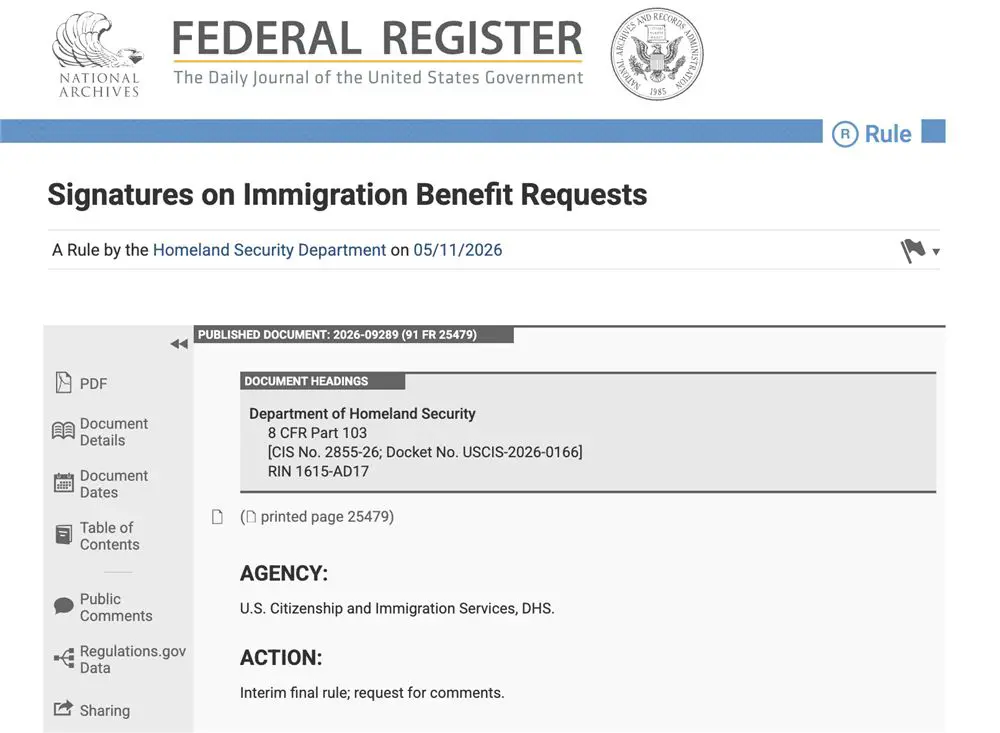
On May 11, 2026, the Department of Homeland Security (DHS) published an interim final rule in the Federal Register regarding signature requirements for immigration benefit applications. The rule clarifies that if U.S. Citizenship and Immigration Services (USCIS) discovers an invalid signature in the application materials after the case has been accepted, the adjudicating officer may, depending on the circumstances, choose to reject the application or issue a direct denial after completing the adjudication.
This means that signature issues, which many applicants have easily overlooked in the past, may no longer be as simple as just "submitting a new signature" in the future.
• Acceptance does not equal safety: Applicants can no longer harbor the wishful thinking that "as long as it is accepted, everything will be fine." Signature issues may be discovered late in the adjudication process, at which point they will face the consequence of a direct denial.
• Application fees are non-refundable: Once "denied," USCIS will retain the application fee because the application is considered to have completed the adjudication process.
• Strict crackdown on fraud risks: The new rule specifically targets fraudulent activities that have surged in recent years, such as "copy-and-paste signatures," "software-generated or stamp-made signatures," and "unauthorized proxy signatures." Data shows that cases denied due to signature issues have surged from 300 in fiscal year 2021 to nearly 3,000 in fiscal year 2025.
The rule will take effect 60 days after its publication in the Federal Register, and a public comment period is open.
More Information to be Reported
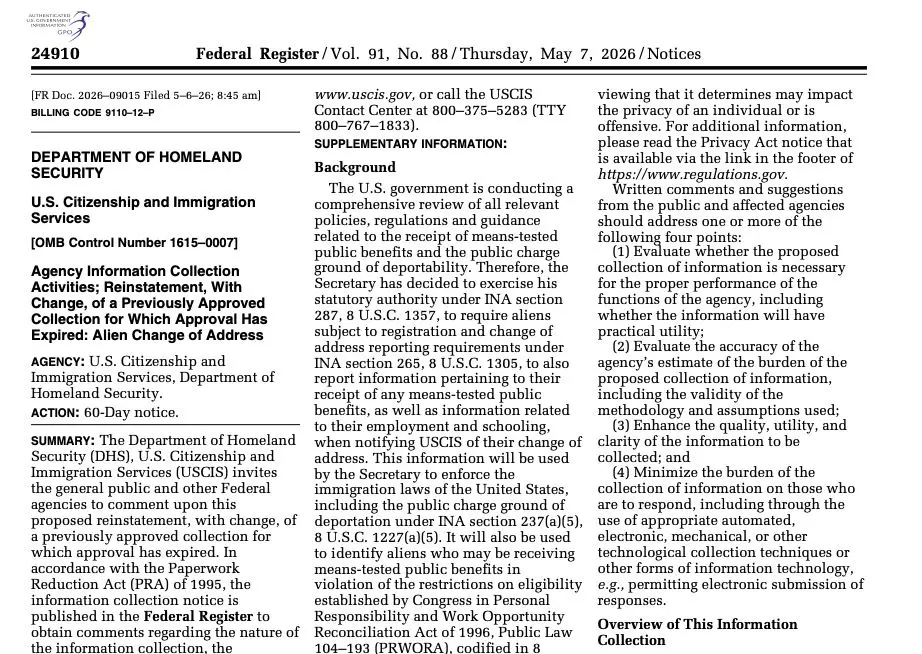
Another noteworthy change is an important proposal regarding the AR-11 (Alien's Change of Address Card) published by USCIS in the Federal Register on May 7, 2026.
According to the proposal, in the future, when reporting an address change, applicants will need to provide more personal information than before, including: employment information, such as current work status, employer name, and address; education information, such as school name, academic progress, and major; and receipt of public benefits, such as whether they are currently applying for or receiving certain government public benefits.
According to current USCIS instructions, with few exceptions, all foreign nationals in the United States are generally required to report a change of address to USCIS within 10 days of moving. The focus of this announcement is that USCIS intends to increase the amount of information collected during address change reporting. This means:
• Dynamic compliance monitoring: USCIS will use address changes as a dynamic window to verify the status compliance of non-citizens in the U.S. in real-time. For example, whether an H-1B visa holder is still working for the designated employer, or whether an F-1 student is still attending the original school.
• Pre-screening for public charge: The newly added benefit receipt information will allow USCIS to assess whether an applicant is involved in "public charge" issues in advance, before the applicant undergoes any status adjustment or visa renewal.
• Increased compliance costs: Applicants will need to spend more effort organizing and proving their employment, education, and benefit status, making the reporting process more complex.
It should be noted that this content is still just a proposal and is currently in a 60-day public comment period, which ends on July 6, 2026. Subsequently, USCIS will need to review it based on public comments and go through relevant approval processes before the new version of the form can be officially implemented. WorldWay will continue to monitor this and will share any new information with you as soon as possible.
Window Period and Action Guide
Against this backdrop, applicants must, on one hand, pay more attention to basic compliance details such as signatures and address updates; on the other hand, they will also pay more attention to which immigration paths still have relatively clear rules and time windows. For many families planning for long-term U.S. status, EB-5 investment immigration remains an important choice.
Key EB-5 Milestones:
• Grandfathering Clause Deadline (September 30, 2026): This is an important protection mechanism under the new EB-5 policy. As long as the application is successfully submitted before September 30, 2026, even if the Regional Center program expires or major policy changes occur in the future, the applicant's case will still be adjudicated according to the old rules.
• Investment Amount Increase (Expected January 1, 2027): The new EB-5 law stipulates that the minimum EB-5 investment amount will be automatically adjusted every five years based on inflation levels. Industry experts predict that the minimum investment amount for Targeted Employment Areas (TEA) will rise from the current $800,000 to $900,000 - $937,500.


For inquiries in mainland China: 400-138-2929, Hong Kong, China customer service center: (852)2802 8798