





Recently, the U.S. Department of Homeland Security (DHS) and U.S. Citizenship and Immigration Services (USCIS) officially released the "Characteristics of H-1B Specialty Occupation Workers: Fiscal Year 2025 Annual Report." The report shows that in fiscal year 2025 (October 1, 2024 - September 30, 2025), USCIS approved a total of 406,348 H-1B petitions.
Below, please join WorldWay to take a look at the important signals released by this report.

1. China Remains Firmly in Second Place Globally
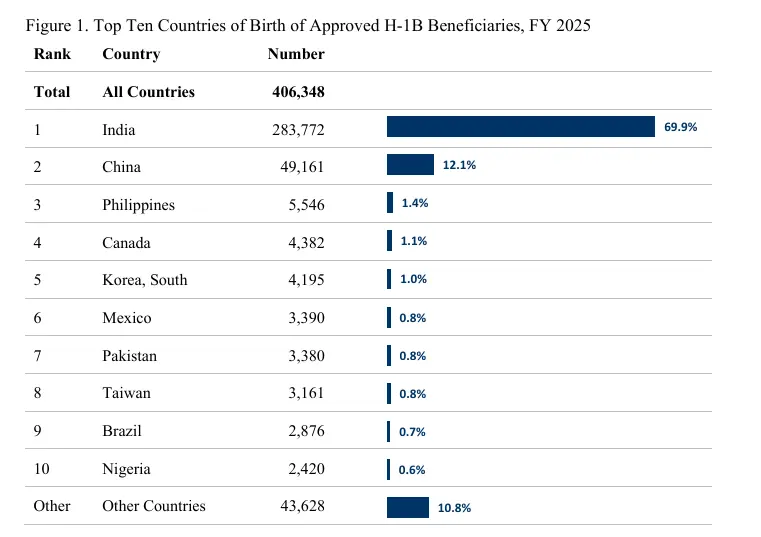
In terms of total approvals, the distribution of beneficiaries' nationalities largely follows the pattern of previous years. Indian nationals accounted for the highest percentage of approvals, reaching approximately 69.9%; Chinese nationals accounted for approximately 12.1% of approvals, ranking second globally.
However, it cannot be ignored that the number of approvals for Indian nationals far exceeds that of other countries, being approximately 6 times the number of approvals for Chinese nationals!
2. High Academic Qualifications Become an Important Threshold for H-1B
The educational structure is one of the most noteworthy parts of this report.
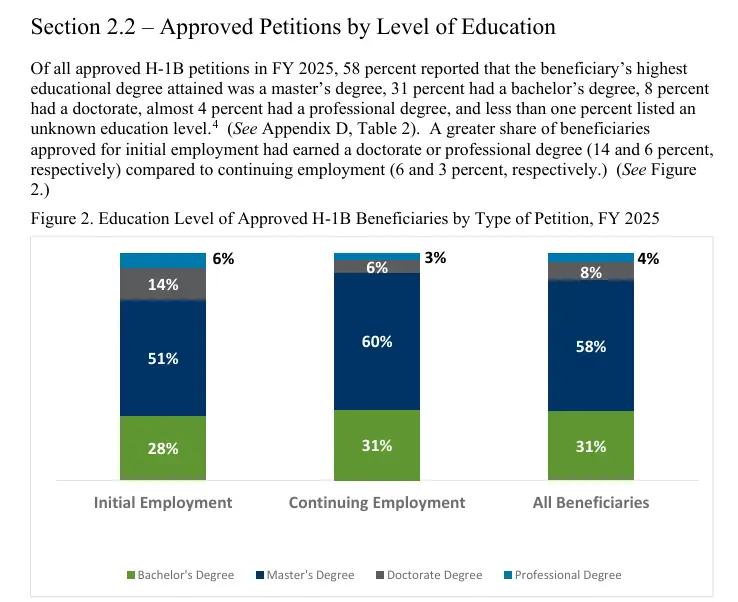
Among all H-1B petitions approved in fiscal year 2025, master's degrees accounted for approximately 58%, bachelor's degrees for approximately 31%, doctoral degrees for approximately 8%, and professional degrees for approximately 4%. Individuals with a master's degree or higher accounted for nearly 70%, highlighting the advantage of highly educated talent.
According to the current H-1B lottery mechanism, applicants with a U.S. master's degree or higher can participate in the advanced degree cap selection in addition to the regular cap selection, further increasing their chances of being selected. In this context, high academic qualifications are not only proof of academic ability but also an important weight for increasing the probability of selection and establishing a competitive advantage.
3. Computer-Related Occupations Continue to Lead
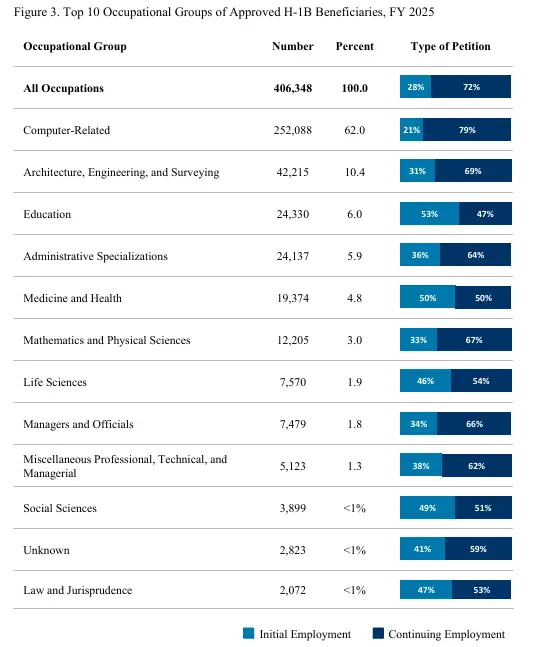
In terms of occupational categories, computer-related occupations still hold an absolute advantage. In fiscal year 2025, 252,088 computer-related occupation petitions were approved, accounting for 62% of all approved H-1B petitions. Looking back over the past 13 years, computer-related occupations have ranked first in the percentage of H-1B holders every year.
4. H-1B Salary Levels Diverge
High-Skilled Positions Have Outstanding Advantages
Salary level is also an important indicator for observing H-1B competition trends. The report shows that the median annual salary for all approved H-1B beneficiaries in fiscal year 2025 was $133,000. Among them, the median salary for initial employment applicants was $103,000, while the median salary for continuing employment applicants was $141,000.
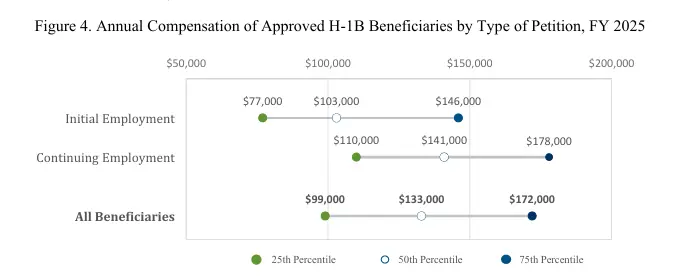
This indicates that H-1B holders who have already entered the U.S. labor market and completed professional accumulation have significantly higher salary levels than applicants who have obtained H-1B status for the first time. In other words, H-1B is not just a lottery, but a career path that requires continuous competition.
From the perspective of occupational categories, legal and judicial occupations have the highest median salary, reaching $225,000; the median salary for computer-related occupations is $140,000; the median salary for management occupations is $150,000; and the median salary for education occupations is only $75,000, which is significantly lower than the overall level.
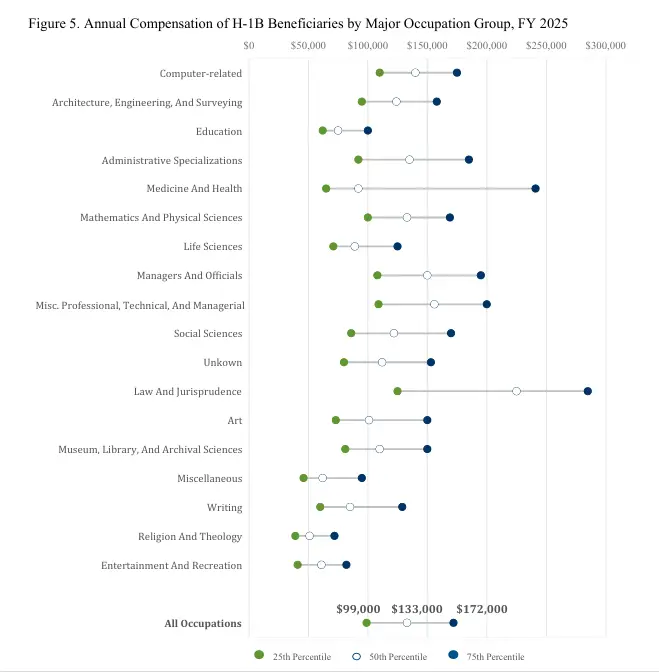
This also means that if the United States further strengthens the policy direction of screening foreign talent "by salary, by skill, and by job value" in the future, applicants in low-wage industries, non-shortage positions, and traditional liberal arts fields may face greater uncertainty.
5. Facing Uncertainty
Planning Status in Advance is More Critical
Regardless, the era when H-1B relied solely on "luck" is passing. High salary, high academic qualifications, and strong professionalism have become important competitive advantages for development in the United States. However, for many international students and professionals in the United States, H-1B still has realistic risks such as lottery uncertainty, reliance on employer sponsorship, and layoffs affecting status.
For those who are currently studying in the United States, are in the OPT stage, are waiting for the H-1B lottery, or already hold an H-1B but wish to obtain a more stable status, EB-5 investment immigration is becoming a status planning path that more and more families are paying attention to.
Compared with H-1B, EB-5 does not rely on employer sponsorship and does not require participation in a lottery. For eligible applicants within the United States, they can also use the I-526E and I-485 concurrent filing mechanism to apply for an EAD work permit and Advance Parole, obtaining higher status flexibility in advance.
6. Seize the EB-5 Policy Window
Complete Status Layout in Advance
It is worth noting that the current EB-5 policy window will not exist for a long time. As the reserved visa quota continues to be consumed, the pressure of visa retrogression is gradually emerging; at the same time, the grandfathering provision will expire on September 30; the minimum investment amount may also be increased on January 1, 2027.
For families intending to plan for U.S. status, the earlier they evaluate, the more opportunities they have to seize the current policy window. Instead of passively waiting for the H-1B lottery results, it is better to evaluate the status path that suits you in advance and prepare for study, employment, and the long-term development of the whole family.


For inquiries in mainland China: 400-138-2929, Hong Kong, China Customer Service Center: (852)2802 8798