





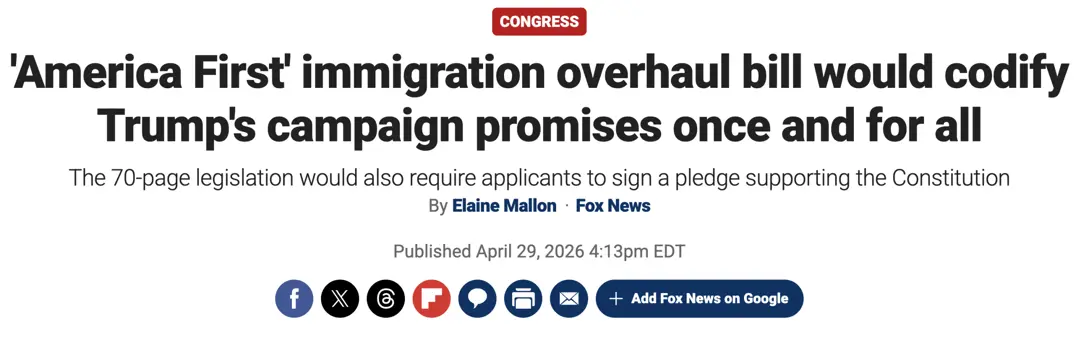
Recently, U.S. immigration policy has once again signaled a strong tightening. The "Americans First Immigration Act," proposed by Republican Congressman Barry Moore, is attracting attention.
This 70-page proposal has gained support from multiple Republicans and is currently in the preliminary discussion stage in the House of Representatives. The core of the proposal is to significantly restrict family-based immigration, eliminate the green card lottery, and introduce a new points-based system. Once passed, it could become a major adjustment to the U.S. legal immigration system in years.

Low-threshold opportunities may be closed
The proposal plans to eliminate the Diversity Visa Lottery program, which provides approximately 55,000 spots annually, commonly known as the "green card lottery."
This program has been viewed by many applicants as an opportunity to obtain a U.S. green card with a low threshold, as its core does not rely on employer sponsorship, family relationships, or high-amount investments, but rather on obtaining an immigrant visa opportunity through a random lottery.
However, the proponents argue that the lottery mechanism is highly random and cannot effectively screen for talent that meets U.S. economic development and security needs. Once this category is eliminated, the path to obtaining a U.S. green card based on "luck" will be closed. Future applicants will need to rely more on personal ability, employment value, or other clear paths for planning.
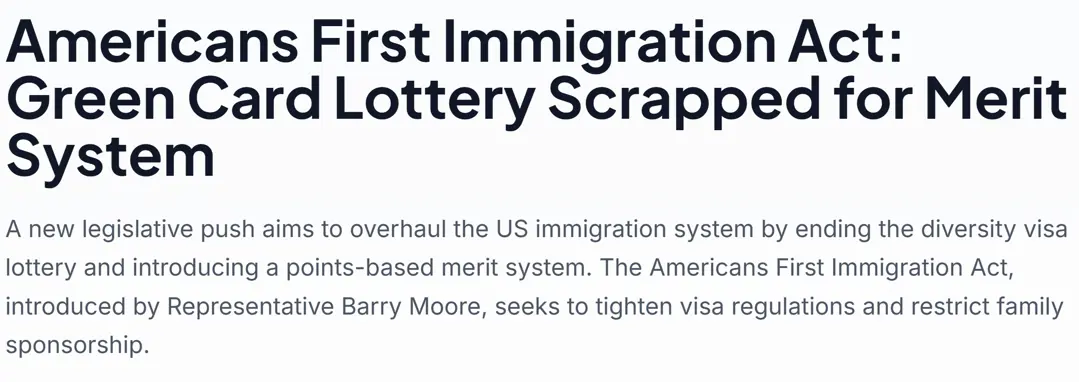
Regarding family-based immigration, the proposal plans to significantly tighten family sponsorship eligibility, focusing immigration quotas more on the "nuclear family" scope.
In other words, in the future, it may only retain the eligibility for U.S. citizens and green card holders to sponsor spouses and minor children for immigration; the channels for U.S. citizens to sponsor parents, adult children, and siblings for green cards may be eliminated or significantly restricted. Supporters argue that the current family-based immigration system increases the burden on the U.S. welfare system.
Immigration screening places more emphasis on "hard power"
In addition to tightening family-based immigration and eliminating the green card lottery, the proposal also suggests introducing a brand-new points-based immigration system.
The points-based system will score applicants based on factors such as English proficiency, educational background, salary level, age, work experience, and military service history. In other words, in the future, U.S. immigration may place more emphasis on whether applicants possess strong educational backgrounds, professional capabilities, language skills, and economic contribution potential.
Among these, salary levels and employer recruitment compliance may also become important thresholds. Applicants will not only need to prove their own strong competitiveness, but employers may also need to prove that they have prioritized hiring U.S. domestic labor. For applicants who rely on work visas and employer sponsorship paths, future uncertainty may further increase.

4. The tighter the policy, the earlier you must plan your status
Currently, the "Americans First Immigration Act" is still just a proposal, and there is still uncertainty about its actual implementation. WorldWay will continue to monitor the subsequent progress of the bill and will share any new information with everyone as soon as possible.
However, the policy signals it releases are still worth noting: the U.S. immigration system is gradually shifting from the more diverse path choices of the past to a new stage that emphasizes screening, compliance, and long-term contribution.
This also means that for those who have needs for studying, working, residing, asset allocation, or long-term family planning in the U.S., status planning must consider the uncertainties that future policy changes may bring in advance. The truly prudent approach is to evaluate family member structure, children's ages, financial arrangements, status in the U.S., and future development goals as early as possible, and choose a status path that better fits your own conditions and is more certain.
In such a policy environment, the planning value of EB-5 investment immigration is even more prominent. The significance of EB-5 is not just about obtaining a green card, but about resolving the status uncertainty for children's future study, internship, work, and long-term development in the U.S. in advance. For families with needs for U.S. residence, education, career layout, and asset allocation, EB-5 can also serve as a more forward-looking long-term status arrangement.
EB-5 immigration application conditions are flexible, with no rigid requirements for age, education, language, business, or work experience background. Especially under the new EB-5 law, rural EB-5 projects are exempt from visa backlogs and have priority processing advantages. At the same time, the "concurrent filing" policy allows applicants to file I-526E and I-485 in the U.S. simultaneously, and they can obtain a Combo card in about 3 months, quickly achieving legal residence and employment eligibility.
WorldWay holds high-quality rural EB-5 projects with official I-956F approval—"North Carolina Sugar Mountain Hilton Hotel", providing investment families with more certain project choices and application path support.

For inquiries in Mainland China: 400-138-2929, Hong Kong, China Customer Service Center: (852)2802 8798