





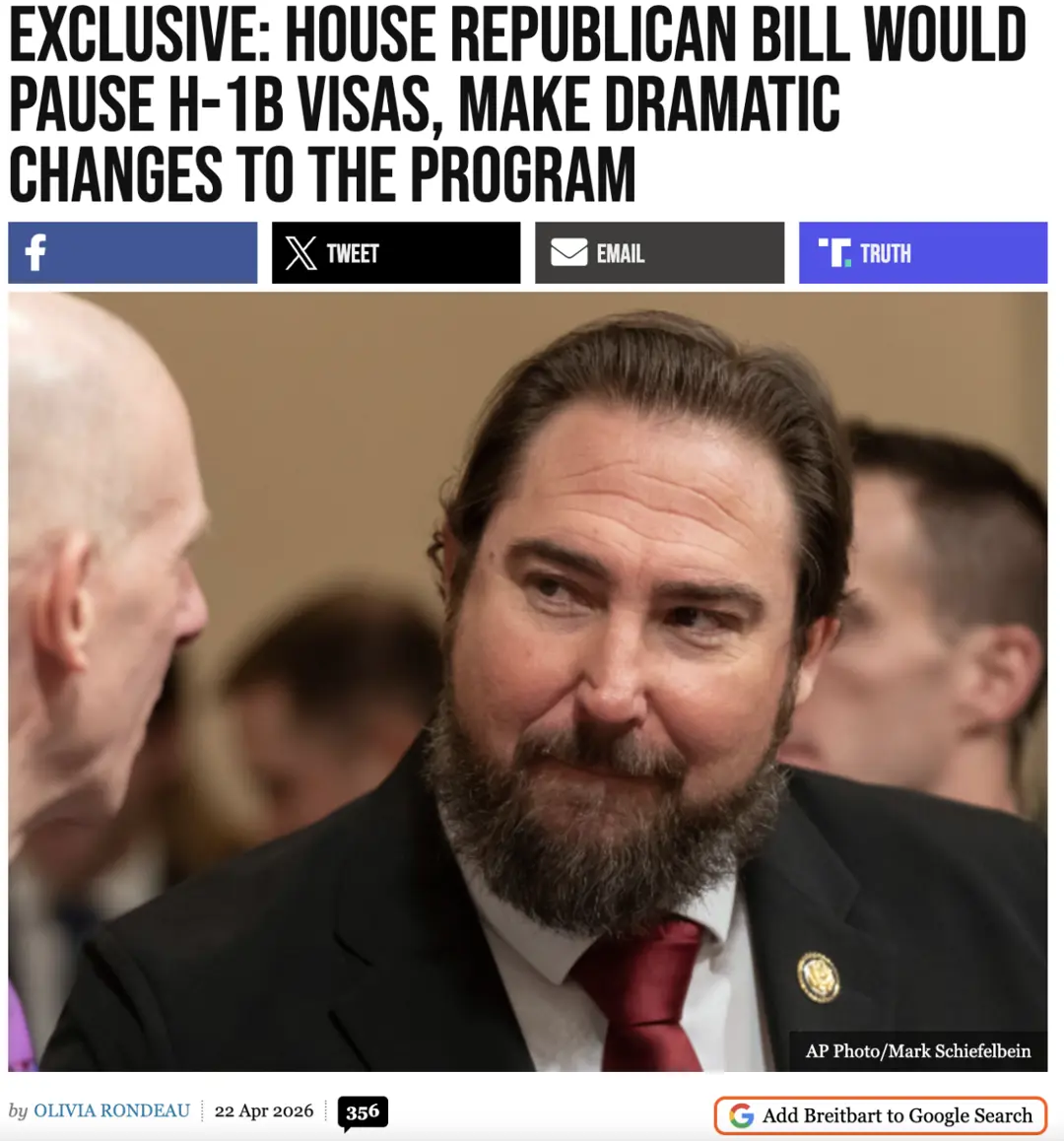
On April 22, 2026, local time, U.S. Representative Eli Crane introduced the "End H-1B Visa Abuse Act of 2026," proposing a three-year suspension of H-1B visa issuance, the elimination of OPT, restrictions on H-1B to green card transitions, and an increase in the minimum annual salary threshold to $200,000... These disruptive measures have rapidly drawn significant attention from the technology industry, corporate employers, and the international student community.
Core Impact: H-1B May Face Comprehensive Tightening
The bill explicitly proposes a 3-year suspension of H-1B visa issuance, during which time existing visa holders would gradually depart the United States. After the suspension period ends, the program would resume, but with significant changes to its scale and rules. Details are as follows:
1. Significant Reduction in H-1B Quotas
Currently, the annual regular H-1B quota is 65,000, with an additional 20,000 spots for those with a U.S. master's degree or higher. The bill proposes to cut the annual regular quota from 65,000 to 25,000 and eliminate existing exemptions. This means that even if H-1B issuance resumes in the future, competition will be even more intense.
2. Shortened Visa Validity + Prohibition on Renewals
Current H-1B rules allow for a maximum stay of 6 years, with renewals every 3 years; this bill compresses the single validity period to 3 years and explicitly prohibits renewals, requiring departure upon expiration.
3. Abolition of the Lottery System
In the past, H-1B used a lottery mechanism; although competition was fierce, ordinary graduates still had a certain probability of being selected. The bill proposes to abolish the lottery system and allocate visas entirely based on salary levels. While this may still offer opportunities for core technical and senior positions at large companies, the threshold will be significantly higher for fresh graduates, junior engineers, general business roles, and positions at small and medium-sized enterprises.
4. Minimum Salary Increased to $200,000
The minimum annual salary requirement is raised directly to $200,000 per year, which is several times higher than current salary standards. In addition, it requires employers to prove that they cannot find qualified U.S. workers and that they have not conducted any layoffs.
5. Restrictions on Part-time Work and Outsourcing
The bill also restricts employment models, explicitly prohibiting H-1B holders from holding multiple jobs and banning third-party staffing agencies from employing them.
6. Cancellation of OPT and Termination of H-4 Work Authorization
The bill proposes to terminate OPT (Optional Practical Training), with all forms of OPT programs being cancelled; at the same time, H-1B visa holders would not be allowed to bring dependents (H-4 visa) into the United States.
7. Prohibition on Green Card Transitions + Status Conversion Restrictions
H-1B holders would be prohibited from adjusting to green card status, would not be allowed to apply for permanent residence (green card), and would be required to leave the United States before converting to other non-immigrant statuses.
In addition, the proposal writes into the legal framework the "$100,000 fee for every foreign employee hired" proposed in previous policies, making it a permanent regulation.

Policy Not Yet Implemented
But the Signal Is Very Clear
It must be emphasized: The bill is currently still in the House proposal stage, has not been passed, and has not become law, but this does not mean that the relevant policy signals can be ignored. Just on April 20, 2026, U.S. Representative Riley Moore publicly wrote to the U.S. Department of Homeland Security, demanding the complete termination of OPT, STEM OPT, and CPT, calling them "disguised foreign labor channels that bypass congressional visa quotas."
From OPT internships to H-1B work visas, the channels international students rely on to stay in the U.S. after graduation are facing tightening pressure, which is enough to trigger high concern among international student families and those planning to go to the U.S.
In the past, U.S. study planning often revolved around schools, majors, and employment: choosing prestigious schools, selecting popular majors, finding internships, joining large companies, drawing for H-1B, and waiting for a green card. But now, more and more families are beginning to realize: no matter how good the major or the job is, if the status path is unstable, the future remains full of variables.
• Lottery Uncertainty: Quotas are limited, the number of applicants is consistently far higher than the quota, and the probability of being selected is small.
• Employer Uncertainty: H-1B is highly dependent on employer support; once a company conducts layoffs, is unwilling to sponsor, or changes positions, status planning can be disrupted.
• Policy Uncertainty: From salary priority and employer audits to the current proposal to suspend H-1B and cancel OPT, policy risks are continuously rising.
Therefore, for families with clear goals of staying in the U.S., the future can no longer rely entirely on OPT and H-1B lotteries for their children's status.
Status Certainty
Is Becoming a Core Consideration for International Student Families
Against the backdrop of rising H-1B uncertainty, EB-5 investment immigration is becoming an important choice for some international student families to configure U.S. status in advance.
Under the new EB-5 law, rural EB-5 projects are exempt from visa backlogs and have priority processing advantages; the "concurrent filing" policy allows applicants in the U.S. to file I-526E and I-485 simultaneously, enabling them to obtain a Combo card in about 3 months, quickly achieving legal residence and employment eligibility.
It is worth noting that the protection period for the grandfather clause of the new EB-5 policy will expire on September 30, 2026. By submitting an application before this date, even if policies change in the future, the applicant can still have their case processed according to current legal rules.
WorldWay holds high-quality rural EB-5 projects with officially approved I-956F petitions—"North Carolina Sugar Mountain Hilton Hotel," helping investors quickly realize their U.S. status planning and embark on a new life in the United States.


For inquiries in mainland China: 400-138-2929, Hong Kong, China Customer Service Center: (852)2802 8798