





According to a study by the international education company Shorelight, the global F-1 visa refusal rate climbed to 35% in 2025, reaching a ten-year high and even surpassing the peak seen during the 2020 COVID-19 pandemic.

I. Surge in Refusal Rates:
Regional Imbalance and the Formation of "High-Refusal Zones"
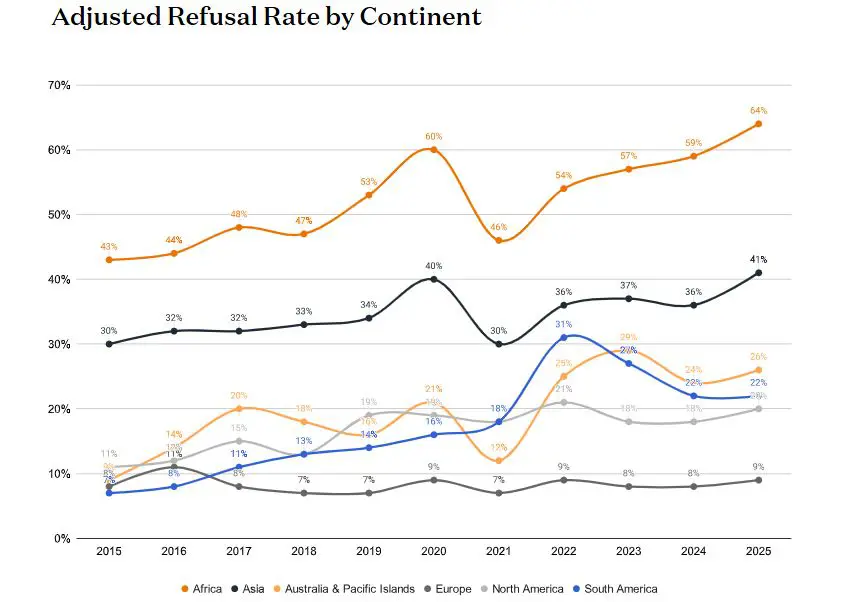
In 2025, F-1 visa refusals showed distinct regional concentration, with regions such as Africa and South Asia becoming "hard-hit areas," forming an insurmountable "high-refusal layer":
• Africa: The refusal rate reached as high as 64%, nearly doubling from 43% in 2015. In countries like Somalia and Sierra Leone, the refusal rate even exceeded 90%.
• South Asia: As a major source of international students for the United States, India saw its refusal rate soar from 36% in 2023 to 61% in 2025; countries such as Afghanistan, Nepal, and Pakistan all saw rates above 70%-80%.
• China: Although it has not entered the "high-refusal zone," the number of F-1 visas issued in the first 8 months of 2025 decreased by approximately 20% year-on-year, the refusal rate has increased significantly compared to ten years ago, and applicants in sensitive majors face stricter background checks.
In contrast, the refusal rate in Europe has remained stable below 9%, while South America saw a decrease from 31% in 2022 to 22% in 2025. Regional differences highlight a "nationality-first" tendency in visa adjudication. The report points out that when a student's ability to obtain a visa depends more on their country of origin than on their academic qualifications, the fairness of the U.S. visa system has been severely compromised.
II. Policy Tightening:
Stricter Scrutiny on Both Status Maintenance and Visa Review
In addition to the rising refusal rate, new regulations implemented by the U.S. Department of Homeland Security last August have further exacerbated the anxiety of international students regarding their status:
• Abolition of the "Duration of Status" (D/S) system: The duration of stay for F/J visas will be determined by the length of the program, but will not exceed 4 years. If the program exceeds 4 years, a status extension through USCIS or an exit visa will be required.
• Shortened grace period: The grace period for departure after completing studies has been compressed from 60 days to 30 days.
• Stricter visa and status review: The United States has comprehensively strengthened the screening and review of applicants' social media accounts and continues to expand the scope of restrictions on sensitive majors. International students at many universities have experienced abnormal changes in their visa status, and some have had their visas "revoked" or their "SEVIS records terminated" by U.S. authorities unilaterally.
These policies have significantly increased the risk of status loss for international students and have made the traditional path of "Study Abroad—OPT—H-1B—Green Card" full of uncertainty.

III. Response Strategies:
"Green Card First" Becomes a New Trend for Studying Abroad
Faced with the high refusal rate of F-1 visas and status restrictions, more and more families are turning to the strategy of "obtaining status first, then studying in the U.S.," with EB-5 investment immigration becoming a popular choice:
• Reduce visa risks: Green card holders do not need to apply for an F-1 visa and can enroll as local students, reducing the uncertainty brought by visa applications.
• Lower economic costs: Green card holders enjoy in-state tuition (approximately 1/3 of that for international students) and can apply for federal grants and scholarships.
• Significant employment advantages: No need to be subject to OPT/H-1B quotas and lottery restrictions, allowing for free career choices without being constrained by visa expiration.
For families of international students, rationally assessing policy risks and diversifying study-abroad paths has become an inevitable choice.
Under the new EB-5 policy, applicants within the United States are allowed to quickly obtain an Employment Authorization Document (EAD) and Advance Parole through "concurrent filing" (I-526E+I-485), which is especially suitable for international students who are already studying in the U.S. or planning for long-term development. At the same time, rural projects under the new law currently enjoy the benefits of "no visa backlog & priority processing."
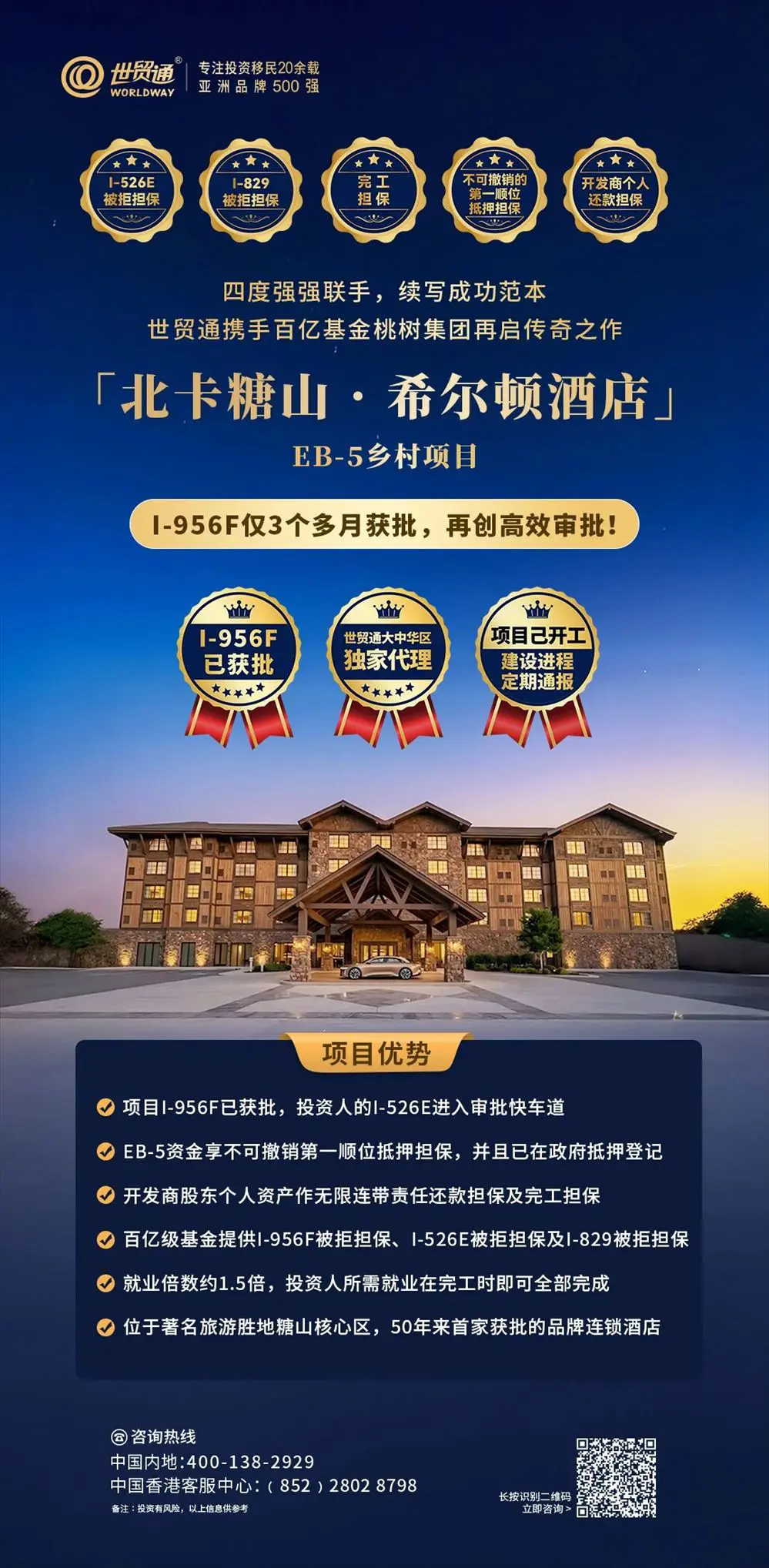
Status planning should be done sooner rather than later. WorldWay holds high-quality rural EB-5 projects with official I-956F approval—"North Carolina Sugar Mountain Hilton Hotel"—helping investors quickly realize their U.S. status planning and embark on a new life in the United States.
For inquiries in mainland China: 400-138-2929, Hong Kong, China Customer Service Center: (852)2802 8798