





Recently, the U.S. immigration landscape reached a critical turning point—Markwayne Mullin was officially sworn in as the U.S. Secretary of Homeland Security. A pragmatic politician who has long supported high-skilled immigration and advocated for a "merit-based" approach, he not only succeeds his predecessor, Kristi Noem, but may also become a "key figure" in driving reform of U.S. legal immigration policy.
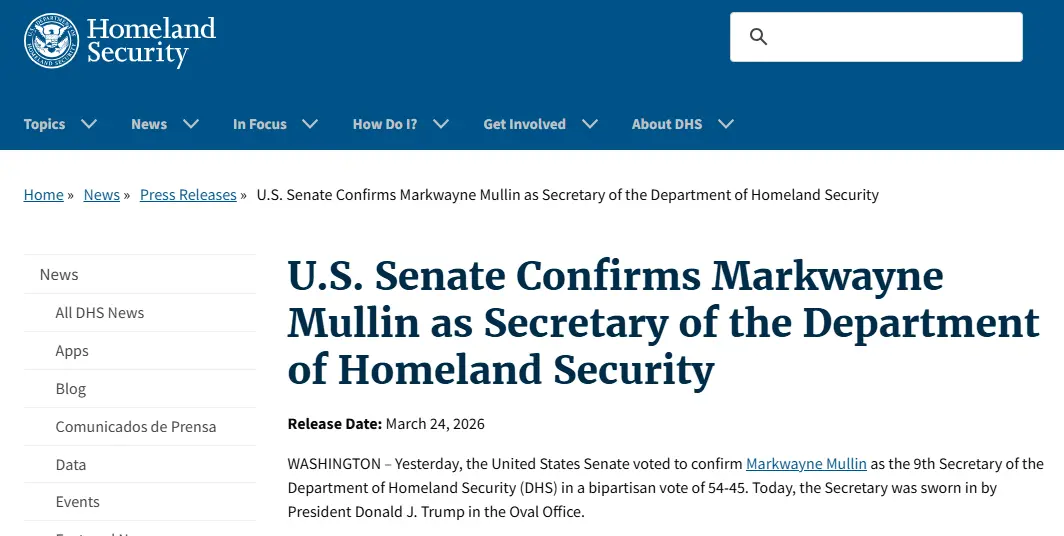
For Chinese EB-5 investors currently waiting in the visa backlog, this is not just a personnel change; it has also reignited discussions on issues such as "legal immigration efficiency" and "fairness in employment-based immigration."

What does Mullin's appointment mean?
During his time as a Senator, Mullin was a staunch supporter of the Fairness for High-Skilled Immigrants Act (H.R.1044/S.386). The core objective of this bill is to eliminate the "7% per-country quota" in employment-based immigration—a systemic bottleneck that has long hindered applicants from large countries like China and India.
Now, he has moved from Capitol Hill to the Department of Homeland Security, completing the transition from a "participant in policy discussion" to the "head of the administrative system." As Secretary of Homeland Security, he holds influence over the management style, execution priorities, and departmental coordination of the immigration system.
The "Invisible Shackle" on Chinese EB-5 Applicants
Under current visa allocation rules, the total annual quota for U.S. employment-based green cards is approximately 140,000, with applicants from any single country limited to no more than 7% (approximately 9,800). While this rule may appear "fair," it is, in reality, highly unfavorable to countries with large numbers of applicants.
Take Chinese EB-5 investors as an example: thousands of families submit I-526/I-526E applications each year, but due to the 7% quota, the actual number of available visas is far from sufficient, leading to a severe supply-demand imbalance. Consequently, for countries with concentrated application demand, the pressure of visa backlogs is often more pronounced.
Is there hope for a substantial improvement in the backlog?
The Fairness for High-Skilled Immigrants Act supported by Mullin advocates for: eliminating the per-country quota cap for employment-based immigration; implementing a "first-come, first-served" principle; and establishing a transition period protection mechanism.
If relevant policies are truly advanced and implemented in the future, the impact on Chinese EB-5 applicants will be profound: once the per-country quota restriction is relaxed, the backlog structure is expected to see substantial improvement; for applicants already in the system, this may also lead to more favorable expectations for their wait times.
Crackdown on illegal immigration; immigration vetting may become stricter
It is worth noting that Mullin is not a representative of "comprehensive immigration relaxation."
Based on current public statements and reports, his more explicit policy priorities remain border security, law enforcement, and the control of illegal immigration. He has consistently emphasized "protecting American workers" and "national security," which means that immigration background checks may become more stringent. At the same time, after taking office, he halted plans from the previous administration to expand immigration detention centers and mentioned in public that he hopes to maintain better communication with localities and communities during policy implementation.
This also means that in the future, while U.S. immigration policy execution may adhere to the "security first" theme, it may also better balance the practical needs of "talent and investment priority." On one hand, immigration categories for high-level talent and professional elites, such as EB-1A & NIW, are expected to continue receiving policy-level attention; on the other hand, as an investment immigration program that can directly create jobs, drive project development, and stimulate infrastructure investment, EB-5 remains in a window period worthy of close attention.
it is better to take advantage of the window while it is still open and plan early.
Historical experience tells us: policy benefits always favor those who are "already in the system."
Mullin's reforms still require legislative promotion by Congress and have not yet been finalized. However, from the applicant's perspective, this round of discussion at least reminds the market again: the issues of fairness and efficiency in the U.S. immigration system still have the possibility of further adjustment. For Chinese EB-5 investors, rather than waiting for potential future changes, a more realistic approach is to submit the I-526 application as soon as possible to lock in a priority date.
Currently, under the new EB-5 law, Rural EB-5 projects enjoy the advantages of no visa backlog and priority processing; the "concurrent filing" policy allows applicants in the U.S. to submit both I-526E and I-485 simultaneously, enabling them to obtain a Combo card in about 3 months, quickly achieving legal residency and employment authorization.

WorldWay holds high-quality rural EB-5 projects with officially approved I-956F, such as the "North Carolina Sugar Mountain Hilton Hotel," helping investors achieve U.S. status planning steadily, without backlogs, and efficiently, quickly embarking on a new life in the United States.

For inquiries in Mainland China: 400-138-2929, Hong Kong Customer Service Center: (852)2802 8798