





For many international talents harboring the “American Dream,” the H-1B work visa was once a core bridge to developing a career in the United States.
However, this bridge is becoming increasingly narrow and unstable. Recently, a new proposal in Iowa has once again pushed the tightening trend of H-1B visas to the forefront, with the higher education sector becoming a major disaster area in this “encirclement” campaign.
Iowa Takes Action:
Further Escalation of H-1B Restrictions in Higher Education
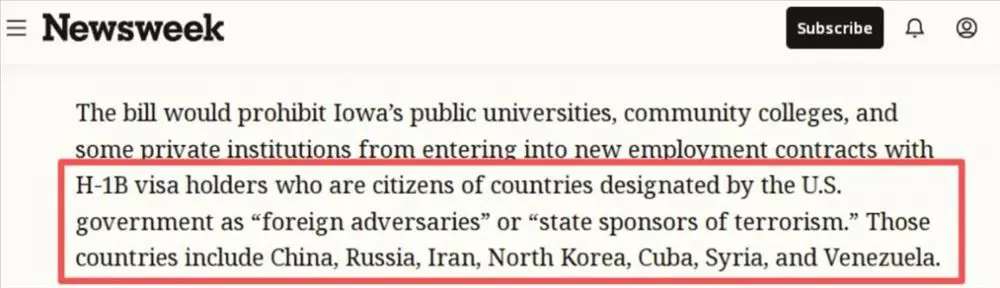
On April 10, local time, it was reported that a proposal in Iowa aimed at restricting the hiring of certain foreign workers by universities (House Bill 2513) is progressing rapidly in the state legislature. The bill prohibits public universities, community colleges, and certain private institutions in Iowa from entering into new employment contracts with individuals who hold H-1B visas and originate from “foreign adversaries” or “state sponsors of terrorism” as designated by the U.S. government.
The proposal passed the House in early March and will next be submitted to the full Senate for a vote. If finally passed, it is expected to apply to new contracts starting in mid-2026.
According to the proposal's definition, these countries include China, Russia, Iran, North Korea, Cuba, Syria, and Venezuela. This means that scholars, researchers, and teachers from these countries will find it difficult to obtain new faculty or research positions at universities in Iowa.
Not an Isolated Case:
H-1B Restrictions in Higher Education Continue to Spread
Iowa's action is not an isolated event, but a reflection of the further spread of the H-1B tightening trend in U.S. universities.
• Florida: On March 2, the Board of Governors overseeing the State University System of Florida passed a resolution by an overwhelming vote of 17 to 2: suspending the hiring of new H-1B visa holders by the state university system, with the freeze lasting until January 5, 2027. (For details, please click to read previous reports from WorldWay: From Texas to Florida: What Signals Are Released Behind the Tightening of H-1B?)
• Texas: The Governor also issued a directive requiring all government agencies and public universities in the state to immediately stop submitting new H-1B visa applications until May 31, 2027. (For details, please click to read previous reports from WorldWay: Breaking! Texas Halts H-1B Visa Applications)
It can be seen that restrictions on H-1B at the state level are echoing the policy tightening at the federal level, causing increasingly obvious impacts on international talent, especially groups that rely on the university system for development.
H-1B Uncertainty Continues to Rise
From the federal level to the state level, the difficulty and uncertainty of obtaining an H-1B visa are rising sharply:
Federal Rule Changes: U.S. Citizenship and Immigration Services (USCIS) has implemented a new “wage-weighted lottery” mechanism, replacing the original random lottery. This change clearly favors high-paying positions, significantly reducing the winning rate for entry-level positions for fresh graduates. At the same time, background checks in some sensitive professional fields have become increasingly strict, and the entry and status risks faced by international students and young professionals have risen significantly.
Spread of State-Level Restrictions: As mentioned earlier, states such as Florida, Texas, and Iowa have already tightened the gates for H-1B in the field of public higher education. This trend is likely to spread further in the future, and the possibility of extending it to more states and more industries cannot be ruled out.
Status Dependency Risk: H-1B is essentially still a work visa that is deeply tied to a specific employer and position. Once an employer adjusts its recruitment strategy due to policy changes, or the state where it is located introduces new restrictive measures, the holder's work arrangements and even legal status may be directly affected.
These changes indicate that the uncertainty of H-1B is further amplifying. For those who truly wish to stay in the U.S. for the long term, relying solely on H-1B is becoming increasingly difficult to support long-term planning for careers, families, and status.
Say Goodbye to Uncertainty
EB-5 Investment Immigration Becomes a Better Solution
Facing the continuous tightening of H-1B visas and the “encirclement” at the state level, tying personal career and family planning entirely to H-1B is tantamount to handing one's fate over to ever-changing policies and employer decisions. For those who wish to stay in the U.S. for long-term stable development, finding a more reliable and autonomous “Plan B” has become imminent.
In contrast, obtaining a U.S. Green Card is the fundamental way to achieve long-term stable development. Among various immigration pathways, the EB-5 investment immigration program is becoming the focus of more and more high-net-worth individuals and families. Under the new EB-5 law, Rural EB-5 projects enjoy the advantages of no visa backlog and priority processing; the “concurrent filing” policy allows applicants to file I-526E and I-485 simultaneously in the U.S., and they can obtain a Combo Card in about 3 months, quickly achieving legal residence and employment eligibility.
However, it is worth reminding that as the reserved quotas continue to be consumed, warnings of invisible backlogs have quietly appeared; at the same time, the grandfather clause will expire on September 30; the minimum investment amount may also be raised from $800,000 to $900,000 or more on January 1, 2027. In other words, time is opportunity. The earlier you act, the more likely you are to lock in advantages before policy changes and calmly complete your status planning.
WorldWay holds a high-quality rural EB-5 project with an officially approved I-956F: “Sugar Mountain, North Carolina · Hilton Hotel”, helping investors achieve U.S. status planning steadily, without backlogs, and efficiently, and quickly embark on a new life in the United States.

For inquiries in Mainland China: 400-138-2929, Hong Kong Customer Service Center: (852)2802 8798