





On April 1, local time, the U.S. Supreme Court held oral arguments regarding the Trump administration's executive order to restrict birthright citizenship. President Trump himself attended the hearing, becoming the first sitting U.S. president in history to attend oral arguments at the Supreme Court. The Supreme Court is expected to reach a final verdict by the end of June or early July this year.
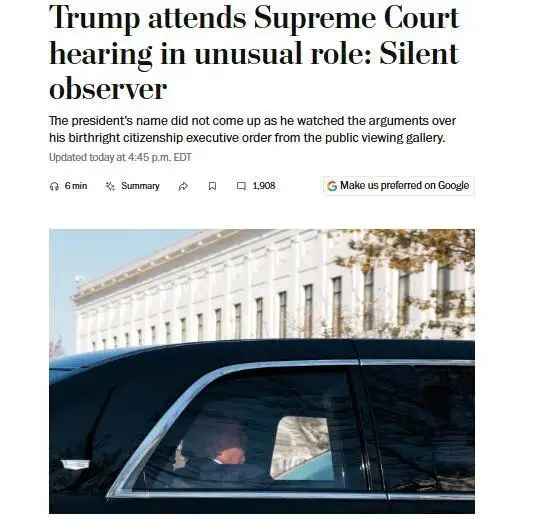
On the surface, this is a legal dispute surrounding the 14th Amendment to the U.S. Constitution, which was established in 1868: “All persons born or naturalized in the United States, and subject to the jurisdiction thereof, are citizens of the United States”; but for Chinese families, what is truly worth noting about this case is not whether Trump will win this time, but that it has once again exposed an increasingly realistic question: Is it still stable to bet the entire family's future on an “anchor baby”?
The Reality Check Under the “Anchor Baby” Halo
1. The child is a U.S. citizen, but how can the parents legally accompany them?
This is the most awkward reality. The child is a U.S. citizen, but this does not mean the parents automatically obtain a green card or long-term residency. When the child is a minor, parents who wish to accompany their child for schooling and living in the U.S. often face an immigration status vacuum.
Misconception: Thinking one can frequently travel back and forth using a B1/B2 tourist visa for long-term “staying for accompaniment”.
Reality: As U.S. immigration scrutiny tightens, long-term stays or frequent entries on a tourist visa are easily judged as having “immigrant intent,” leading to the risk of deportation.
2. With policies hanging over their heads, what risks do “anchor baby” families face?
The core target of Trump's executive order is precisely the “temporary visa” and “illegal overstay” groups.
Risk: If the executive order takes effect, children born in the U.S. to parents holding H-1B, F-1, or B-2 visas may no longer automatically obtain citizenship. More seriously, parents may face visa revocation or entry denial due to being determined to have “immigrant intent.”
Consequence: The child may face the awkwardness of being “stateless,” or the family may be forced to separate. In this window of uncertainty, any wishful thinking could lead to the collapse of family planning.

EB-5: The “Ballast” of Status That Transcends Cycles
Trump's angry tweet after the hearing——“The United States is the only country in the world where a person comes in and has a baby, and the baby is essentially a citizen of the United States with all of those benefits!”——indicates that he will never easily give up this fight. Regardless of the final ruling, the trend of the U.S. tightening immigration policies is a foregone conclusion.
For Chinese families, what is needed is not just a child's birth certificate, but a legal status that allows the whole family to enjoy rights and develop freely. In this battle for status, EB-5 is not just a green card; it is a “Noah's Ark” for high-net-worth families to counter policy risks and lock in future certainty. In particular, the “EB-5 Reform and Integrity Act of 2022” has opened a precious “window of opportunity” for current applicants.
Why is now a good time to plan for EB-5?
1. Visa set-asides, the dividend of no backlog
The new law reserves visa quotas for specific categories of projects, which are currently in a “no backlog” status. This means applicants can obtain a green card faster without having to wait for years as in the past. Among them, rural area projects have a 20% annual visa set-aside and enjoy priority processing.
2. The freedom of status brought by “Concurrent Filing”
For applicants already in the U.S. (such as those holding F-1 or H-1B visas), this is the greatest blessing. When visa quotas are current, applicants can simultaneously file Form I-526E (Immigrant Petition) and Form I-485 (Adjustment of Status).
While waiting for the green card, one can obtain an “Employment Authorization Document (EAD)” and “Advance Parole” in advance. This means no longer being constrained by a single visa, allowing for the freedom to work, start a business, and even travel in and out of the U.S. freely, saying goodbye to “status anxiety.”
3. The protection of the Grandfather Clause
Immigration policies change rapidly, but the “Grandfather Clause” is the final line of defense (expiring September 30, 2026). Once you file your I-526E application, you lock in the current policy benefits. Even if policies tighten, investment amounts increase, or backlogs return in the future, it will not affect your application process.
Don't let your child's future
become a bargaining chip in policy games
As the “anchor baby” halo gradually fades, what can truly transcend policy cycles and support long-term family planning is often not emotional imagination, but a path of status actively mastered by parents. Through EB-5, the initiative of family planning is firmly held in one's own hands, no longer subject to the whims of external political winds. It locks in a certain future for the child that is unaffected by policy games.

Worldway currently has two high-quality rural EB-5 projects with I-956F formal approval——「North Carolina Sugar Mountain Hilton Hotel」 and 「Great Smoky Mountains Marriott Hotel」, helping investors quickly obtain U.S. green cards.


For inquiries in Mainland China: 400-138-2929, Hong Kong Customer Service Center: (852)2802 8798