





Recently, QS released the 2026 World University Rankings by Subject! This ranking provides a comparative analysis of the performance of over 1,900 universities across 100 countries and regions in 55 academic disciplines. Additionally, it evaluated five broad subject areas (Arts and Humanities, Engineering and Technology, Life Sciences and Medicine, Natural Sciences, and Social Sciences and Management).
The results once again confirm the dominant position of U.S. universities.
In this ranking, U.S. institutions maintain a clear lead.
U.S. universities ranked first in 37 out of the 55 disciplines, far surpassing other countries.
Among them, Harvard University performed the most impressively, ranking first globally in 17 disciplines, an increase of two top-ranked subjects compared to last year; the Massachusetts Institute of Technology followed closely, ranking first globally in 12 disciplines.
In the popular field that many families are concerned about—Computer Science and Information Systems—the landscape remains very stable: MIT, Stanford, and CMU (Carnegie Mellon University) occupy the top three spots globally. This also means that in currently high-interest areas such as artificial intelligence, computing, and software engineering, U.S. universities continue to firmly occupy the world's top tier.

Ranking Methodology: Five Core Indicators
QS uses five key indicators to compile the subject rankings. The precise weighting of each indicator varies by subject to reflect the different characteristics of each field. Specifically, these include:
• Academic Reputation: Surveys scholars from different fields worldwide to obtain their evaluations of global universities.
• Employer Reputation: Which universities and majors employers prefer to hire graduates from.
• Citations per Paper: The average number of citations per paper for a university.
• H-Index: The quantity and quality of a university's published papers.
• International Research Network: The ability of universities to diversify the geography of their international research networks through sustainable research partnerships with other higher education institutions.
The Systemic Advantages of U.S. Education
Of course, the advantages of U.S. education are not just because of this impressive performance in the QS Rankings. The ranking is more of a result presentation; what is truly worth noting is the systemic advantage that the U.S. higher education system has formed over the long term, which is reflected behind these results.
On one hand, the U.S. possesses a concentration of high-quality university resources globally. Whether it is traditional prestigious schools with outstanding comprehensive strength or specialized institutions with clear advantages in engineering, business, medicine, and computer science, the U.S. has formed a multi-layered and diverse higher education system. On the other hand, the strength of U.S. education is not only reflected in the classroom and rankings, but also in its deep connection with scientific research, industry, and employment. Because of this, many families value U.S. education not only for the reputation of the school itself, but also for the mature and perfect talent cultivation system behind it.
Beyond Educational Planning, Identity Planning Is Becoming Increasingly Important
As more families view U.S. education as part of their long-term planning, their focus is quietly changing. In the past, many families were more concerned with: what school the child can apply to and what major they will study; but now, more and more families are starting to think: if the child hopes to study, intern, work, or even develop in the U.S. in the future, then besides the school itself, should they consider the issue of status earlier?
This is because in the actual process of studying in the U.S., many key factors are often not entirely determined by the school itself. For international students, tuition costs, internship and research opportunities, and post-graduation paths are all affected by status conditions at different stages. Especially in the current U.S. study and employment environment, many students still need to go through a series of uncertain links such as OPT, H-1B lottery, and work visa transitions after graduation.
It is precisely for this reason that identity planning is becoming an important part of the educational layout for more and more families.
The Value of EB-5: A Dual Layout of Identity and Educational Planning
In the current U.S. identity planning path, EB-5 is seen as a choice more suitable for long-term layout. The value of EB-5 lies not only in the status itself, but also in laying a more stable foundation for the child's future education and development in advance. From the perspective of the current policy environment, now is an important window period for laying out EB-5.
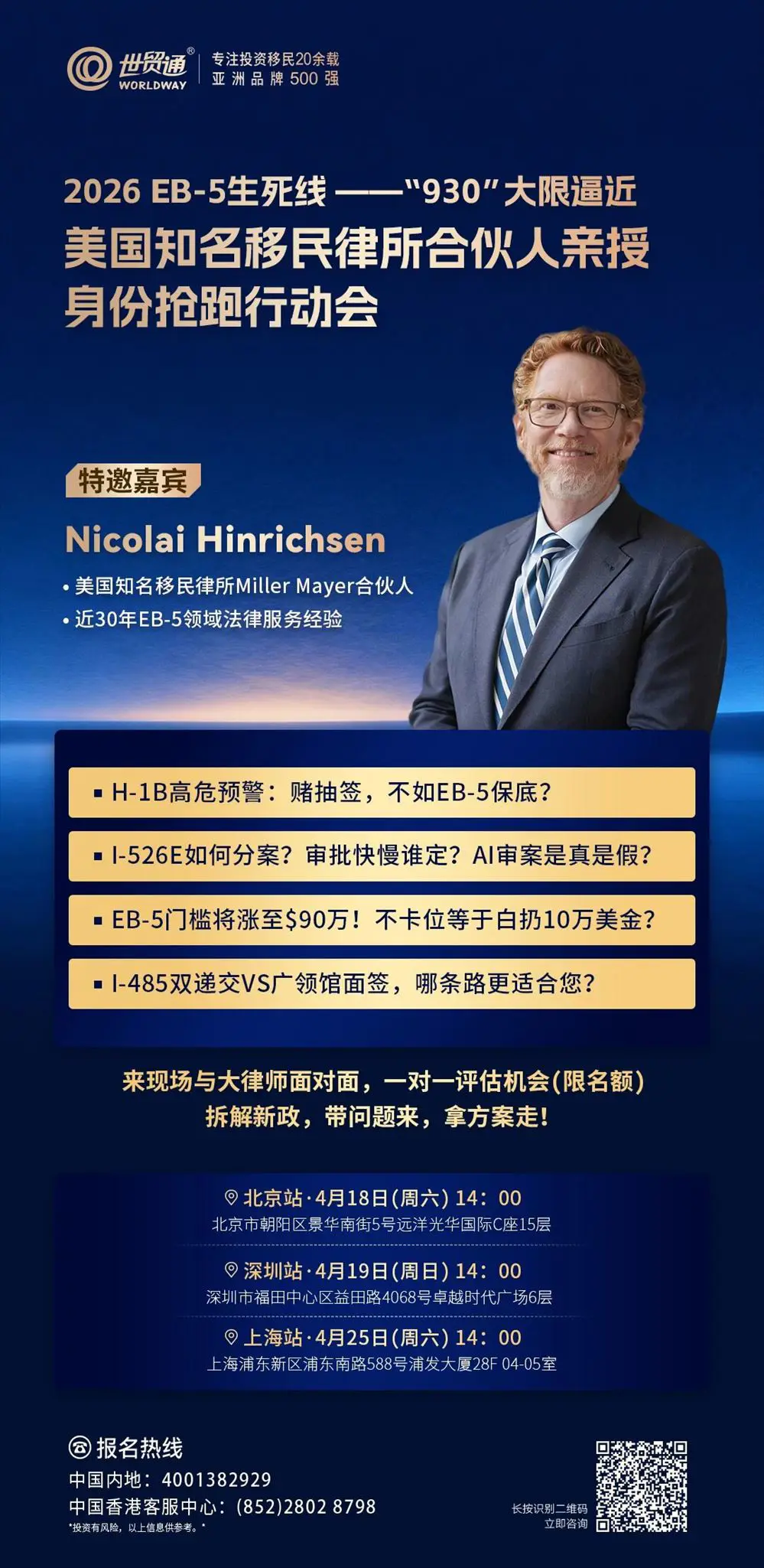
Under the new EB-5 law, rural EB-5 projects are exempt from visa backlogs and have priority processing advantages; the "concurrent filing" policy allows applicants in the U.S. to file I-526E and I-485 simultaneously, and they can obtain a Combo card in about 3 months, quickly achieving legal residence and employment eligibility.
However, this advantage will not last forever. As the reserved quota continues to be consumed, invisible backlog warnings have quietly appeared; at the same time, the grandfather clause will expire on September 30; the minimum investment amount may also be raised from $800,000 to $900,000 or even higher on January 1, 2027. In other words, the earlier you act, the more likely you are to lock in this rare policy window.

Worldway currently has two high-quality rural EB-5 projects with official I-956F approval—"North Carolina Sugar Mountain Hilton Hotel" and "Great Smoky Mountains Marriott Hotel", helping investors quickly obtain U.S. green cards.


For inquiries in Mainland China: 400-138-2929, Hong Kong Customer Service Center: (852)2802 8798