





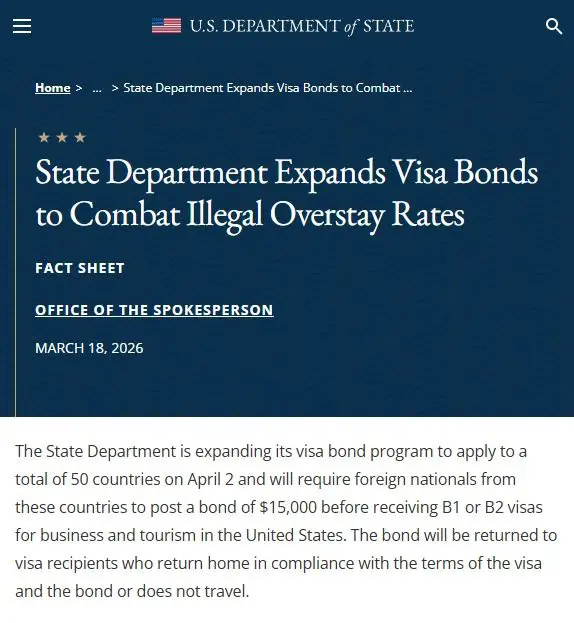
On March 18, 2026 (local time), the U.S. Department of State officially updated the list of countries subject to the visa bond policy, expanding the scope to 50 countries and specifying that some newly added countries will be subject to implementation starting April 2, 2026.

Applying for a B1/B2 visa
may require a bond payment first
According to current rules, certain applicants from countries on the list may be required to pay a bond ranging from $5,000, $10,000, or $15,000 when applying for a U.S. B1/B2 business or tourist visa.
Whether a bond is required and the specific amount will be determined by consular officers on a case-by-case basis; if the applicant departs on time and complies with visa regulations, the bond may be refunded.

12 newly added countries: Cambodia, Ethiopia, Georgia, Grenada, Lesotho, Mauritius, Mongolia, Mozambique, Nicaragua, Papua New Guinea, Seychelles, Tunisia.

Original 38 countries: Algeria, Angola, Antigua and Barbuda, Bangladesh, Benin, Bhutan, Botswana, Burundi, Cape Verde, Central African Republic, Côte d'Ivoire, Cuba, Djibouti, Dominica, Fiji, Gabon, The Gambia, Guinea, Guinea-Bissau, Kyrgyzstan, Malawi, Mauritania, Namibia, Nepal, Nigeria, São Tomé and Príncipe, Senegal, Tajikistan, Tanzania, Togo, Tonga, Turkmenistan, Tuvalu, Uganda, Vanuatu, Venezuela, Zambia, Zimbabwe.
What is worth noting
is not just the extra cost
On the surface, this appears to be just an adjustment in the visa application process; but in reality, it reflects that the U.S. is further tightening its management of short-term entries, which is also becoming more uncertain.
In the past, many families viewed business and tourist visas as a "transitional method" for visiting the U.S.—to go and see, to make arrangements, and to plan further later.
But now, the variables facing this approach are clearly increasing: whether the visa itself is successful, whether one is required to pay a high bond, and whether future stay records will affect subsequent arrangements are all issues that need to be carefully considered.
This also means that the act of going to the U.S. is gradually shifting from "whether one can go once" to "whether there is a more stable way to go." And this is precisely the question that many families need to rethink at this moment.
What you really need to think about
is a more stable status path
For those who truly have needs for U.S. education, family relocation, asset arrangement, or long-term living plans, short-term visas are ultimately just short-term tools. They can solve a temporary trip, but it is difficult to support long-term planning. Especially in the context of continuously tightening policies, the more one relies on temporary status, the easier it is to be affected by external changes.
It is precisely because of this that more and more families have begun to re-emphasize "status planning" itself in the last two years.
Because the core of status planning has never been just about solving a single entry, but about striving for more certainty for future family arrangements. Children's educational paths, the freedom of movement for family members, future entry rhythms, and the allocation of assets and lifestyles all rely on a more stable and clearer status foundation.
Why more and more people
are refocusing on status planning
In such a policy environment, the value of EB-5 investment immigration is also becoming further highlighted.
Unlike short-term visas, EB-5 is an immigration path aimed at permanent U.S. status. In the current policy environment, its value is becoming further highlighted.
According to the U.S. Department of State visa bulletin, the reserved visa categories for EB-5 under the new act currently remain in a non-backlogged status; at the same time, the concurrent filing policy also provides a more efficient status conversion path for applicants already in the U.S., allowing for the simultaneous filing of I-526E and I-485 to enter the status adjustment process sooner. In addition, rural projects also enjoy priority processing advantages, receiving more attention in the current application environment.
This also means that the significance of EB-5 has long gone beyond just applying for a green card; it is about providing a clearer, more stable, and more certain status configuration path for families with long-term planning needs, against the backdrop of continuously rising thresholds for entering the U.S. and increasing uncertainty for short-term visas.
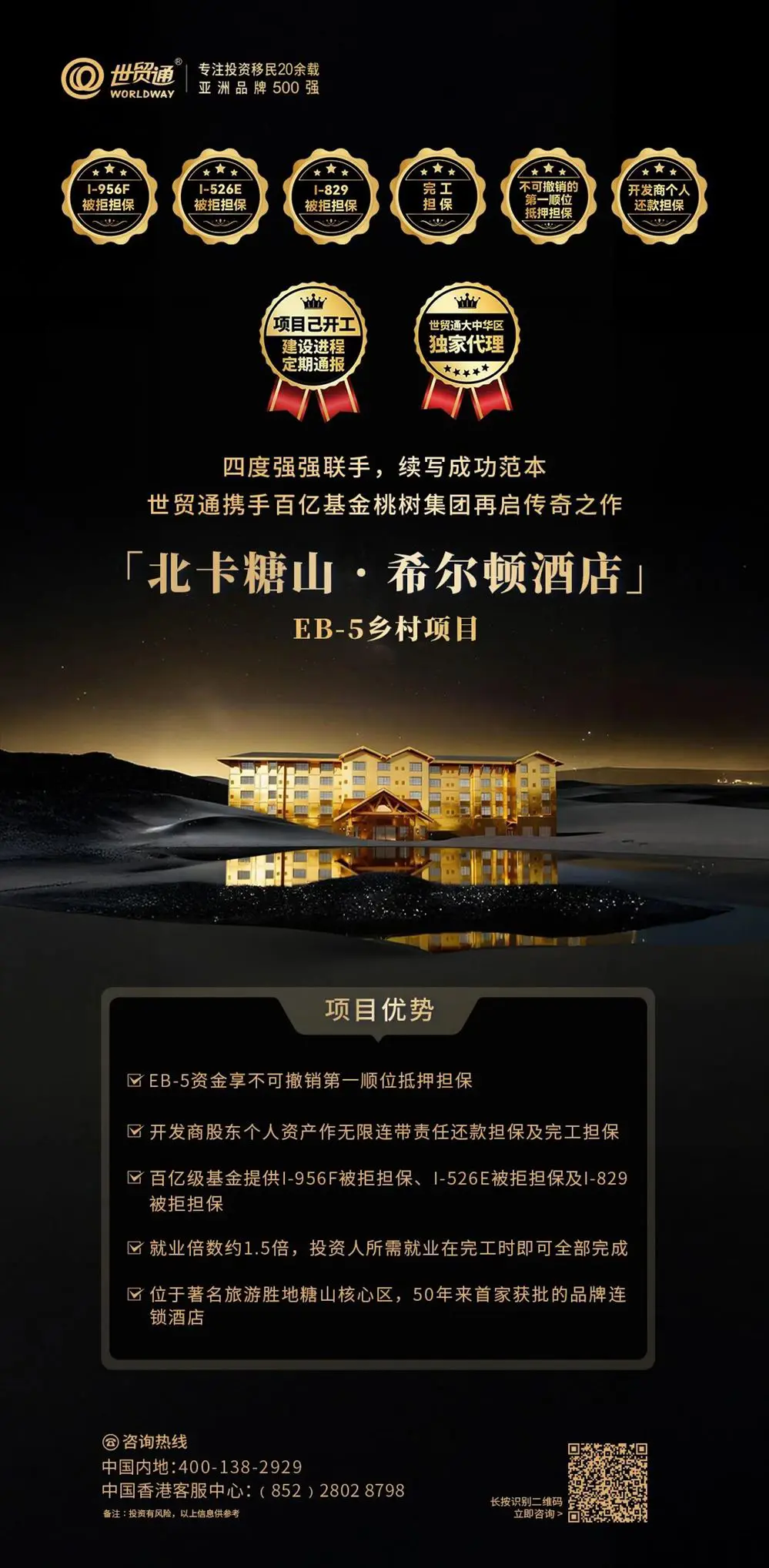
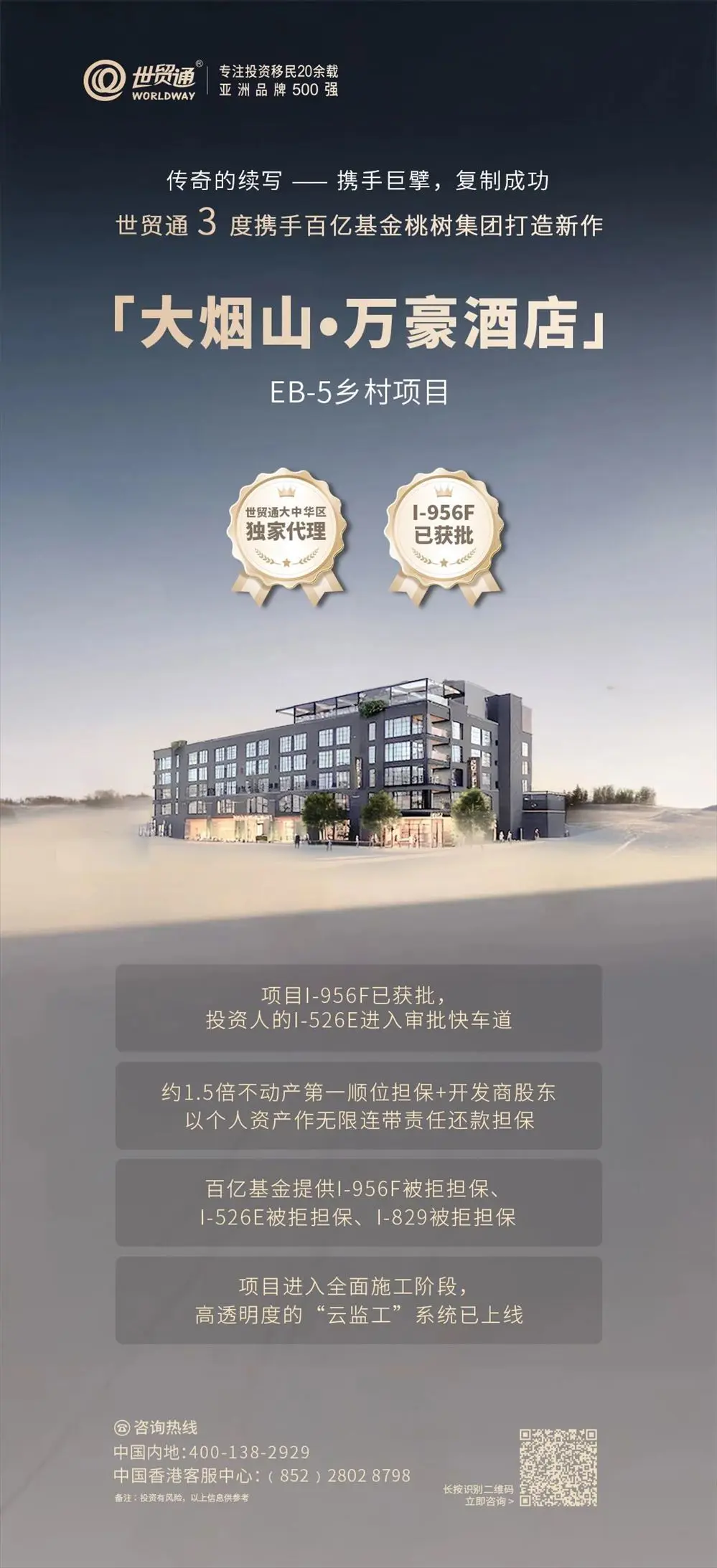
Seize the window of opportunity; the earlier you plan, the more initiative you have. WorldWay holds two high-quality EB-5 rural projects, helping investors achieve U.S. status planning steadily, without backlogs, and efficiently. Global quotas are limited, seats are scarce, first come, first served!

For inquiries in Mainland China: 400-138-2929, Hong Kong, China Customer Service Center: (852)2802 8798