





The most familiar employment path for international students in the United States after graduation is facing new uncertainties.
Recently, a letter made public by U.S. Senator Eric Schmitt has drawn widespread attention from the international student community. According to the letter, Kristi Noem, the Secretary of the Department of Homeland Security (DHS), stated in her response:DHS is reevaluating the current framework of Optional Practical Training (OPT) due to concerns that this system may not align with the interests of the U.S. labor market, taxation, and national security.
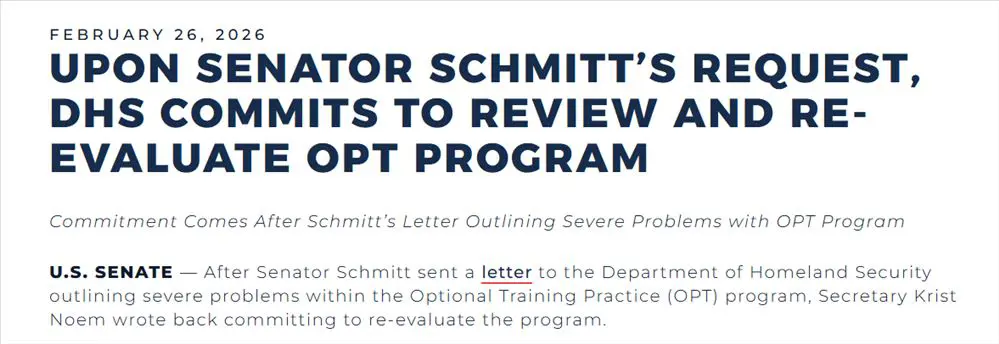
1. Why is this OPT reevaluation concerning?
Many students see such news and their first reaction is often: Does a system as impactful as OPT not require congressional legislation, lengthy discussions, and voting to be adjusted?
The problem lies precisely here. OPT and its related STEM OPT extension are not systems created by specific congressional legislation, but rather arrangements based on administrative regulations.
Because of this, DHS has significant interpretative and adjustment authority over this system. As long as it follows the administrative rule-making process, including proposing new regulations, soliciting public comments, and ultimately taking effect, the scope, duration, and even the overall implementation method of OPT could be adjusted. This also means that the most concerning aspect is not just whether it will change, but that it indeed "can change."
2. Why is OPT so important?
For many international students, OPT is never just a work permit after graduation, but the most important transitional period in the path to staying in the United States.
In the past, many families understood studying in the United States as a relatively clear path:
Study abroad → Internship → OPT → Work visa → Long-term development
OPT is a crucial link in this path. Under the current framework, general students typically have 12 months of OPT, while STEM students can receive an additional 24-month extension. It is precisely because of this time that many students can enter companies after graduation, accumulate experience, seek employer support, and buy time for subsequent applications for work visas such as H-1B.
If the STEM OPT is shortened or faces stricter limitations in the future, many students' paths to staying in the United States will be significantly compressed. The originally gradual job search pace, identity arrangements, and career planning may also be forced to accelerate.

3. The real changes may not just be with OPT itself
If this OPT reevaluation is understood only as a standalone event, it may not be comprehensive enough.
What is more concerning is that the changes may not just be with OPT, but the entire path for international students after graduation to stay in the United States is tightening simultaneously.
On one hand, H-1B is becoming increasingly difficult: costs are higher, and selection is more focused on salary levels, increasing the competitive pressure on newly graduated international students.
On the other hand, the buffer space for F-1 status may shrink: once the stay period is tightened, every step from graduation to applying for OPT and transitioning status will become more urgent.
Additionally, companies and some universities are becoming more cautious when initiating new H-1B applications, with some universities even suspending recruitment of new H-1B visa applicants through related recruitment systems. (For details, please refer to previous reports by WorldWay: From Texas to Florida: What Signals Are Being Sent Behind the Tightening of H-1B?)
What international students may face in the future is not just "difficulty in finding a job," but that every key step from graduation to staying in the United States is becoming more difficult and uncertain.
4. Beyond studying abroad, it is essential to consider identity planning in advance
In light of current trends, more and more families are beginning to realize that what truly needs planning for the future may not just be "which school to attend in the United States and what major to study," but rather "how to have a more stable development path after graduation."
As the uncertainties surrounding paths like OPT and H-1B continue to rise, relying solely on the approach of "studying abroad first and resolving identity issues after graduation" is also increasing in risk. For families hoping to establish a long-term presence in the United States and wishing for their children to have more autonomy in education, internships, employment, and development, early identity planning is becoming increasingly important.
For applicants with long-term development needs in the United States, the current environment's EB-5 is one of the paths worth focusing on. Its significance lies not only in obtaining U.S. status but also in striving for more certainty and autonomy in future arrangements for education, internships, employment, and residence. Especially under the current policy window, rural EB-5 has advantages such as no waiting period, dual submission, and priority review, which can help applicants secure identity planning opportunities earlier.
If you would like to learn more about changes in U.S. immigration policy, please feel free to contact WorldWay for one-on-one consultations or attend the offline seminars on U.S. immigration hosted by WorldWay in Beijing, Shenzhen, and Shanghai from March 20 to 21.
This event will feature Jennifer Hermansky, Vice Chair of the National EB-5 Committee of the American Immigration Lawyers Association, who will provide in-depth interpretations of the I-526E approval rules of the immigration bureau, combining the application logic of EB-5 in the current environment with future policy trends, and share how to effectively seize priority review opportunities for rural projects. Seats are limited, and we welcome you to scan the QR code to register.


For inquiries in mainland China: 400-138-2929, Hong Kong customer service center: (852)2802 8798